
The Witcher 3 Remastered vs Warhammer 40,000 Dawn of War 4
Compare The Witcher 3 Remastered and Warhammer 40,000 Dawn of War 4 for PC: release dates, gameplay, PC specs, and which RPG or RTS to choose.
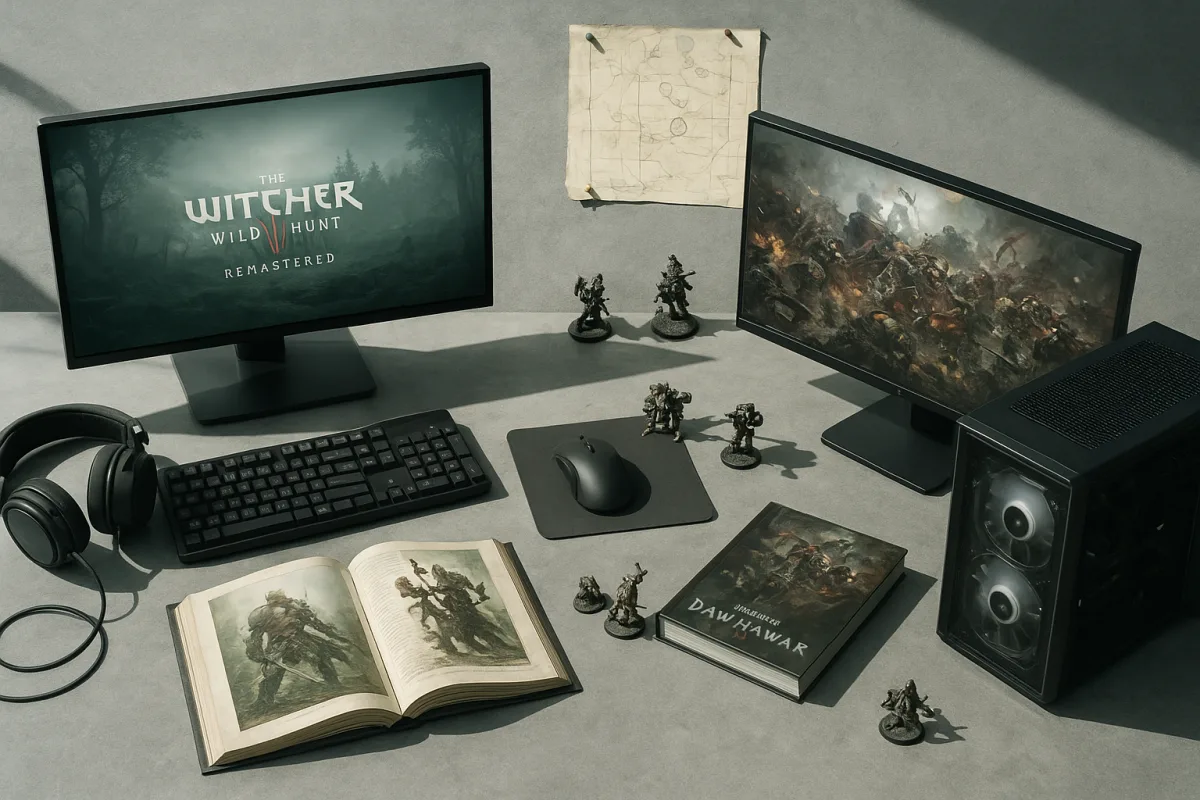
The decision: replay the RPG giant, or learn the new strategy war?
These are not really rivals in the usual sense. The Witcher 3: Wild Hunt, Remastered is an action RPG revision of a decade-defining campaign. Warhammer 40,000: Dawn of War 4 is a new real-time strategy game with campaigns, faction systems, base building, and enough resource pressure to make “one more upgrade” famous last words.
Still, both ask for the same scarce thing, a large chunk of your winter PC gaming time. If the choice is one launch window commitment, The Witcher 3 Remastered is the safer recommendation. Dawn of War 4 is the more exciting gamble for players who want fresh multiplayer and co-op problems to solve.
The important correction is that Dawn of War 4 is not an RPG just because it has commanders, campaigns, upgrades, and Warhammer lore. It is an RTS returning to the original Dawn of War’s large battles and base-building priorities.
[5] Your character build is an army composition, your dialogue choice is whether to spend shared resources on another power-node upgrade, and the consequences arrive with grenades.
Head-to-head comparison
| Criterion | The Witcher 3: Wild Hunt, Remastered | Warhammer 40,000: Dawn of War 4 |
|---|---|---|
| Release timing | PC release and storefront replacement arrive September 29, 2026. [2][4] | Launches December 3, 2026, after a delay from September 17. Commander Edition early access begins November 30. [9] |
| Price and value | Free upgrade for existing owners. New buyers purchase the remastered edition replacing the Complete Edition, but no new PC price is confirmed in the supplied reporting. [[1]](https://www.pcgamer.com/games/the-witcher/witcher-3-remastered-guide/?utm_source=openai "The Witcher 3 Remastered details | PC Gamer")[3] |
| Core loop | Third-person exploration, story quests, monster preparation, gear, signs, alchemy, and choices. | Base building, map control, resource upgrades, army composition, faction mechanics, and campaign or skirmish objectives. [5] |
| Difficulty | Likely familiar in structure, with gameplay revisions still needing hands-on verification after release. | Hard AI is visibly aggressive, but two developers losing does not establish final player-facing difficulty. [[6]](https://sitgi.com/news/warhammer-40-000-dawn-of-war-4-developers-struggle-against-hard-mode-ai-orks-2026-09-23-039e2c55?utm_source=openai "Warhammer 40,000: Dawn of War 4 Developers Struggle Against Hard Mode AI Orks |
| Build depth | Established Witcher gear, mutagens, signs, oils, bombs, and expansion content, plus a new 2027 expansion. [2] | Four factions, branching campaigns, networked Adeptus Mechanicus buildings, and Necron regeneration and Power Matrix mechanics. [5] |
| PC readiness | Minimum specs are known: Ryzen 5 2600 or Core i5-8400, 12GB RAM, GTX 1660 or Radeon RX 5500 XT with 8GB VRAM, and 70GB SSD space. [[1]](https://www.pcgamer.com/games/the-witcher/witcher-3-remastered-guide/?utm_source=openai "The Witcher 3 Remastered details | PC Gamer")[7] |
| Post-launch confidence | Includes Hearts of Stone and Blood and Wine, with Songs of the Past planned for 2027. [2] | Crusade Mode, a map pack, commanders, a Mission Editor, and two story expansions are planned for 2027. [5] |
| Biggest risk | A remaster can improve lighting and texture work without making a replay feel mechanically new. | Early balance can move quickly once players optimize build orders, counter units, and exploit AI weaknesses. |
1. What you are actually playing minute to minute
The Witcher 3 Remastered wins immediately if your ideal session starts with a quest marker and ends somewhere completely different because a village had a cursed lighthouse, a political disaster, and an unexpectedly competent side character.
GamingBolt’s preview of quests worth revisiting points toward Skellige in particular: Cave of Dreams, Possession, The Lord of Undvik, and Contract: The Phantom of Eldberg. Those are good remaster stress tests because they combine dark interiors, water, fog, snow, and large monster fights.
That said, “ray-traced fog makes an old quest better” is the sort of claim publishers and preview coverage can get carried away with. Better lighting cannot rebalance a sword build, repair a weak quest reward, or make repeated scavenger hunts thrilling. It can make revisiting familiar spaces more convincing.
Dawn of War 4 has a fundamentally different rhythm. The IGN gameplay demonstration has Space Marines scrambling between objectives in the Maelstrom mode, using Outriders, a bike-mounted Chaplain, Thunderhawk relays, reserve drops, turrets, bunkers, and forward barracks to reach objectives before Orks flood them.
That sounds like ordinary RTS vocabulary until the shared-resource wrinkle starts doing work. In the official demonstration carried by IGN, teammates share resources, meaning one player’s decision to upgrade a power node supports both armies. A teammate who ignores economy is not merely behind, they are borrowing against the whole team’s response time.
This is the first place where Dawn of War 4 looks more demanding and more promising. It is not just about selecting the correct unit counter. It asks whether you can claim a point, reinforce, tech up, and retain enough mobile force to answer an objective spawn without opening your base to a counterattack.
2. Difficulty: known quantity versus loud warning sign
The Witcher 3 has the advantage of familiarity. Veterans know the broad contours of its difficulty, even if the remaster adjusts combat and progression details. Its challenge traditionally comes from preparation and build execution, whether that means oils, decoctions, Quen safety nets, or committing to a sign-focused setup.
The unresolved issue is how much the remaster changes those calculations. GamingBolt anticipates combat revisions and revamped build approaches, but pre-release enthusiasm is not patch documentation. Until CD Projekt Red publishes exact skill, gear, enemy, and economy adjustments, claims that a specific build is dead or newly dominant are premature.
A remaster can quietly alter a great deal with one number. If a sign’s stamina cost falls, a forgotten Griffin-school build may suddenly function without feeling like a self-imposed challenge run. If enemy poise or dodge windows change, fast-attack spam may stop being the universal answer.
Dawn of War 4 has shown the opposite problem. Its balance is not knowable yet because players have not had time to break it. IGN reported that King Art Games creative director Jan Theysen and senior designer Elliott Verbiest lost twice to Hard AI Orks, first in just over four minutes, then after 13 minutes. [6]
The publisher-friendly reading is “Hard mode is genuinely hard.” The community-panic reading is “the AI cheats and the game is impossible.” Neither conclusion has enough evidence. Two developers playing while explaining systems are not a ladder team with optimized openings, and an unreleased AI has not faced thousands of human attempts.
But the footage does show what Hard appears to demand. The Space Marines have better individual units, while Orks compensate with bodies and pressure. That punishes passive teching, slow reinforcements, and players who lose objectives while trying to assemble the perfect elite army.
The likely first-wave meta is predictable: mobile cappers, cheap early control, and forward production will look strong because Maelstrom objectives reward presence. The developers themselves placed a Chapel Barracks centrally after their first failure, which is less a revelation than a large neon sign reading “walking from base is too slow.”
How quickly that meta moves depends on tuning, maps, and whether the AI follows the same economy rules as players. Expect the first two weeks after launch to be full of confident build-order claims, then a quieter correction once players find the actual counters.
3. Builds, progression, and replay value
The Witcher 3 Remastered has the deeper bank of proven content. It includes Hearts of Stone and Blood and Wine, and CD Projekt Red has scheduled the Songs of the Past expansion for 2027. [2] That is a substantial package even before the new material lands.
Its weakness is equally clear. Returning players may find that the best bits are still the best bits because they were already there. The Bloody Baron chain, Skellige politics, contracts, and expansion stories do not need a remaster to be well written. Visual refinement is a reason to return, not a replacement for novelty.
Dawn of War 4 has the more volatile replay proposition. The campaign includes branching missions across four factions, while Adeptus Mechanicus uses networked buildings to reduce costs and strengthen defenses. Necrons lean on regeneration, resurrection, and a Power Matrix system instead of conventional control-point play. [5]
Those mechanics are more than faction paint. Adeptus Mechanicus could reward players who establish defensible linked positions rather than constantly redeploying. Necrons potentially change the map-control question entirely, because a faction that gains value through a separate Power Matrix system cannot be judged solely by standard point-denial rules.
This is also where balance problems can hide. A cost reduction looks harmless until it compounds across a networked base. Resurrection looks thematic until it lets a player win an attrition war without paying the normal reinforcement tax. Those are not accusations, just the exact mechanics that will need testing after launch.
4. PC hardware and the anti-hype checklist
The Witcher 3 Remastered at least gives PC players a floor. CD Projekt Red’s confirmed minimum is a 64-bit Windows 11 installation, Ryzen 5 2600 or Core i5-8400, 12GB of RAM, GTX 1660 or Radeon RX 5500 XT with 8GB VRAM, DirectX 12, and 70GB on an SSD. [1][7]
Those are not outrageous specifications, but they matter. The 8GB VRAM requirement is a sharper cutoff than some players may expect from a remaster, and the 70GB SSD requirement means an older hard-drive install is not the supported baseline. Recommended specifications remain unannounced. [1]
There are no detailed independent benchmarks or broad stability reports yet. Reports say CD Projekt Red expects improved Steam Deck performance through engine work, but “should run well” is not a frame-time graph. [1] Wait for testing from PC hardware outlets before buying hardware for this version.
Dawn of War 4 is even less settled on this front. Its December release date is confirmed, as is the delay intended to reach the quality target King Art Games described. [9] That phrasing is normal launch messaging, not evidence that its performance, pathfinding, AI load, or multiplayer stability are solved.
RTS games can punish CPUs in ways a cinematic RPG does not. A fight with dozens of squads, reinforcements, base structures, projectile effects, and AI decision-making can turn an apparently adequate system into a stutter factory. Until requirements and testing arrive, there is no honest hardware verdict.
Who each option suits
The Witcher 3: Wild Hunt, Remastered suits existing PC owners who want a free return to a long-form RPG, players who value quests over competitive mastery, and anyone happy to revisit familiar builds while waiting to see exactly what the remaster changes. It falls down for players wanting wholly new encounters rather than a technically improved replay. [1][3]
Warhammer 40,000: Dawn of War 4 suits RTS players who enjoy learning faction economies, coordinating in co-op, and losing enough early matches to understand why map control matters. It falls down for players who want settled balance, proven PC performance, or an easy Hard-mode victory lap on launch week. [5][6]
Frequently Asked Questions
What are the PC requirements for The Witcher 3 Remastered?
The Witcher 3 Remastered requires a 64-bit Windows 11 OS, an AMD Ryzen 5 2600 or Intel Core i5-8400 CPU, 12 GB of RAM, and a GPU equivalent to NVIDIA GeForce GTX 1660 or AMD Radeon RX 5500 XT with 8 GB VRAM. It also needs DirectX 12 and 70 GB of SSD storage. Recommended system requirements have not been released as of late September 2026.
How does Warhammer 40,000 Dawn of War 4 differ from The Witcher 3 Remastered?
Warhammer 40,000 Dawn of War 4 is a real-time strategy game focused on base building, resource management, and large-scale battles with four factions and branching campaigns. In contrast, The Witcher 3 Remastered is an action RPG featuring third-person exploration, story quests, and character progression through gear, alchemy, and combat skills.
Is Warhammer 40,000 Dawn of War 4 an RPG or RTS?
Warhammer 40,000 Dawn of War 4 is a real-time strategy (RTS) game. Despite having commanders, campaigns, and upgrades, it emphasizes base-building, map control, and resource management rather than RPG mechanics.
What gameplay styles do The Witcher 3 Remastered and Dawn of War 4 offer?
The Witcher 3 Remastered offers a third-person RPG experience with story-driven quests, character builds, and combat involving signs, alchemy, and gear customization. Dawn of War 4 provides a strategy gameplay style with base building, resource upgrades, army composition, and tactical battles across different factions.
How we researched this
This article was assembled from 2 video sources across 2 channels, 2 published articles, 9 cited references.
Nothing here is based on hands-on testing. Where a figure or finding appears, it belongs to the source cited beside it, and the writing says so rather than implying otherwise. Every source is listed below so you can check it.
Sources
Warhammer 40,000: Dawn of War 4 - Official 2v2 Team Skirmish Maelstrom Gameplay Overview — IGN
The Witcher 3 Remastered - 10 Best Quests WE CAN’T WAIT to Revisit — GamingBolt
The First Ace Combat Game In Seven Years Is Playing For Keeps — Kotaku
The Witcher 3 will be free on PC for Xbox players next week, CD Projekt Red confirms
Warhammer 40k: Dawn of War 4 Looks to Return To Series’ Roots|Game8
Warhammer 40,000: Dawn of War 4 Developers Struggle Against Hard Mode AI Orks | Sitgi News
Watch Upcoming and Remastered RPGs: The Witcher 3 and Warhammer 40,000 Dawn of War 4 on Youtube
Also from the sources
Related Articles
Blizzard Upcoming Games 2026
Discover Blizzard's upcoming games in 2026 including Diablo 5, StarCraft open-world shooter, and Overwatch's new hero Doctrine with release dates and
Onimusha Way of the Sword Review and Edition Comparison
Read our Onimusha Way of the Sword review with edition comparisons, PC requirements, and gameplay insights to help you decide before launch.
Gamescom 2026 Indie and Strategy Games Highlights
Explore key indie and strategy game highlights from Gamescom 2026, including gameplay, release info, and PC hardware insights.

Persona 4 Revival vs Persona 4 Golden
Compare Persona 4 Revival and Persona 4 Golden: release dates, voice cast, gameplay, and which version PC players should choose.