
Warhammer 40,000 Dawn of War 4 and Boltgun 2 Impressions
Read impressions comparing Warhammer 40,000 Dawn of War 4 and Boltgun 2, covering gameplay, release info, and which game to buy or wait for.
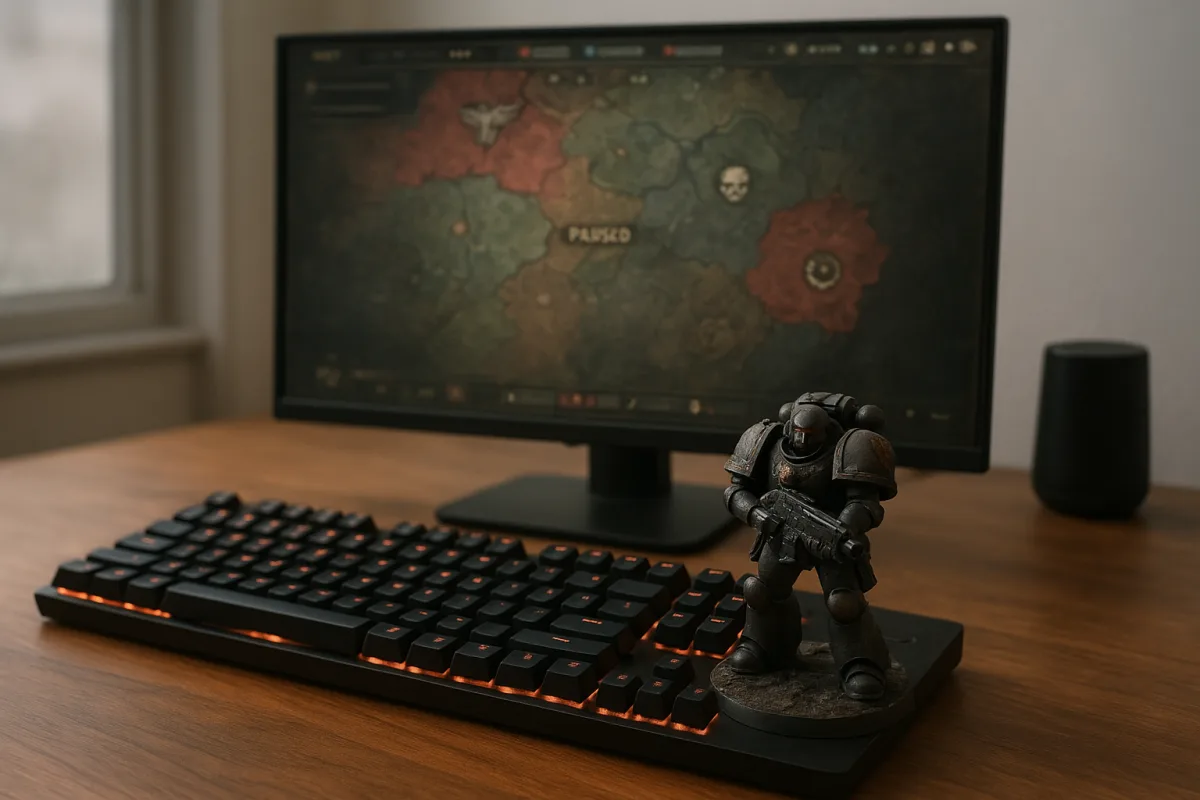
The quick list
- Best overall: Warhammer 40,000: Boltgun 2, for 40K fans and boomer-shooter players who want a known quantity rather than a promising preview build.
- Best for RTS diehards: Warhammer 40,000: Dawn of War IV Standard Edition, for players prepared to wait for campaign and multiplayer verdicts after its December 3 launch.
- Best value: Warhammer 40,000: Dawn of War IV Standard Edition at $53.99 during Steam’s 10% pre-release discount, for players already certain they want its four-campaign RTS package. [10]
- Best for co-op-free single-player purging: Warhammer 40,000: Boltgun 2, for players who prefer movement tech, weapon switching, and branching combat spaces to economy management.
The actual choice is less complicated than the shared Warhammer branding makes it look. Warhammer 40,000: Boltgun 2 is the game to buy if you need something good to play today. Warhammer 40,000: Dawn of War IV is the game to watch if your ideal evening involves building generators, losing a flank, and spending ten minutes deciding whether one more production building is greed.
That distinction matters because Dawn of War IV is still unreleased. Steam lists its launch for December 3, 2026, with the Standard Edition at $59.99, currently reduced to $53.99, and the Commander Edition at $89.99, currently $80.99. [10] Boltgun 2 is already in the hands of players and critics, so its strengths and annoyances are no longer theoretical.
Comparison table
| Game | Price in supplied research | Genre and scale | Best campaign hook | Main trade-off | PC hardware information |
|---|---|---|---|---|---|
| Warhammer 40,000: Dawn of War IV | Standard Edition $59.99, currently $53.99. Commander Edition $89.99, currently $80.99. [10] | Real-time strategy, four faction campaigns | Branching campaign paths across Space Marines, Orks, Necrons, and Adeptus Mechanicus | Promising faction design, but no final reviews or multiplayer meta yet | Steam confirms 64-bit CPU and OS only. RAM, GPU, storage, DirectX, and recommended specs are not published. [10] |
| Warhammer 40,000: Boltgun 2 | No price is provided in the supplied research | Retro-style first-person shooter with two protagonists | Branching levels, more varied environments, and aggressive movement-based combat | Strong moment-to-moment shooting, but repeated objectives and limited between-mission progression reduce replay depth. [3] | No detailed benchmark, settings, or hardware data is provided in the supplied research |
The pricing comparison has an awkward but important gap. The research supplied for Boltgun 2 does not establish a current PC price, so it would be fiction to label it the cheaper option. Dawn of War IV’s pricing is confirmed by Steam, while Boltgun 2’s value case rests on its completed state and positive reception rather than a verified sticker figure. [10]
Boltgun 2 is the safer purchase now
Auroch Digital’s Warhammer 40,000: Boltgun 2 has the easier pitch: it is a sequel to a competent retro shooter that understands why a boltgun should sound like industrial equipment failing violently. It keeps the pixel-art gore and forward-pressure combat, then gives the player more interesting places to use them.
GamingBolt’s review highlights the practical improvement. Where the first Boltgun reportedly became repetitive in level layout and enemy use, the sequel moves through trenches, prisons, blood-soaked fortresses, a corrupted moon, cargo trains, and mine-cart sequences. That is not a revolution in objective design, but it is a meaningful improvement over endlessly circling another samey daemon corridor.
The basic survival rule also remains correct for a boomer shooter: keep moving, keep killing, and collect the health and armour drops created by dead enemies. GamingBolt describes Malum Caedo as the heavier, high-health Space Marine option, while newcomer Nyra Varrath trades that weight for speed, higher base armour, and time-slowing during a jump from a slide.
That is a genuine loadout-style choice, not merely two character portraits with different voice lines. Malum suits players who want dependable Space Marine bulk and familiar weapon handling. Nyra suits players who treat a shooter arena like a movement puzzle, chaining slides and jumps to maintain angles, escape melee pressure, and keep a fight from settling down.
GameDaily’s review roundup says critics particularly liked Nyra’s slide and the branching campaign structure, while also noting complaints that her arsenal does not always feel as strong or satisfying as it should.
[3] That sounds about right beside GamingBolt’s more specific objection: several new weapons are attached to Nyra, but the stake thrower can feel awkward, while Malum receives only one notable new weapon, the frag cannon.
The weapon changes are where sequel enthusiasm needs a small purity check. GamingBolt found the meltagun less like the original’s thermal shockwave and more like a mid-range beam, disliked the changed feel of readying the heavy bolter, and noted that the Vengeance Launcher is gone.
Those are not automatic dealbreakers, but they will matter to players who loved Boltgun’s exact rhythm rather than its general aesthetic.
Enemy behaviour is more encouraging. GamingBolt describes melee threats such as Bloodletters and Berserkers requiring different priorities, with Berserkers especially worth executing before their near-death frenzy becomes a problem. Other enemies demand spacing and kiting, including projectile-heavy Marines and phase-shifting Scarab Occultist Terminators.
This is the balance change Boltgun 2 needed most. More enemy types do not automatically make a shooter better, but different target priorities force weapon swaps and positional decisions. When a melee rush, a disruptive projectile unit, and a durable elite appear together, the player cannot simply hold primary fire and call it tactical depth.
Still, the community’s positive consensus should not erase the recurring criticism. The independent research brief notes complaints about repetitive objectives, limited character progression between missions, simplistic enemy AI, and repeated enemy types in later stages. Those problems are less damaging in a short, replayable shooter than in a 50-hour RPG, but they cap how long the campaign’s novelty lasts.
Boltgun 2 is therefore not the genre’s next rulebook. It is a well-regarded refinement, with an 81 Metacritic score and a Very Positive Steam response in the research brief. [3] If the first game’s visual style and blunt-force pace appealed but its corridors wore thin, this is the sequel that directly addresses that complaint, even if it has not eliminated every repeated loop.
Dawn of War IV is the bigger gamble
King Art Games’ Warhammer 40,000: Dawn of War IV has the more ambitious structure. It will contain four campaigns, for Space Marines, Orks, Necrons, and Adeptus Mechanicus, and each campaign is said to be larger than the original Dawn of War campaign and Dawn of War III’s 17-mission campaign. [7]
The branching path system matters more than the raw mission count. GamesRadar reports that players will not see all campaign content in one run because mission paths branch. [7] That is good for faction identity and replay value, but it also means claims about overall campaign size should be treated carefully until people have mapped how much exclusive content each branch contains.
The Adeptus Mechanicus campaign currently looks like the better bet for players who enjoy being asked to make actual RTS decisions. IGN’s preview describes Skitarii Rangers as long-range anti-infantry troops and Skitarii Vanguard as more durable medium-range fighters, both vulnerable in melee. Ruststalkers exist to cover that weakness by pinning enemies in close combat.
That composition has clear counterplay. Put Rangers in cover and let them fire freely, use Vanguard to handle tougher targets, and position Ruststalkers so an opponent cannot simply dive the gunline. If the ranged units become isolated, the build collapses. This is the useful kind of faction asymmetry, because its power comes with a specific failure condition.
The Noosphere Network adds another layer. IGN describes connected Adeptus Mechanicus structures receiving benefits such as stronger defences or faster unit production, with distant points linked by fragile Cogitator Relays or more expensive Cognis turrets. The Dawn of War Wiki similarly frames the Noosphere around technological bonuses, with Void Shields supporting defensive play. [2]
In match terms, that quietly rewards players who build coherent territory rather than scattering individual structures across the map. It also creates a flank weakness. An enemy that destroys a relay can break the network and remove bonuses from whatever was relying on it. The obvious greed build is rapid expansion through cheap relays, and the obvious answer is a fast raid.
Necrons appear to have the opposite economy rhythm. IGN calls them a “goo faction,” spreading a machine lattice from Nexus of Dominion structures while generating their dominion resource. Their early troops are durable but slow, so fast factions such as Orks can claim points first while Necrons build toward a decisive late-game push.
That is a familiar slow-tide RTS identity, but the details are promising. The independent research brief says the Power Matrix buffs Necron units and Resurrection Galleries revive fallen units free of charge. Those tools suggest a faction that can turn a won fight into an increasingly impossible position, assuming it gets enough map presence to establish its infrastructure.
The catch is that this is all pre-release. IGN’s preview encountered campaign loads exceeding two minutes on an SSD and client hangs when cutscenes began. Those problems may be fixed before launch, but they cannot be waved away as if they were already fixed. No performance benchmarks or graphics-setting analysis are available in the supplied research.
Rock Paper Shotgun’s preview identifies a strategic concern, too. In the Ork campaign, cheap units can accumulate into a broad blob that is easier to throw at defences than to manage precisely. The Adeptus Mechanicus initially encourage more careful combined arms, but larger battles can apparently drift toward the same massed-army solution.
That does not prove Dawn of War IV is shallow. It does mean players expecting Dawn of War II’s constrained squad tactics should temper expectations. King Art is visibly drawing from the original Dawn of War’s base building, cover, and larger armies, and those systems historically allow an economy lead to turn into a large, fairly blunt attack force.
Finally, ignore any attempt to sell the Blood Ravens’ black chest symbol as a major lore emergency. Eurogamer reports that game director Jan Theysen said King Art chose black simply because it followed the latest established depiction.
The campaign will not resolve the Blood Ravens’ mysterious origins, either, because its story is focused on survival far from their home. That is continuity housekeeping, not a new faction twist.
Who each option suits
Choose Warhammer 40,000: Boltgun 2 if you want the dependable option: a completed 40K game with positive player response, responsive high-speed shooting, branching environments, and a choice between a sturdy Space Marine and a more mobile protagonist. It suits Doom, Quake, and retro-FPS players who value combat flow over elaborate progression systems. [3]
Choose Warhammer 40,000: Dawn of War IV Standard Edition if you want classic RTS structure, four faction perspectives, and campaigns built to be larger than earlier Dawn of War entries. Buy at the current $53.99 Steam discount only if you accept that final performance, campaign reception, and multiplayer balance remain unknown. [7] [10]
Choose Warhammer 40,000: Dawn of War IV Commander Edition only if its extras have independent value to you after they are fully detailed. At $80.99 during Steam’s discount, it costs $27 more than the discounted Standard Edition, money that does not answer the unanswered questions around PC requirements or launch stability. [10]
Wait on both only if performance certainty is non-negotiable. Boltgun 2 lacks supplied benchmark material, while Dawn of War IV has the more worrying gap: Steam has not published conventional minimum or recommended specifications beyond requiring a 64-bit processor and operating system. [10]
Frequently Asked Questions
Should I buy Warhammer 40,000 Boltgun 2 or wait for Dawn of War 4?
If you want a finished and fast-paced first-person shooter now, Warhammer 40,000: Boltgun 2 is the safer purchase with positive reviews and an 81 Metacritic average. Dawn of War IV, launching December 3, 2026, is better suited for players interested in a larger real-time strategy experience but remains unproven in campaign and multiplayer quality.
What are the differences between Dawn of War 4 and Boltgun 2?
Boltgun 2 is a retro-style first-person shooter focused on fast movement and combat arenas with branching levels, while Dawn of War IV is a real-time strategy game featuring four faction campaigns and economy management. Dawn of War IV emphasizes strategic depth with factions like Adeptus Mechanicus and Necrons, whereas Boltgun 2 prioritizes moment-to-moment shooting and movement.
How does Boltgun 2 improve on the original game?
Boltgun 2 expands level variety by including trenches, prisons, and mine-cart sequences, reducing the repetitiveness of the first game’s arenas. It also introduces two distinct protagonists with different playstyles, offering genuine loadout choices rather than cosmetic differences.
What is the release date and price for Dawn of War 4?
Dawn of War IV is scheduled for release on December 3, 2026. The Standard Edition is priced at $59.99 but is currently discounted to $53.99 on Steam, while the Commander Edition costs $89.99, discounted to $80.99. Detailed system requirements beyond a 64-bit CPU and OS have not been published.
Which Warhammer 40,000 game is better for RTS fans?
Dawn of War IV is the recommended choice for RTS fans interested in a four-campaign strategy experience with faction-specific mechanics. However, since it is unreleased, campaign quality, multiplayer balance, and performance remain unverified, so players should wait for post-launch reviews.
How we researched this
This article was assembled from 1 video source, 4 published articles, 11 cited references.
Nothing here is based on hands-on testing. Where a figure or finding appears, it belongs to the source cited beside it, and the writing says so rather than implying otherwise. Every source is listed below so you can check it.
Sources
Warhammer 40,000: Boltgun 2 Review - The Final Verdict — GamingBolt
Dawn of War 4 clearly loves the Warhammer 40K strategy games that came before, but it misses that they loved to reinvent themselves — Rock Paper Shotgun
How to find a dynamic op phone in DMZ in Modern Warfare 4 — Polygon
WH40K: Dawn of War 4 releases new Space Marine gameplay trailer
Dawn of War 4 ne lèvera pas encore le voile sur les Blood Ravens - Art Gaming
[Warhammer 40,000: Dawn of War 4] Massive Single Player Campaign Sets New RTS Record - Pulse Gaming
Dawn of War 4 piles on a massive single-player siege | ENMNEWS
Dawn of War 4's four campaigns "offer more than any other RTS," says dev
Watch Warhammer 40,000: Dawn of War 4 and Boltgun 2 Impressions on Youtube
Related Articles
Silent Hill Townfall Review
Read our Silent Hill Townfall review covering gameplay, editions, Scottish setting, and PC performance insights for this first-person horror game.
Halloween The Game Review: Editions, Gameplay, and PC Specs
Read our Halloween The Game review covering editions, gameplay impressions, PC specs, and early access issues before buying.
The Witcher 3 Remastered vs Warhammer 40,000 Dawn of War 4
Compare The Witcher 3 Remastered and Warhammer 40,000 Dawn of War 4 for PC: release dates, gameplay, PC specs, and which RPG or RTS to choose.
Control Resonant Gameplay and Graphics Review Deep Dive
Explore Control Resonant gameplay, Gravity Shift mechanics, graphics settings, and edition comparisons for an optimized PC gaming experience.