
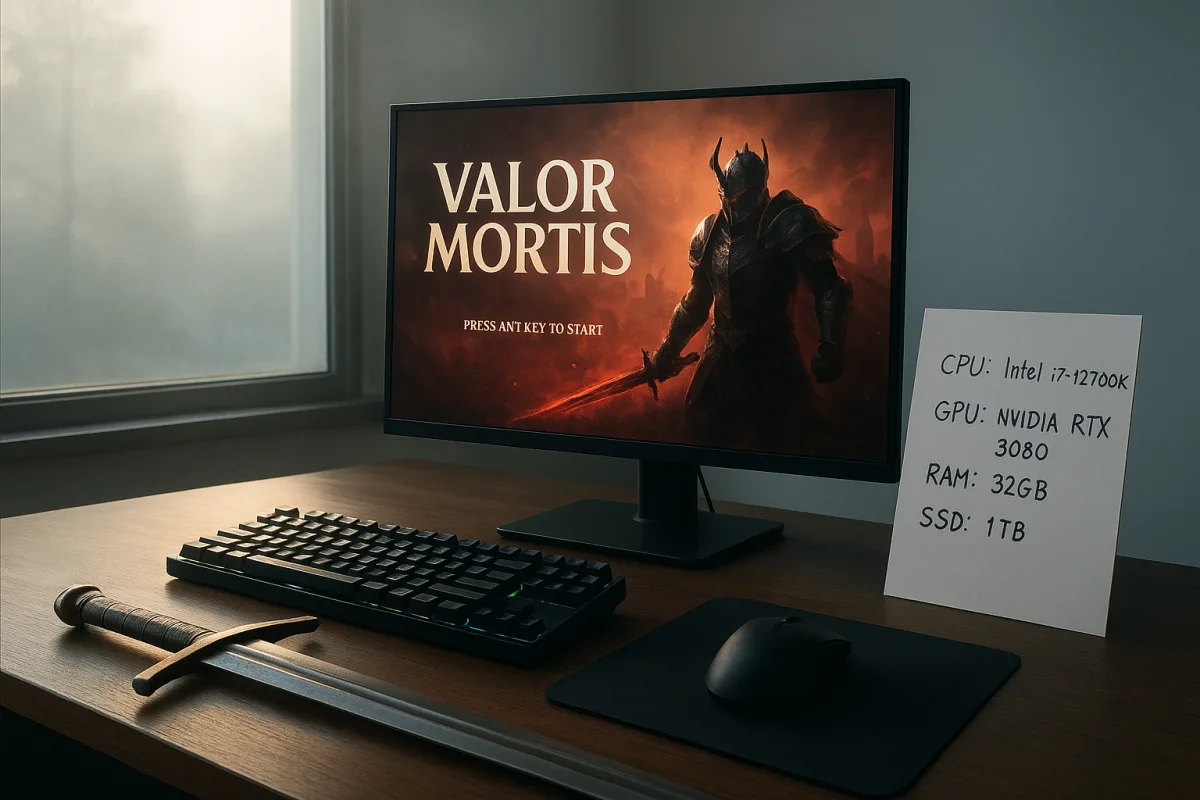
Valor Mortis system requirements and review
Get detailed Valor Mortis system requirements and an in-depth review covering gameplay, combat, and hardware needs for PC players.
The quick list
Best overall: Valor Mortis on the official minimum specification, for Soulslike players who want a fresh camera angle and can meet the demanding listed hardware target.
Best value: Waiting for post-launch patches and benchmarks, for PC players below the RX 6700 or RTX 2070 Super tier who do not want to buy hardware on speculation.
Best for older rigs: Valor Mortis via a demo or refund-window test, for GTX 1070, GTX 1660 Ti, and RX 5600 XT owners, because the lower requirement reports are not officially confirmed.
Best for parry specialists: Valor Mortis’ saber-and-fire setup, for players who like posture breaks, executions, and reactive duels more than huge weapon rosters.
Best avoided by: Buildcraft-first Soulslike players, who expect radically different stat paths, many viable archetypes, and boss encounters as the main attraction.
What you are actually deciding
Valor Mortis is not asking whether you like Soulslikes. There are enough of those now that “hard action game with lantern checkpoints” barely narrows the field. The real question is whether a first-person Soulslike, built around sword parries and Napoleonic body horror, sounds more exciting than exhausting.
One More Level’s angle is clean enough: an alternate 1817 where Napoleon won at Waterloo, the war has become a supernatural catastrophe, and resurrected soldier William Dowsett has to cut through plague-mutated troops. It launches October 13, according to the Steam listing. [7]
That setting does more work than the publisher-friendly phrase “fresh take on the genre” usually implies. IGN’s review highlights battlefields littered with cavalry remains and bayonets, raised wrecked ships, flooded settlements, and a town run by children surviving amid the collapse.
Polygon’s hands-on coverage similarly finds the world’s quieter details more effective than simple zombie shock tactics. Abandoned carts, burned villages, mountain routes, ruined churches, and dead soldiers sell a war that has already ended badly, leaving you to walk through its aftermath.
The comparison most reviewers reach for is BioShock crossed with Dark Souls. That is not quite wrong, but it undersells the actual rhythm. One hand carries a saber, rapier, or claymore; the other carries a gun or a supernatural transmutation. The game is still principally about spacing and parry timing.
Comparison table
| Option | Cost and hardware requirement | Campaign size and structure | What it does well | Main trade-off |
|---|---|---|---|---|
| Valor Mortis on official minimum PC | Game price was not supplied. Steam lists Ryzen 7 3700X or Core i7-11700, 16GB RAM, RX 6700 or RTX 2070 Super, and 50GB SSD space. [7] | IGN estimates 20-plus hours. Areas begin fairly linear, then open into denser routes and shortcuts. | First-person parries, strong atmosphere, unusual historical setting. | Demanding official minimum, uncertainty around launch performance and stability. |
| Valor Mortis on reported lower-spec PC | Unconfirmed reports named Ryzen 5 3600 or Core i5-10600K with RX 5600 XT or GTX 1660 Ti. Used RX 5600 XT pricing has been reported around $120 to $175, while GTX 1660 Ti listings sit around $240 to $274.50. | Same game, no confirmed lower-spec performance target. | Potentially cheaper route if revised specs become official. | No developer confirmation or official benchmark data. |
| Wait for patches and benchmarks | No extra cost beyond the game, though GPU prices fluctuate. | Lets launch-week reports establish real frame rates, crashes, and settings scaling. | Lowest-risk option for borderline PCs. | You miss the launch window and early discovery period. |
| Choose another traditional third-person Soulslike | Varies by game and hardware. | Typically offers wider camera awareness and more established genre conventions. | Better fit for players who dislike first-person spatial awareness. | Loses Valor Mortis’ unusually intimate parry framing and setting. |
The GPU prices above are component prices, not an “upgrade cost.” They exclude the rest of a capable PC, including CPU, motherboard, power supply, memory, storage, operating system, and any labour. They are also volatile used-market figures, not stable MSRP.
Why the first-person view matters
The first-person camera is not a cosmetic switch. In a conventional third-person Soulslike, the camera gives you crowd information almost for free. You can see flankers, judge weapon range from outside the character model, and often read a whole boss’s body language at once.
Valor Mortis takes that information away, then designs around it. Kicks & Grips’ early coverage and other previews describe the first-person framing as making parries feel immediate, while also requiring more deliberate target selection. [1][2] You are not simply rotating around a large enemy, you are waiting for a blade to fill the screen.
GamingBolt’s review argues that off-screen markers soften the camera’s biggest weakness. Rock Paper Shotgun agrees that most encounters are constructed head-on, so the perspective is less chaotic than a first-person Soulslike sounds on paper.
That does not mean the camera is magic. Rock Paper Shotgun notes that close-range boss animations can leave key tells outside the frame. The outlet also found itself stepping backward off cliffs or into awkward corners more often than it expected, which is a very first-person problem.
The good news is that the combat’s basic read is apparently strong. Standard attacks can be blocked or parried, red-glowing attacks demand a dodge, and posture breaks lead to high-damage executions. Preview coverage specifically calls out the parry-and-counter loop as the game’s central strength. [1][3]
The build system quietly favors sword players
There are three melee weapons, three firearms, and three transmutations, according to IGN. That sounds like nine routes through the game, but the reviews are more cautious. This is a toolkit game, not the kind of RPG where every stat investment creates a new character.
GameSpot found the opening saber so broadly useful that its rapier and claymore alternatives felt situational rather than transformational. The rapier emphasizes thrusts and weak points but gives up forgiving blocking, while the late claymore reportedly cannot parry at all. That is a hard sell in a game whose parry feedback is its best trick.
The resulting meta, if you want to call it that before public launch, looks obvious. Saber users get dependable blocks and parries, fire offers immediate damage and environmental utility, and firearms handle weak points or explosive opportunities. That is a strong baseline, but it risks flattening experimentation.
Ambers are where the more interesting tuning lives. IGN describes combinations such as healing after a posture-break execution alongside Perfectionism, which grants substantially higher damage at full health. That setup rewards clean play, speeds ordinary fights, and quietly makes recovery tools more valuable than raw defensive padding.
Polygon takes the more optimistic view. Its preview says lantern respecs cost a moderate amount of catalysts scaled to level, bosses drop catalysts outside their arenas after defeat, and even failed boss attempts award some currency through damage dealt. If those systems survive launch unchanged, build changes should not demand a full restart.
Still, do not confuse easy respecs with enormous build diversity. Rock Paper Shotgun and GameSpot both found the skill tree dominated by straightforward health, damage, stamina, and posture upgrades. The likely result is adjustment around the edges, not a full caster, gunner, tank, or dexterity meta.
Levels, bosses, and the Ghostrunner question
The campaign’s layout appears to improve after its opening hours. GameSpot describes early battlefields as relatively linear, with only slight detours, before later villages, cities, catacombs, and university spaces develop better shortcuts and more hub-like connections between lanterns.
That matters because Soulslike level design lives or dies on return routes. A shortcut is not just a convenience, it changes the emotional cost of dying. The more quickly the game reconnects you to a dangerous encounter, the more willing you are to test a different weapon, amber, or parry timing.
One More Level’s Ghostrunner background also shows up in wall-running, grappling, and ability-driven platforming. The reviews split sharply here. Rock Paper Shotgun thought the movement worked best when it opened stealth routes and attack angles, rather than when it became a separate obstacle-course segment.
IGN was much less forgiving, reporting collision problems, falls through geometry, missed ledges, and other rough edges in its review build. That matters more than it might in a pure platformer because a Soulslike asks players to trust its failure states.
Bosses are another disagreement. GamingBolt enjoyed the spectacle and wanted a boss-rush mode. IGN found too few major bosses and judged many of them underwhelming, especially repeat encounters and oversized versions of regular enemies. GameSpot’s middle position is that bosses provide useful challenge, but cannot fully repair an uneven enemy pool.
The sensible read is neither “bosses are broken” nor “bosses are amazing.” The game seems to hit hardest in close one-on-one duels where first-person parries can sing, and softer when it asks the same small group of enemies or minibosses to carry too much runtime.
PC requirements: treat the alleged cut as a bad tooltip until confirmed
Rock Paper Shotgun reported that Steam requirements appeared to drop shortly before release, from a Ryzen 7 3700X or Core i7-11700 and RX 6700 or RTX 2070 Super, to a Ryzen 5 3600 or Core i5-10600K and RX 5600 XT or GTX 1660 Ti.
That report is worth knowing about, but it should not guide a purchase today. The current official Steam listing still shows the higher configuration: Windows 11 64-bit, 16GB RAM, an RX 6700 or RTX 2070 Super, DirectX 12, and 50GB on an SSD. [7]
There is no official confirmation from One More Level that the lower specifications are final. Nor are there official performance comparisons between the alleged RX 5600 XT or GTX 1660 Ti minimum and older cards such as the GTX 1070. [6]
This is exactly where community hardware advice gets silly fast. A card having comparable raster performance in another game does not prove stable frame pacing in this one. Unreal Engine stutter, VRAM pressure, CPU limits, and upscaler quality can all turn “technically runs” into “not worth playing.”
As of October 12, there is also no post-launch user evidence for crashes, bugs, or stability trends because the game has not launched. Any claims based on finished review builds, including IGN’s reported crashes and missing geometry, are useful warning signs, not confirmed retail-build behaviour.
Who each option suits
Valor Mortis on the official minimum PC suits players who already own the listed hardware and want a Soulslike with more personality than another ruined medieval kingdom. The first-person parry system and Napoleonic setting are the reason to play.
Valor Mortis on a lower-spec or older PC suits only players able to verify performance themselves through a demo, a free weekend, or a retailer’s refund policy. Do not treat unconfirmed specification changes as a promise of acceptable performance.
Waiting for patches and benchmarks suits players who care about smooth frame pacing, stable launches, and reliable controller or ultrawide support. It also suits anyone burned before by buying a technically ambitious action game during its least polished week.
The saber-focused, parry-heavy approach suits players who enjoy learning attack strings, breaking posture, and turning a clean defensive read into an execution. It is probably the most supported playstyle based on the available reviews.
Another third-person Soulslike suits players who want wide camera awareness, more elaborate character archetypes, and a larger boss-first challenge curve. Valor Mortis looks most convincing when it stays intimate, reactive, and sword-focused, not when it tries to outbuild or out-boss the genre’s specialists.
Frequently Asked Questions
What are the official Valor Mortis PC system requirements?
As of October 2026, the official minimum PC requirements for Valor Mortis are Windows 11 64-bit, an AMD Ryzen 7 3700X or Intel Core i7-11700 CPU, 16 GB RAM, and an AMD Radeon RX 6700 or Nvidia GeForce RTX 2070 Super GPU, with 50 GB of SSD storage. There has been no developer confirmation of any reductions to these requirements.
How does Valor Mortis' first-person combat work?
Valor Mortis uses a first-person perspective that emphasizes sword parries and spacing. The combat involves carrying a saber, rapier, or claymore in one hand and a gun or supernatural power in the other, requiring precise timing and deliberate target selection. Early coverage highlights that first-person parries feel immediate and create a unique rhythm compared to traditional third-person Soulslikes.
Is Valor Mortis playable on GTX 1660 Ti or RX 5600 XT?
There are unconfirmed reports suggesting Valor Mortis might run on systems with a GTX 1660 Ti or RX 5600 XT, but no official benchmarks or developer validation exist for these GPUs as of launch. Players with these cards are advised to try the demo or use refund options rather than relying on speculative performance claims.
What are the main strengths and weaknesses of Valor Mortis?
Valor Mortis is praised for its unusual first-person sword-and-parry combat, strong atmosphere, and distinctive Napoleonic horror setting. However, it faces criticism for uneven difficulty spikes, limited enemy variety, and a thinner upgrade system than expected. The demanding official hardware requirements and uncertain launch stability are also notable trade-offs.
How long is the Valor Mortis campaign?
IGN estimates that the Valor Mortis campaign lasts roughly 20 hours. The game features initially linear areas that open into more complex routes with shortcuts as the player progresses.
How we researched this
This article was assembled from 3 video sources across 3 channels, 5 published articles, 7 cited references.
Nothing here is based on hands-on testing. Where a figure or finding appears, it belongs to the source cited beside it, and the writing says so rather than implying otherwise. Every source is listed below so you can check it.
Sources
Valor Mortis Review — IGN
Valor Mortis Review - A Must-Play Soulslike With A Brutal Edge — GamingBolt
Valor Mortis Tries Too Much With Its Attempt At A First-Person Soulslike - Review — GameSpot
Valor Mortis' system requirements appear to have been drastically cut, just before the FPSoulslike launches — Rock Paper Shotgun
First-Person Soulslike Valor Mortis Is Brutal, Frightening, and Strangely Chill — Polygon
He-Man and the Masters of the Universe: Dragon Pearl of Destruction Release Date Confirmed — IGN
Valor Mortis review - this Napoleonic first-person swordfighter is one of the freshest Soulslikes in years — Rock Paper Shotgun
Valor Mortis Review — IGN
Valor Mortis Review: First-Person Parries Carry a Familiar Soulslike | Kicks & Grips
Valor Mortis' first-person perspective opens up "new opportunities" within the soulslike genre
Valor Mortis Preview: Uneven Difficulty Balance - Game Informer
Valor Mortis launches October 13: PC requirements and which GPUs run it | CanIRun.gg
Watch Valor Mortis Soulslike Reviews and System Requirements on Youtube
Also from the sources
Related Articles
Phantom Blade Zero PC Gameplay and Performance Guide
Explore Phantom Blade Zero PC gameplay, system requirements, and optimization tips to ensure smooth performance and master combat mechanics.
Ace Combat 8 Wings of Theve Gameplay and Franchise Revival
Explore Ace Combat 8 Wings of Theve gameplay, new weather mechanics, system requirements, and how it revives the arcade flight combat franchise.
Control Resonant Gameplay and Graphics Review Deep Dive
Explore Control Resonant gameplay, Gravity Shift mechanics, graphics settings, and edition comparisons for an optimized PC gaming experience.
Onimusha Way of the Sword Review and Edition Comparison
Read our Onimusha Way of the Sword review with edition comparisons, PC requirements, and gameplay insights to help you decide before launch.