
Call of Duty Modern Warfare 4 Multiplayer and Story Recap
Get a full recap of Call of Duty Modern Warfare 4 multiplayer features, story, editions, and PC requirements in one comprehensive guide.
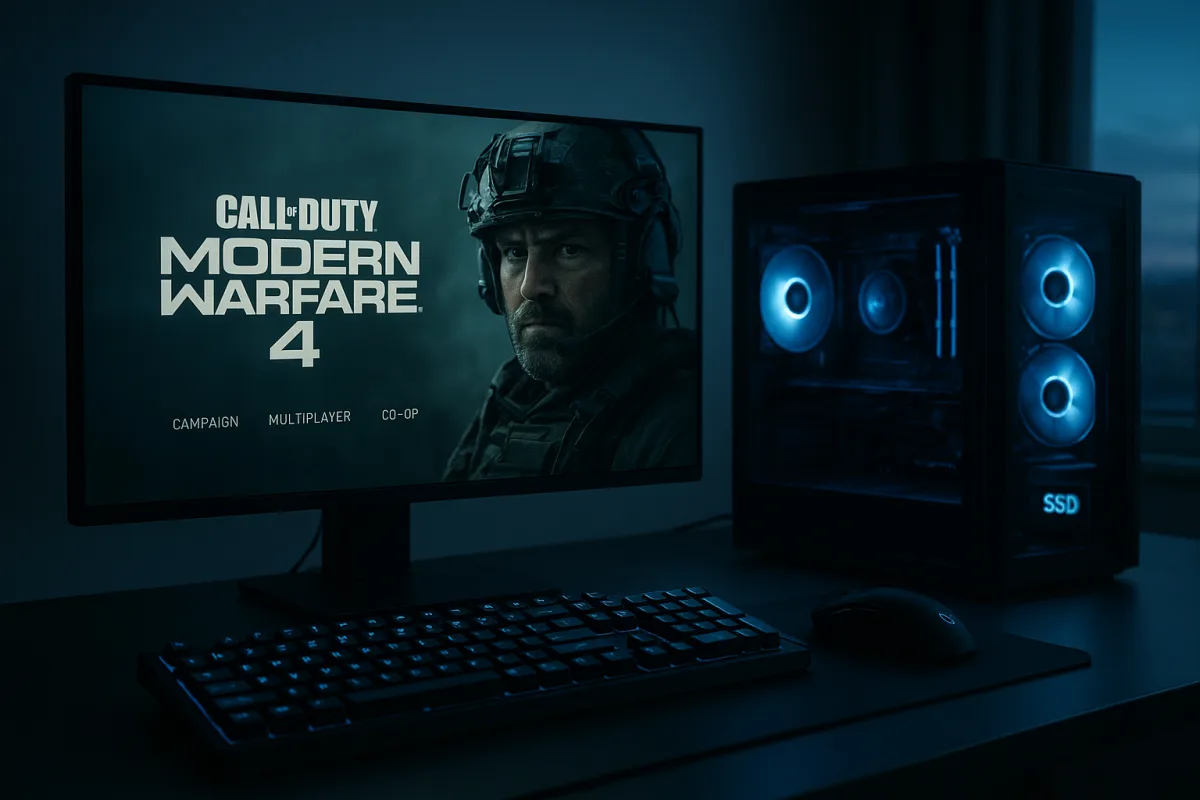
First problem: deciding which edition actually makes sense
Modern Warfare 4 launches on October 23, 2026, for PC and current platforms, with no PlayStation 4 or Xbox One version. Gematsu lists the Standard Edition at $69.99 and the Vault Edition at $99.99.[1]
The Standard Edition includes the base game and pre-order bonuses, including early beta access and the Hunter Killer Operator Skin for Black Ops 7 and Warzone. That skin is cosmetic content, not a reason to expect an in-match edge.[1][2]
The Vault Edition costs another $30. It includes early campaign access from October 16, early DMZ access from October 20, two operator packs, multilingual voice packs, five Signature Collection weapons, and a BlackCell season bundle.[1][2]
That BlackCell bundle contains 1,100 COD Points, 20 tier skips, and exclusive seasonal items. It is useful only if you were already going to buy a season pass and value skipping progression, rather than because it improves a weapon’s underlying damage model.[10]
For a player arriving chiefly for 6v6, the Standard Edition is the sensible starting point. The Vault Edition is a convenience-and-cosmetics package, despite the usual implication that the premium edition is somehow the complete multiplayer experience.
PC players also should not buy on the assumption that Modern Warfare 4 will land in Xbox Game Pass at release. The research available before launch says it will not be available through Game Pass on day one.[3]
Second problem: getting the PC ready before the download finishes
Activision’s minimum specification is modest on paper: a Ryzen 5 1400 or Core i5-6600, 8 GB RAM, and an RX 470, GTX 970, GTX 1060, or Intel Arc A580 with 3 GB VRAM.[9]
Recommended hardware is more relevant for multiplayer: a Ryzen 5 3600 or Core i7-8700, 16 GB RAM, and an RX 6600 XT, RTX 3060 Ti, or Intel Arc B580 with 8 GB VRAM.[9]
Every listed tier requires a 64-bit Windows installation, DirectX 12 support, broadband internet, and an SSD with 115 GB free. Do not interpret the storage figure as a mechanical-drive suggestion, because Activision specifically calls for SSD storage.[9]
The Ultra 4K upscaled ray-tracing target is substantially heavier: a Ryzen 7 3700X or Core i7-10700K, 32 GB RAM, and either an RX 9070 XT or RTX 5070 Ti with 16 GB VRAM.[9]
That tier is a visual target, not the configuration a competitive player should chase blindly. Multiplayer visibility and stable frame delivery matter more than reflections, especially when the game’s own design puts more visual masking around muzzle smoke.
Before troubleshooting drivers, check firmware settings. Activision requires both TPM 2.0 and Secure Boot for online play, and these caused access problems during the August 21 to September 1 beta period.[9]
The beta also produced “Networking Failed to Start” errors under heavy load and shader stutter even on high-end systems reporting 120 to 200 FPS. Those reports are not proof that the retail build remains broken, because no post-launch testing exists yet.[9]
Practical order matters here: enable TPM 2.0 and Secure Boot, update Windows, leave the required SSD headroom, then launch early enough for shader compilation. If stutter persists, lower expensive visual options before assuming your displayed FPS tells the whole story.
Third problem: learning movement without donating free kills
Infinity Ward is moving away from the acrobatic Omnimovement emphasis toward what it calls grounded tactical movement. The studio’s pitch is “slick and sophisticated” traversal that still feels fair to the player trying to shoot the mover.[5]
That framing is developer intent, not field-tested balance. There is no public post-release sample yet showing whether faster players can repeatedly break aim assist, cameras, or hit registration, so ignore both “movement is dead” and “it is overpowered” pre-launch certainty.
GamingBolt’s feature rundown describes redesigned mantling, pipe climbing, climbing jumps, hanging, leaning, shimming, and a backward or supine slide. The important change is control during a mantle rather than raw animation speed.[4]
You can reportedly steer left or right, aim down sights, cancel a mantle, or carry mantle momentum into a slide. On paper, that kills the old habit of treating every climb as a forced, helpless animation.[4]
Use those options conservatively for the first few sessions. Cancel a mantle when an angle is covered, and use the transition-to-slide only when it carries you behind hard cover, not merely because a movement tutorial made it look stylish.
The new slide finish on your back has obvious close-quarters potential, but it also advertises your position and leaves fewer aiming adjustments than a normal strafe. Expect it to be a niche corner-clear or panic-survival tool until match data proves otherwise.
Weapon handling is also meant to respond to sharp turns, fatigue, nearby walls, and tight interiors. Tactical sprint posture changes as stamina declines, so do not build a route around endlessly sprinting through exposed lanes.[4]
The quiet multiplayer consequence is that disciplined pre-aiming may gain value relative to full-speed corner launches. A player who reaches an angle with a settled gun should beat one whose weapon is still reacting to a hard direction change.
Fourth problem: making shots land after hip-fire bloom disappears
Modern Warfare 4 removes hip-fire bloom, according to GamingBolt’s rundown. Shots are intended to travel where the weapon is pointed, while recoil, weapon sway, and movement still determine whether that point is useful.[4]
That does not mean hip fire becomes universally reliable. It means random spread is less of an excuse and recoil control, crosshair placement, and movement discipline become more directly responsible for the result.
Start by separating true close-range weapons from general-purpose rifles. A compact aggressive build gains more from predictable off-aim firing, while a longer-range build still wants recoil stability and sight-picture clarity rather than pretending it is a room-clearing gun.
GamingBolt also reports improved muzzle-smoke masking and a redesigned depth-of-field treatment intended to preserve the sight picture. PC players get a rebalanced field-of-view system designed to retain peripheral awareness without making targets look absurdly small.[4]
Set field of view for target readability first, then widen gradually if awareness feels too limited. Publisher descriptions do not supply an optimal number, and one does not exist across monitor sizes, resolutions, sensitivities, and engagement ranges.
Fifth problem: the Gunsmith has 500 attachments and no patience for you
The launch inventory is reported as 33 weapons: 24 primaries, eight secondaries, and one melee weapon. More than 500 standard attachments accompany them, which is breadth, not automatic balance.[4]
This is the point where players often paste a creator’s “zero recoil” build onto every gun and wonder why it loses inside ten metres. Make one class per practical job: close-range entry, flexible objective play, lane holding, and large-map support.
Create-a-Class now ties an operator and killstreak selection directly to each loadout. That should make switching roles quicker, provided you avoid the trap of picking a streak package that only works when your match goes perfectly.[4]
Smart streaks now accept objective contribution toward progression as well as kills. On Domination-style modes, choose a class you are willing to use near flags, because captures and defensive work can now contribute to streak momentum.[4]
That change quietly buffs players who rotate, defend, and play the win condition. It does not make reckless flag dives clever, but it reduces the old mismatch where the correct objective play could feel economically worse than farming kills elsewhere.
Apex attachments sit above regular Gunsmith parts and unlock once a weapon is maxed. GamingBolt says they attach freely without consuming a slot and can substantially change a weapon’s behaviour, including close-range or stealth-oriented conversions.[4]
Those are the attachments to watch during the first balance cycle. A free behaviour-changing part is more dangerous than a tiny recoil reduction because it can let a weapon cross roles without giving up the attachments that normally enforce trade-offs.
Do not assume every Apex option becomes a meta emergency. The actual answer depends on damage ranges, handling penalties, and whether the conversion preserves a weapon’s strongest base traits, none of which has credible post-launch testing yet.
If the attachment grid is more homework than fun, use Gunny, the optional Gunnery Sergeant build tool. It assembles close-range, balanced, or long-range builds from attachments you have already unlocked and updates as your inventory grows.[4]
Gunny is a sensible baseline, not an oracle. Use it to identify an appropriate role, then change one attachment at a time after several matches so you can tell whether a build improved recoil, range, or handling rather than merely feeling different.
Sixth problem: adapting when the map will not stay solved
Kill Block is a modular map that reconfigures between matches, with GamingBolt reporting more than 500 possible layouts. Memorising one perfect route will be less valuable than identifying which lanes currently offer cover, elevation, and safe retreats.[4]
For the opening minute, use a low-risk route and look for changed barriers, sightlines, and climbing opportunities before committing to a flank. The players who suffer most here will be those repeating a spawn rush from a previous configuration.
Combat Outpost expands Ground War with resource-gathering outposts, follow-on objectives, infantry, vehicles, and airborne streaks. Build specifically for the mode rather than taking a 6v6 run-and-gun class into open vehicle lanes.[4]
For large-scale matches, reserve one loadout for range and survival, then another for taking an outpost at close range. Smart streak objective credit makes the second class particularly worthwhile when the match asks for actual captures.
Seventh problem: choosing prestige without accidentally resetting the wrong progress
Modern Warfare 4 offers two prestige paths. Classic prestige resets level, unlocks, and Create-a-Class progression for rewards and milestones, while regular prestige returns you to level one but retains Create-a-Class unlocks.[4]
Pick regular prestige if you want the seasonal level climb without repeatedly rebuilding your useful classes. Pick classic only if the reset itself is part of the appeal and you accept temporarily losing the tools that make specialised loadouts work.
The meta should not truly settle in a weekend, regardless of launch-week highlight clips. With Apex attachments locked behind weapon progression and a modular map in rotation, give players at least a few weeks to unlock, test, and copy the genuinely strong combinations.
Eighth problem: remembering why Captain Price is suddenly in trouble
The reboot continuity began in 2019’s Modern Warfare, before Task Force 141 existed. Captain John Price, Kyle “Gaz” Garrick, CIA officer Kate Laswell, Alex Keller, and Urzikstan Liberation Force leader Farah Karim pursued stolen chemical weapons.[3]
Farah’s brother Hadir stole the gas and ultimately joined Al-Qatala after Russia’s occupation of Urzikstan killed the siblings’ parents. Roman Barkov’s chemical-weapons operation was destroyed, Barkov was killed by Farah, and Laswell formed Task Force 141.[3]
The first game’s aftermath was inconveniently spread across Special Ops and Warzone. Alex, initially presumed dead, returned after losing a leg, while Price, Farah, Ghost, and Nikolai stopped arms dealer Victor Zakhaev’s nuclear plan in Verdansk.[3]
Modern Warfare 2 then pivoted to American ballistic missiles stolen after a Russian military group intercepted a covert US transfer. Task Force 141 worked with Mexican special-forces soldier Alejandro Vargas while General Shepherd and Shadow Company tried to bury their role.[3]
Phillip Graves and Shepherd betrayed the team, Hassan Zyani’s Chicago missile attack was stopped, and the Russian theft pointed toward Vladimir Makarov. Meanwhile, Hadir later led Al-Qatala before Price, Farah, and Alex killed him in Special Ops.[3]
The important thing is not to treat every apparent death as final. The reboot has already revived Alex through seasonal content and later revealed Graves survived, a storytelling habit IGN specifically highlights when explaining why this continuity feels unusually tangled.[3]
Going into Modern Warfare 4, Makarov remains at large. The other essential setup is that Price is a fugitive, reportedly hunted by former allies Ghost and Gaz after Task Force 141 was disbanded.[6][7]
That is the campaign’s usable starting point: the usual anti-Makarov mission now has a fractured team and a hunted commander. Expect callbacks to the old trilogy’s names, but do not expect the reboot to follow its events cleanly, because it has repeatedly rerouted its own setup through seasonal modes.
Frequently Asked Questions
What are the key differences between Modern Warfare 4 Standard and Vault editions?
The Standard Edition costs $69.99 and includes the base game plus pre-order bonuses like early beta access and a cosmetic Hunter Killer Operator Skin. The Vault Edition, priced at $99.99, adds early campaign access, early DMZ mode access, two operator packs with multilingual voice options, five Signature Collection weapons, and a full BlackCell season bundle with 1,100 COD Points and 20 tier skips. The Vault Edition mainly offers convenience and cosmetics rather than competitive gameplay advantages.
What is the Modern Warfare 4 multiplayer gameplay like?
Multiplayer encourages building classes specialized for specific maps and modes, with over 500 attachments and various operators, streaks, and objective scoring systems. The new movement system aims for grounded, tactical traversal including mantling, climbing, hanging, and backward sliding, designed to balance smooth movement with fairness for both movers and shooters. However, no post-launch data is available yet to confirm which movement techniques dominate.
What is the story recap of Call of Duty Modern Warfare 4 campaign?
The campaign continues unresolved threads from previous games: Vladimir Makarov remains free, and Captain Price is a fugitive after the collapse of Task Force 141. Price is reportedly targeted by former allies Ghost and Gaz, setting a tense narrative backdrop. Early campaign access is available with the Vault Edition starting October 16, 2026.
What are the PC system requirements for Modern Warfare 4?
Minimum requirements include Windows 10 64-bit, AMD Ryzen 5 1400 or Intel Core i5-6600 CPU, 8 GB RAM, and a GPU like AMD RX 470 or NVIDIA GTX 970 with 3 GB VRAM. Recommended specs call for Windows 11 64-bit, Ryzen 5 3600 or Core i7-8700 CPU, 16 GB RAM, and GPUs such as RX 6600 XT or RTX 3060 Ti with 8 GB VRAM. All installations require an SSD with 115 GB free, DirectX 12 support, broadband internet, and mandatory TPM 2.0 and Secure Boot for online play.
How does the new movement system work in Modern Warfare 4 multiplayer?
The movement system replaces the previous "Omnimovement" with more grounded, tactical traversal options like mantling, climbing, hanging, and backward sliding. It is designed to feel smooth and sophisticated while maintaining fairness for players trying to shoot moving opponents. This system is untested pre-release, and no data yet exists on how it will impact competitive or public matches.
How we researched this
This article was assembled from 2 video sources across 2 channels, 1 published article, 10 cited references.
Nothing here is based on hands-on testing. Where a figure or finding appears, it belongs to the source cited beside it, and the writing says so rather than implying otherwise. Every source is listed below so you can check it.
Sources
Call of Duty Modern Warfare 4 (2026) Multiplayer - 15 Things You Need To Know Before You Buy — GamingBolt
Call of Duty: Modern Warfare Timeline Recap (Watch Before Modern Warfare 4) — IGN
Call of Duty: Modern Warfare Story Recap – What You Need To Know Ahead of MW4 — IGN
Call of Duty: Modern Warfare 4 announced for PS5, Xbox Series, Switch 2, and PC - Gematsu
Call of Duty: Modern Warfare 4 - PS5 Games | PlayStation (US)
Modern Warfare 4: Everything we know about the new Call of Duty game
Call of Duty: Modern Warfare 4 – Every New Feature Explained
Is Modern Warfare 3 the End or Will There Be a Modern Warfare 4? - GameRevolution
Modern Warfare’s Chaos Trail Points Straight At MW4 | ENMNEWS
Modern Warfare 4 BlackCell Explained: What's Included, How to Get It & Is It Worth It (2026)
Watch Call of Duty: Modern Warfare 4 Multiplayer and Story Recap on Youtube
Also from the sources
Related Articles
Ace Combat 8 Wings of Theve PC Reception and Features
Explore Ace Combat 8 Wings of Theve PC reception, system requirements, editions, and multiplayer features before its October 2026 launch.
Ace Combat 8 Wings of Theve Gameplay and Franchise Revival
Explore Ace Combat 8 Wings of Theve gameplay, new weather mechanics, system requirements, and how it revives the arcade flight combat franchise.
Onimusha Way of the Sword Review and Edition Comparison
Read our Onimusha Way of the Sword review with edition comparisons, PC requirements, and gameplay insights to help you decide before launch.
Call of Duty Modern Warfare 4 Switch 2
Get key updates on Call of Duty Modern Warfare 4 for Switch 2, including file size, beta dates, console pricing, and gameplay controls.