
World of Warcraft Forever Community, Tournaments
Explore World of Warcraft Forever's community, beta challenges, tournaments, and Blizzard's management of its evolving MMO platform.
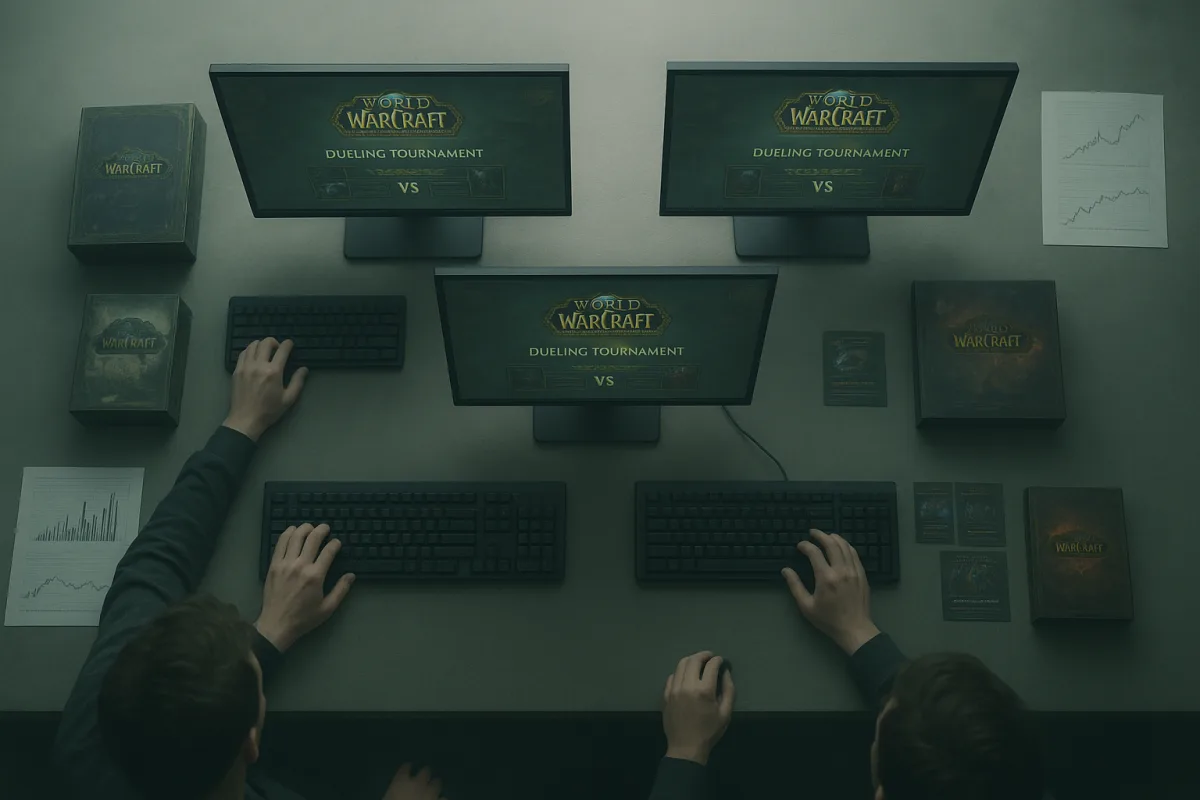
WoW Forever has shifted from nostalgia product to managed platform
The shift is plain: World of Warcraft: Forever is becoming a live community platform before it has properly launched, and Blizzard is already being pushed to manage its population, economy, competitive scene, and social fault lines.
That is not based on one loud Reddit thread. GamesRadar reported repeated population-cap increases after beta demand overwhelmed the public-test infrastructure, while Icy Veins covered a $100,000 community dueling event built around the beta ruleset. [8][4]
Meanwhile, PC Gamer reported players finding expensive Black Market items and a temporary mount-speed buff, and TechRadar focused on player anxiety around faction-locked mega-servers. [6][7] Different outlets are circling the same problem from different directions.
WoW Forever is not merely asking whether players miss level-60 Azeroth. It is asking whether a fixed-cap MMO can remain socially and economically interesting once the usual expansion treadmill is removed.
That explains why the beta’s arguments are not limited to class tuning. Players are arguing about queue times, access to friends, whether gold can buy meaningful power, and who gets to define the competitive rules before level 60.
The popularity evidence is real, but the numbers are thin
Blizzard’s response to beta load is the clearest hard signal. GamesRadar reported multiple population-cap increases after launch-day disconnections, queues, and instability showed that the available PTR capacity was not enough. [8]
That does not give us a public concurrent-player figure, so claims that WoW Forever is Blizzard’s biggest beta ever would be guesswork. The available evidence supports heavy demand and infrastructure strain, not a precise ranking.
The important part is Blizzard’s behaviour. Raising caps and expanding infrastructure is an operational response, not the kind of cosmetic engagement campaign publishers can manufacture with a promotional trailer.
It also makes the early access structure more relevant. The Skyborne Epic Pack costs $59.99 and includes beta access, 30 days of game time, cosmetics, pets, tabards, and Invite-A-Friend codes. [9][10]
The $29.99 Skyborne Heroic Pack includes the Skyborne race, Zephras Isle starting experience, early name reservation, and the Cerulean Prideclaw mount, but not beta access. [9][12] It suits players who want the themed extras without paying for the beta bundle.
The $79.99 Warcraft Forever Collection adds Warcraft III: Reforged, the Forsaken Kingdom campaign, and housing decor to the Epic Pack contents. [9][14] It suits someone who specifically wants those companion products, not someone simply trying to enter Azeroth at launch.
The $150 Collector’s Edition is a physical package containing the higher-tier digital content, with beta access delivered separately by email. [10][12] It is for collectors, and does not change the core launch requirement.
For regular play, Forever follows the existing World of Warcraft model: base access comes with an active subscription or game time. [10][13] None of the paid editions is required to roll a character when the game launches.
That distinction matters because beta demand arrived despite the higher-tier access path. It suggests interest is not solely the result of a free weekend stampede, though it still tells us little about long-term retention.
The first tournament is a stress test, not a league
The only confirmed large competitive event is the Forever Open, scheduled for October 17 and 18 on the Horde PvP ruleset. Participants need level 30 characters, which makes the event accessible during the early progression window. [4]
The tournament was organised by Warcraft streamers TipsOut, Xaryu, and Esfand. Streamer TimTheTatman then doubled its prize pool to $100,000, giving a beta-era dueling tournament a larger stake than most Classic community events receive. [4]
That is a meaningful signal of creator interest. It is not evidence that Blizzard has committed to a permanent tournament ecosystem, seasonal circuit, broadcast programme, or raid-racing series.
The difference is worth spelling out because community hype tends to skip it. A single prize pool can pull in elite duelers quickly, but a competitive scene needs stable rules, spectator tools, anti-cheat confidence, and regular scheduling.
WoW Forever’s early format also narrows what the result can prove. Level-30 dueling on one PvP ruleset will reveal plenty about class breakpoints and player skill, but it cannot settle level-60 raid balance or faction-wide server health.
No other prize-pool tournament has been confirmed for late 2026 or early 2027. That includes the December 9 raid unlocks for Barrow Deeps, Hyjal Summit, and Onyxia’s Lair. [5]
For a player planning a guild, community event, or content project, this means building around the Forever Open is sensible. Building a business plan around Blizzard-backed WoW Forever esports is premature.
The meta will probably move more slowly than retail’s weekly churn, but it will still move. A public dueling showcase accelerates class perceptions, especially when one spec repeatedly wins on stream, whether or not the matchup is representative.
Gold controls are Blizzard’s quietest balance patch
The most revealing beta controversy is not a raid boss. It is the question of what gold should buy in a game whose characters are meant to remain at level 60 indefinitely.
PC Gamer reported that players found the Gift of Galloping, a 150-gold item granting 10% mounted movement speed for 15 days. [6] In an early Classic-style economy, 150 gold is deliberately out of reach for most levelling characters.
The backlash makes sense, but “pay to win” is too loose a label unless Blizzard sells the effect directly for real money. The immediate balance concern is gold advantage, convenience, and whether farming capacity compounds into mobility.
A 10% mount-speed increase does not make a warrior win a duel. It does make gathering loops, world travel, farming routes, and possibly open-world objective response faster for 15 days.
That is a soft-power buff, and soft-power buffs can be the nastiest ones in a permanent server economy. They do not kill a build directly, but they can reward players already able to control profitable routes.
The beta also contains a Black Market Auction House at Powderfuse Port in Riverglades. Items such as the Disgusting Oozeling and Black Tabby reportedly start around 100 gold, while a reagent vendor sells Black Lotus and Arcane Crystal for 50 gold each without purchase limits. [2][3]
That vendor design looks like an attempt to establish price ceilings for certain high-value materials. If a player can buy Arcane Crystal for 50 gold from an NPC, auction-house sellers cannot hold it sustainably above that price.
It does not prove that Blizzard has solved inflation. It only controls the items covered by the vendor, and convenience premiums can still emerge if travelling to Riverglades is inconvenient or supply becomes constrained by other systems.
Most importantly, there is no public average auction-house data for Fel Crystal or Stranglevine. Reports that these are rare crafting materials are not the same as proof of stable pricing, scarcity, or a profitable profession route. [6]
Anyone planning a profession project should watch the live auction house rather than copy beta screenshots. The beta began on September 17, and its economy is both young and vulnerable to player resets, exploits, and sudden population changes. [11]
Mega-servers expose the social cost of scale
The server-capacity problems are connected to the faction-lock argument. More players want to play together, but unlimited access to one faction can turn an ostensibly PvP server into a one-sided social network.
TechRadar’s concern is that faction-locked mega-servers could split established communities, especially if groups discover too late that friends have selected incompatible realms or factions. [7] That is a practical guild problem, not mere forum drama.
Blizzard has not provided enough public detail to judge the final rules fairly. There is no detailed official explanation of the lock thresholds, transfer approach, or whether restrictions will adapt cleanly as faction populations fluctuate.
The same evidence gap applies to the teased mega-dungeon concept. Blizzard has indicated interest in a sprawling, Blackrock Depths-style dungeon experience, but detailed layouts, rewards, lockouts, and routing incentives are not public. [1]
Players are right to ask whether such a dungeon becomes a social hub, a five-player raid, or a mandatory gear treadmill. They are wrong to declare it dead on arrival before Blizzard has shown its actual systems.
A true mega-dungeon could quietly help the Forever model if it supports different reasons to visit: targeted gear, professions, exploration, rare materials, or repeatable social runs. If it is only a longer loot corridor, the novelty will wear off.
What project builders should take from the beta
For guild leaders, tournament organisers, addon authors, and community hosts, WoW Forever’s opportunity is its uncertainty. Players need reliable information because official details, beta discoveries, and streamer-led events are arriving faster than settled norms.
The useful project is not another vague “best class” list. It is a maintained tool that states its patch date, server ruleset, tested level bracket, and uncertainty, especially where data has not yet emerged.
Tournament organisers should start with tightly defined formats. The Forever Open shows that level-30 dueling can attract attention, but raid races, battleground cups, and economy competitions need rules that account for server access and faction imbalance. [4]
Guild projects should assume launch instability rather than promise perfect attendance. Population-cap increases have improved access, but GamesRadar’s reporting makes clear that Blizzard is still stabilising the beta environment. [8]
Finally, do not confuse controversy with failure. The Black Market arguments, faction-lock disputes, and tournament excitement are all signs that players think the rules will matter for a long time.
That is the real change around WoW Forever. Blizzard is no longer simply selling a return trip to old Azeroth. It is trying to govern an MMO whose community expects the destination to stay relevant.
Frequently Asked Questions
What challenges does Blizzard face managing WoW Forever's community?
Blizzard is managing significant challenges including server population caps that have required multiple increases due to overwhelming beta demand. The community has raised concerns about faction-locked mega-servers potentially splitting player bases, and the Black Market NPC selling rare items and a 15-day movement speed buff has caused balance and pay-to-win worries. Overall, Blizzard is working to stabilize servers, manage the economy, and address social fault lines before launch.
How popular is World of Warcraft Forever's beta?
The beta has seen heavy demand and infrastructure strain, with Blizzard repeatedly raising population caps to accommodate players. While exact concurrent player numbers are not public, the operational response to beta load indicates strong interest and engagement, rather than a manufactured promotional campaign.
What is the $100,000 WoW Forever tournament about?
The $100,000 Forever Open is a community dueling tournament organized by streamers TipsOut, Xaryu, Esfand, and TimTheTatman, who doubled the prize pool. Scheduled for October 17–18, 2026, it features the Horde PvP ruleset and requires participants to be at least level 30. This event is the only confirmed competitive tournament for WoW Forever at this time.
Does WoW Forever require a subscription or expansion purchase?
WoW Forever requires an active World of Warcraft subscription or game time for standard launch access. Optional editions, such as the $59.99 Skyborne Epic Pack, include beta access and extras but do not replace the subscription model. Expansion purchases priced at $29.99 or $59.99 do not grant base game access without a subscription.
How is the WoW Forever economy behaving during beta?
The in-game economy is dynamic and volatile during beta, with no publicly established prices for key crafting materials like Fel Crystal and Stranglevine. The Black Market Auction House sells rare items and reagents at set prices, but these do not reflect stable market values. Players are advised not to rely on beta auction house anecdotes for long-term investment decisions.
How we researched this
This article was assembled from 7 published articles, 14 cited references.
Nothing here is based on hands-on testing. Where a figure or finding appears, it belongs to the source cited beside it, and the writing says so rather than implying otherwise. Every source is listed below so you can check it.
Sources
Control Resonant Proves Everything Is a Live-Service Game Now — Polygon
Dave Franco, Manny Jacinto, and Jenny Slate talk Forgotten Island — Polygon
New 'Pokémon Winds and Waves' Leaks Fill Major Gap Left by Game Freak's Silence — Polygon
'God of War Laufey' Footage Officially Reveals New Gameplay, Physical Edition — Polygon
The Stakes Have Been Raised - $100,000 Dueling Tournament - Icy Veins
World of Warcraft: Forever Raids — Sizes, Unlock Date & Roadmap
WoW: Forever beta gets another population cap increase as Blizzard struggles to fit fans in the MMO
WoW Forever: release date, beta, roadmap, Skyborne and editions · WoW Forever
WoW Forever Price ($29.99+) Pre-Purchase, Subscription, Collectors Edition Cost
WoW Forever Beta: How to Get Access on 17 September | METAMMO
Is WoW Forever Free With Your Subscription? What It Actually Costs
Warcraft Forever Collection - Warcraft Wiki - Your wiki guide to the World of Warcraft
Related Articles
WoW Forever New Content and Player Experience Explained
Explore WoW Forever new content and player experience, including dungeons, contested tags, and social gameplay in the 2026 beta.
World of Warcraft Forever Class Changes and Legacy Talents
Explore World of Warcraft Forever class changes and how the Legacy Talent system affects leveling and account-wide progression.
Wardogs Tactical FPS Gameplay Guide: Maps, Economy & Combat
Explore Wardogs tactical FPS gameplay, including maps, economy, combat, and base building strategies for PC players.
Physint Development Funding Challenges and Publisher Impact
Explore Physint's development funding challenges and how publisher changes affect Kojima Productions' milestone-based game progress.