
Xbox Halo restructuring: studio changes and industry impact
Explore Xbox Halo restructuring, studio layoffs, and Activision's new role in Halo's future development and industry impact.
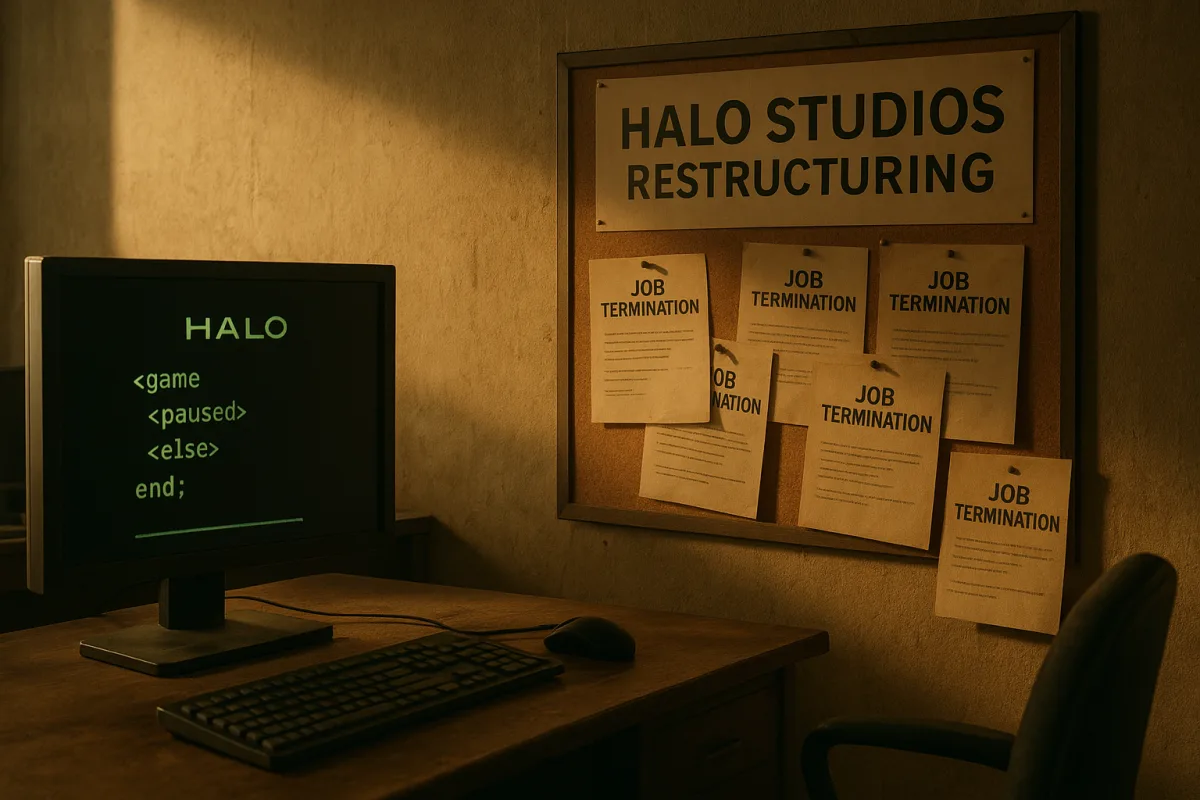
Xbox has moved Halo out of Halo Studios
The shift is plain: Halo is no longer being led as a major in-house Xbox Game Studios production. Microsoft has cut 268 more Xbox jobs, transferred Halo oversight to Activision, and left Halo Studios as a much smaller support operation. [1][4]
That is not a minor reporting-line tweak, despite Microsoft’s preferred language of “streamlining.” Halo was once the franchise that sold the original Xbox’s pitch in a single screenshot, a ringworld, a green-armoured supersoldier, and a LAN party waiting to happen.
Now it sits under the same corporate umbrella that runs Call of Duty. Activision has formed a dedicated team for the next mainline Halo rather than simply assigning an existing Call of Duty studio to it. [1][4]
That distinction matters. “Call of Duty developer makes Halo” would suggest a straight asset pipeline swap, with familiar annualisation pressures and likely design habits following it. A newly assembled team at least leaves room for Halo to be built around different priorities.
Still, a new internal team is not evidence of a healthy, fully funded long-term plan. It is evidence that Microsoft decided its existing Halo structure was not delivering what it wanted, then chose a different management group to solve that problem.
Reports indicate that Halo Studios has been reduced to roughly 20 developers after the cuts. [3] Microsoft has said the studio will support existing Halo products and community work, a description that sounds much closer to live-service maintenance than full pre-production on the franchise’s next flagship game. [4]
For Halo Infinite players, that should temper both doomposting and optimism. Maintenance mode does not mean servers disappear next Tuesday, but it does mean the studio’s attention is being pulled away from large future additions. PC Gamer reported that Halo Infinite is entering maintenance as the wider team focuses on multiple Halo projects. [6]
In patch-note terms, the old build has not been deleted. It has been moved into sustainment, where the likely priorities are stability, playlist upkeep, backend operations, community events, and fixes that keep the existing population playing without requiring a giant content team.
The evidence is a pattern, not one dramatic Halo decision
Halo’s transfer is the headline because it is emotionally legible, but it is one entry in a much larger spreadsheet rewrite. Microsoft’s July plan called for 3,200 Xbox job reductions by the end of fiscal year 2027, with 1,600 cuts taking effect immediately. [2][11]
September’s 268 layoffs came alongside studio transfers, mergers, divestments, and looming closures. That is the important trend: Xbox is reducing the number of separately managed first-party teams while placing brands beneath larger publishing organisations. [8][10]
Obsidian Entertainment has moved under Bethesda Softworks, linking the studio more directly to Bethesda’s Fallout plans. Playground Games and Turn 10 Studios have been merged, consolidating the Forza and Fable side of Xbox’s portfolio. [1][8]
Rare and World’s Edge also moved under Activision, alongside Halo’s new reporting arrangement. [1] This is not Microsoft abandoning games, exactly. It is Microsoft treating its game operations less like a single platform-holder’s exclusive studio family and more like a set of publishing divisions.
The July reset also spun off studios including Compulsion Games, Double Fine Productions, Ninja Theory, and Undead Labs, returning teams and projects to their original management structures. [12] That is a very different move from simply cutting a project and keeping its staff available for reassignment.
A publisher can call this simplification because fewer executives need to approve budgets and fewer teams duplicate services. From the people making games, it looks more like the familiar post-acquisition cleanup phase, where portfolio logic beats individual studio histories.
Microsoft chief executive Satya Nadella praised Xbox’s “streamlining” and said the company needed a sustainable model that could deliver games across PC and Xbox hardware. [8] The strategy is not hidden. The uncomfortable part is that the business model is still being described in broad terms after the cuts.
There are no public figures for the savings from these layoffs, mergers, or divestments. [14] There is also no disclosed estimate for what this reorganisation will add to Xbox revenue, Game Pass growth, or profitability. Anyone presenting a precise financial upside is filling an empty stat slot.
Why Halo was the obvious franchise to move
Halo’s problem has not been a shortage of recognition. It has been cadence, consistency, and a series of attempts to update a foundational arena shooter without agreeing on what its modern identity should actually be.
IGN’s recent Halo analysis made the blunt comparison: Bungie shipped five Halo games in about a decade, while the gap between Halo 5 and Halo Infinite stretched to six years. The next mainline release is now likely to arrive after another similarly long gap.
That gap has a gameplay cost. A franchise that disappears for half a console generation cannot easily retain competitive players, creators, map makers, or friends who used to treat launch night as a recurring ritual rather than an occasional reunion.
Halo 4 leaned into a direct continuation of Bungie’s fiction and introduced loadouts and customisation systems that divided multiplayer players. Halo 5 pursued mobility and Spartan abilities harder, then landed with a campaign many players regarded as an awkward story pivot.
Halo Infinite’s core gunplay, equipment, and arena maps were often well received, but its launch package and post-launch content cadence became the real balance issue. It had a strong moment-to-moment sandbox, then struggled to keep enough meaningful reasons for squads to return.
That is why the panic around Activision needs a little calibration. Halo was not moved away from a studio that had established a stable release rhythm and an obviously successful live-service machine. It was moved because Microsoft had spent years trying to create one.
The counter-panic is also warranted. Activision’s Call of Duty expertise is not a universal first-person-shooter fix. Running seasonal content, matchmaking infrastructure, anti-cheat operations, and huge production teams is useful, but those are production advantages, not a creative thesis.
Halo works when weapons are deliberately constrained and each pickup changes the geometry of an encounter. The combat loop is not built around fifty attachment variants, rarity colours, and a constant inventory purge. Copying Call of Duty’s surface-level retention systems would miss the point.
A battle pass is not automatically bad design, and Halo Infinite already had one. The question is whether progression supports the match or becomes the match, pushing players toward chores, narrow challenges, and temporary modes instead of the clean arena loop Halo needs.
Do not treat a reboot as confirmed
The loudest rumour is that Activision’s Halo could be a reboot that does not continue the existing storyline. Gameranx cited a leak suggesting a “new chapter,” while IGN explored the creative case for stepping away from the accumulated post-Bungie continuity.
Neither report establishes a confirmed reboot. Microsoft has announced no setting, protagonist, engine plan, multiplayer format, release date, or story reset. The only confirmed development change is that Activision is making the next Halo game with a new dedicated team. [1][4]
That absence matters because “reboot” can mean several entirely different production decisions. It could mean a full continuity reset, a new cast within the existing universe, a Halo: Reach-style side story, or simply marketing language for a cleaner onboarding point.
The existing Halo Studios project, reportedly called Halo Next, was cancelled and was said to be years from completion. [5] That makes a near-term replacement unlikely, but it does not prove Activision’s game has started from zero or has inherited any usable work.
This is where community forecasting tends to equip the wrong loadout. Some players are already preparing for annual Halo releases; others expect a Call of Duty clone packed with cosmetic prompts. The public evidence currently supports neither prediction.
The sensible expectation is disruption. New leadership, a smaller legacy team, a cancelled project, and a new development group all create handoff risk. Even excellent studios lose time when tools, design ownership, technical decisions, and narrative plans are changed midstream.
Microsoft is building for reach, not old-school exclusivity
The Halo decision fits Microsoft’s broader attempt to become a publisher and platform operator across PC, Xbox consoles, cloud services, and whatever comes after the current hardware cycle. Nadella described that multi-platform goal directly. [8]
Xbox chief executive Asha Sharma has also discussed Project Helix, described as a next-generation family of Xbox devices including consoles and handhelds. [8] The hardware specifics remain unannounced, so it is not yet possible to say what performance targets, PC integration, or pricing strategy Helix will have.
What can be said is that Microsoft is not behaving like a company whose entire gaming plan rests on selling one closed-box console through exclusive first-party releases. It wants franchises that can publish widely and hardware that can sit inside a larger Xbox ecosystem.
That helps explain why Activision, Bethesda, and Mojang matter so much more than the reduced Xbox Game Studios group. Those divisions have established pipelines, larger catalogues, and brands that already reach PC players well beyond the traditional Xbox console audience.
Polygon described the quieter result as Xbox Game Studios being reduced to a “vestigial rump” after closures, divestitures, and restructures. That wording is opinionated, but the underlying organisational shift is visible in the studio moves themselves. [8]
For players, the upside could be more regular releases and stronger ongoing support for Microsoft-owned series. The downside is that a portfolio managed primarily for scalable publishing can become risk-averse, especially when every pitch is judged against an enormous franchise catalogue.
Analysts speaking to Ars Technica raised concerns that consolidation can reduce creative diversity and make innovation harder. [10] That is not a law of nature, but it is a reasonable concern when independent studio identities are replaced by fewer executive structures.
What this means if you are planning your own game
The immediate lesson is not “never make a big shooter.” It is that a recognisable genre and a famous IP do not solve production risk. Halo had brand awareness most teams would kill for, yet still lost a project during a corporate reset.
If your project depends on a publisher’s long-term enthusiasm, design a version that can prove its value early. That does not mean shipping unfinished games. It means being honest about the first playable milestone, the audience it serves, and what can be cut without breaking the premise.
For a multiplayer project, avoid building your financial model around endless content before you have confirmed that the core match survives repeat play. Halo Infinite’s history is a reminder that excellent weapon feel cannot fully compensate for a weak release cadence or confused progression layer.
For a studio, preserve the practical things that survive a handoff: clear technical documentation, modular tools, source-control discipline, owned build pipelines, and a playable vertical slice that explains itself without the original leadership team in the room.
The Activision Halo team will inherit one of gaming’s most recognisable combat languages, but it will still need to decide what stays sacred. The correct answer is probably not every old map, every lore thread, or every legacy mechanic.
It is the encounter logic. Halo needs readable weapons, enemies that react intelligently, vehicles that produce stories, and multiplayer maps where control of space matters more than whoever brought the most elaborate progression build into the menu.
Frequently Asked Questions
What changes did Xbox make to Halo Studios in 2026?
In 2026, Xbox cut 268 jobs and reduced Halo Studios to about 20 developers. The studio shifted from leading new Halo game development to supporting existing Halo titles and community engagement, effectively moving into maintenance mode. The previously planned Halo Studios project was reportedly cancelled.
Who is developing the next Halo game after Xbox restructuring?
The next mainline Halo game is being developed by a newly formed dedicated team within Activision, separate from the Call of Duty studios. This team was assembled following the transfer of Halo oversight from Halo Studios to Activision.
How does Xbox's restructuring affect Halo game development?
Xbox’s restructuring moved Halo development away from Halo Studios and placed it under Activision’s management. Halo Studios now focuses on sustaining current Halo titles rather than creating new flagship games, while Activision’s new team handles future Halo projects. This reflects a broader Xbox strategy to consolidate management under larger publishing groups.
What is the impact of Xbox layoffs on Halo Studios?
The layoffs reduced Halo Studios to a small support team of roughly 20 developers. This downsizing ended Halo Studios’ role in developing new Halo games and shifted its focus to maintaining existing games and community support, rather than large-scale future content development.
How is Activision involved in the future of Halo games?
Activision now oversees the Halo franchise and has created a dedicated internal team to develop the next mainline Halo game. However, there is no confirmed release window, game format, or reboot plan announced, and the previous Halo Studios project was cancelled before completion.
How we researched this
This article was assembled from 3 video sources across 3 channels, 3 published articles, 14 cited references.
Nothing here is based on hands-on testing. Where a figure or finding appears, it belongs to the source cited beside it, and the writing says so rather than implying otherwise. Every source is listed below so you can check it.
Sources
Halo Needs a Reinvention — IGN
GTA6 COLLECTOR'S EDITION IS WEIRD, ACTIVISION HALO & MORE — gameranx
XBOX Just Killed Halo — LevelCapGaming
Xbox Almost Spoiled the Best Time of Year for Games — Polygon
Microsoft CEO says Xbox's "streamlining" is "great to see" despite cuts and layoffs — Eurogamer
Xbox Lays Off 268 Employees, Assigns Activision Next 'Halo' Game
Xbox to lay off 3,200 employees, divest five studios - Gematsu
Halo Studios Reportedly Down to About 20 Developers After Xbox’s Latest Cuts
Xbox Confirms Job Losses and Studio Changes, Activision to Make Next Halo Game | Push Square
Halo Studios' Next Game Was Reportedly Years Away Before Cancellation - Techtroduce
Xbox Lays Off 268 More People, Hands Halo Series To Activision
Shuffling the deck chairs: Xbox continues its "reset" with dramatic restructuring - Ars Technica
How Microsoft's new Xbox chief is resetting one of the company's most iconic brands | Fortune
Microsoft is cutting 3,200 Xbox jobs and spinning off four game studios | TechSpot
Watch Xbox and Halo Restructuring and Industry Impact on Youtube
Also from the sources
Related Articles

Physint Publisher Switch
Explore why PlayStation dropped Physint and how Xbox's publishing affects Hideo Kojima's game's development and milestones.
Physint Development Funding Challenges and Publisher Impact
Explore Physint's development funding challenges and how publisher changes affect Kojima Productions' milestone-based game progress.
Marathon Shooter Update: Bungie's Revamp and Future Plans
Explore the Marathon shooter update, Bungie's revamp plans, new PvE and PvP modes, and strategies to boost player retention.

Gamescom 2026 Theft Impact on Indie Developers and Security
Explore how Gamescom 2026 thefts affected indie developers and the event's security measures to protect exhibitor equipment.