
World of Warcraft Forever Class Changes and Legacy Talents
Explore World of Warcraft Forever class changes and how the Legacy Talent system affects leveling and account-wide progression.
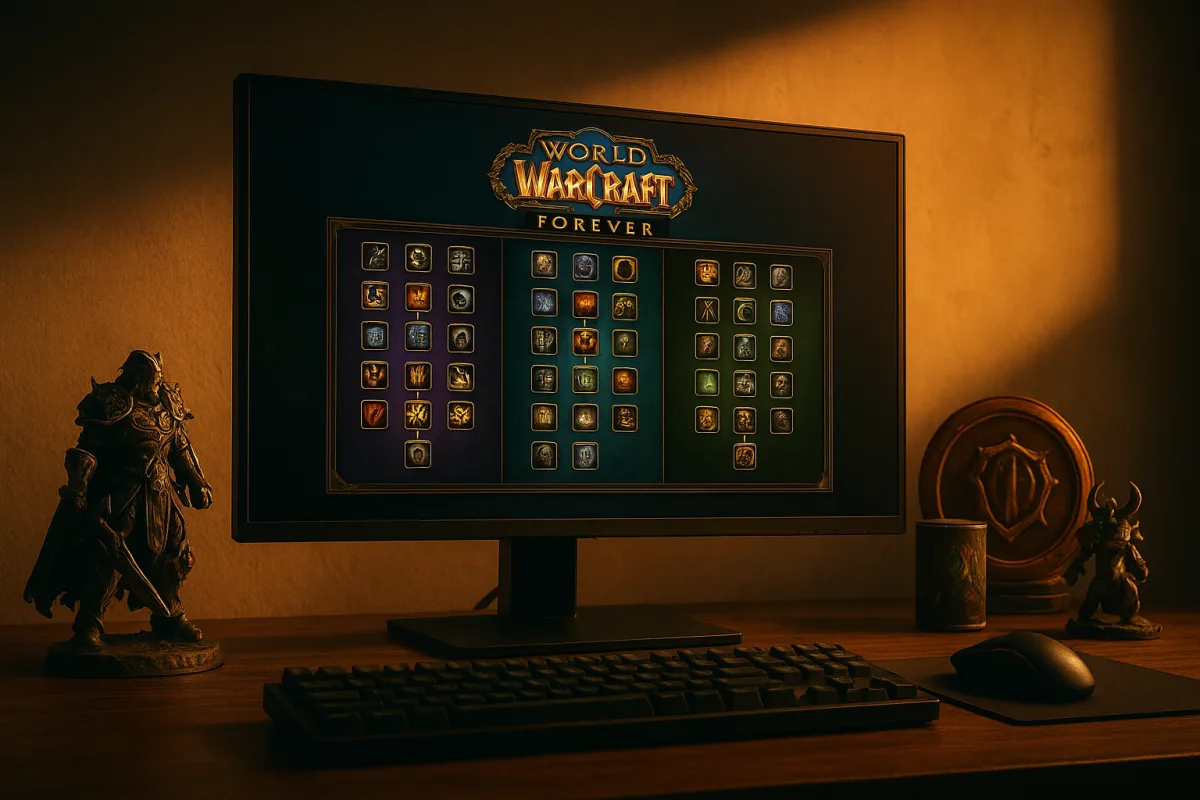
WoW Forever’s Legacy Talents Are an Account Power System, Not Just Faster Leveling
Legacy Talents are earned by the account, spent by the character
A conventional Classic character earns talent points as it levels. The familiar breakpoint is level 10, when a character gets its first point, then receives one point per level through level 60. That produces the classic maximum of 51 points.
Forever keeps that maximum. A level-60 character still cannot exceed 51 talent points, according to Blizzard Watch’s BlizzCon reporting and the available Talented perk description. [3][8] This is the first thing that gets lost when players hear “account-wide talent points.”
You are not building a level-60 warrior with a 52-point tree while everybody else remains trapped in vanilla arithmetic. The system changes when points arrive, not the final number available at maximum level.
Legacy Points are the currency or progression measure behind those account-wide unlocks. Blizzard Watch reports that players earn them by completing Legacy Challenges across characters, including progression tied to leveling, professions, PvP ranks, reputations, dungeons, raids, and seasonal objectives. [3]
That structure is Blizzard’s obvious attempt to make playing several characters feel productive. Reach a specified level on a hunter, develop trade skills, earn PvP rank, kill raid bosses, and your account progresses even if none of those activities happen on the same character.
The catch is equally obvious. An established player with a mature account can roll a new character carrying unlocks that a first-time player does not have. That is account progression by design, but it is also power progression when the reward affects talent timing.
What Talented actually changes
The Talented Legacy Perk moves the first talent point from level 10 to level 9. [8] That sounds comically small until you remember how Classic talent trees work.
Early talent points are not equal in value. A point invested at level 9 can be the first step toward a defining passive, a mana-efficiency talent, improved crowd control, or a damage modifier that makes a weak early rotation less miserable. A point at level 9 also means every later breakpoint arrives one level sooner.
Suppose a build needs 11 points in one tree before it can reach the next tier. Under the standard schedule, it reaches that threshold at level 20. With Talented, it can reach it at level 19. The same pattern follows throughout the leveling process.
That does not necessarily mean the veteran has a point lead at every level. The 51-point cap eventually catches the system. The practical model is a point pulled forward from the end of the leveling curve, not a permanently added point.
At level 9, a Talented character has one point and a standard character has none. At level 19, the Talented character can have 11 while the standard character has 10. By level 60, both must land at 51. [3][8]
That is why the alarmist version, “Legacy Talents permanently make veterans stronger,” is inaccurate. The more precise criticism is that they make veterans stronger during the part of the game Blizzard says it wants to protect: the journey through the world.
Why one level matters more in Forever than it would in retail
In retail World of Warcraft, leveling is mostly a guided sprint. One early passive is rarely the difference between winning a contested mob, surviving an accidental extra pull, or earning a battleground objective.
Forever is explicitly avoiding level scaling, according to GamesRadar’s report on the announcement. A creature’s level and strength remain fixed, while your character’s level, gear, preparation, and build determine whether you can handle it. [1]
That makes an early talent point real power. It can reduce downtime, improve a pet’s durability, increase a healer’s efficiency, or make a PvP crowd-control chain more reliable. A one-level breakpoint is not an automatic duel win, but it can shift the texture of a leveling zone.
The design is especially relevant because Blizzard is simultaneously making more aggressive class changes than Classic players are used to. BlizzCon floor footage examined by streamer Sodapoppin showed revised trees with new active abilities and altered baseline mechanics, including Hunter tools that can change the value of early tree access.
That does not prove every class benefits equally. In fact, it strongly suggests they will not. A class whose first few points are only minor percentage bonuses gains less from Talented than a class that reaches an important utility talent or damage conversion breakpoint a level sooner.
The real pressure point is bracket PvP
Endgame raiders can relax, at least about Talented specifically. The 51-point ceiling means no additional deep-tree capstone or hybrid build becomes possible at level 60 solely because an account has the perk. [3][8]
Low-level PvP is different. A level-19 or level-29 battleground character is not at the cap, so the early point is simply an extra point at that bracket. In a game with deliberately slow combat, limited healing, mana constraints, and meaningful crowd control, that can matter.
Imagine two equally geared level-19 players. The Legacy-enabled player may have access to an 11-point threshold talent or an extra rank of a core passive while the fresh-account player does not. That is a measurable build difference, not merely convenience.
Whether it becomes a serious problem depends on rules Blizzard has not fully nailed down publicly. If Legacy combat perks apply in battlegrounds, twink brackets become the natural place for players to optimize them. If Blizzard disables them in instanced PvP, the effect is largely contained to leveling and world PvP.
The available Legacy previews have already indicated that some perks are explicitly disabled in dungeons, raids, or battlegrounds. [3] That is encouraging, but it is not the same as confirmation that Talented itself is restricted there. Until Blizzard states that clearly, neither panic nor reassurance has much foundation.
The system has more than combat rewards
Talented gets attention because players can immediately imagine a level-19 rogue or warlock with an earlier breakpoint. But the broader Legacy system shown at BlizzCon also contains economic and convenience perks.
Blizzard Watch’s reporting describes bonuses affecting profession skill gains, scarce-material gathering, reputation progression, rested experience, flight-path costs, durability loss, and other account-wide benefits. [3] Those are not glamorous, but they will shape who gets ahead on a new realm.
A gathering-material bonus, for example, does not directly increase your Frostbolt damage. It increases the supply of valuable crafting inputs entering the economy through players who have already completed Legacy challenges. That can lower prices for buyers while concentrating early gold-making efficiency among veterans.
This is where Forever’s “world is the main character” line gets tested. Account progression can encourage people to revisit old content and use professions, which fits the pitch. It can also turn every activity into a checklist toward permanent efficiency, which is retail MMO behavior wearing a burlap Classic tunic.
The answer will come from costs and caps. If Legacy Points arrive steadily from ordinary play, the system can feel like a gentle account journal. If important combat nodes require a long pile of legacy chores, it becomes mandatory homework before players feel allowed to level seriously.
The new-player problem is real, but currently overstated
A Blizzard forum poster criticizing Forever’s design argues that forced optimal paths reduce real build choice. [9] That complaint overlaps with Legacy Talents, although not in the simplistic sense that Talented chooses your build for you.
Talented gives you an earlier point. The player still chooses where it goes. But whenever a system gives veterans an earlier breakpoint, the community rapidly identifies the best use of that breakpoint, especially in PvP brackets and hardcore leveling.
Then the social pressure begins. “Take this account perk, spend the point here, level in this zone, reroll if you did not unlock it.” Blizzard does not need to literally lock talent choices for an account-power system to narrow the perceived acceptable choices.
Still, the claim that a new player will be hopelessly behind at level 60 does not survive the 51-point cap. [3][8] The danger is more mundane: a new player may be behind during the first twenty or thirty levels, exactly when Forever is supposed to be its most approachable.
Blizzard’s own designers told IGN that a level-one character begins with one ability and learns the game gradually. That is good onboarding. Telling that same player, silently, that nearby veteran alts received their defining talent a level earlier is less elegant.
Beta should answer the questions that previews cannot
The PC Gamer beta guide says the World of Warcraft Forever beta begins September 17, runs until October 21, and initially caps characters at level 20 before raising the cap to 30 roughly two weeks later. [6] That is nearly perfect timing for testing Talented’s real leveling impact.
The beta is available through the $59.99 Skyborne Epic Pack or $79.99 Warcraft Forever Collection, while players can also opt into a chance-based beta selection. [6][7] The Epic Pack suits players who specifically want the beta, included game time, and cosmetics. The limited-time Collection suits players who also want Warcraft III: Reforged, the Forsaken Kingdom campaign, and extra housing items. [6][7]
The $29.99 Skyborne Heroic Pack is the cheaper fit for players who only want the Skyborne elves, Zephras Isle starting experience, early name reservation, and its cosmetics. It does not include beta access. [6][7] All three packages include extras beyond the base game, and Blizzard’s edition descriptions should be checked before purchase because early reporting around whether Skyborne access was paywalled has been inconsistent. [1][6]
For the system itself, testers should do boring comparisons rather than race to pronounce a meta. Level identical classes with and without Talented, record when each tree reaches meaningful tiers, and test whether the perk functions in duels, world PvP, and battlegrounds.
That testing should also account for Forever’s revised classes. A one-level earlier talent is modest when it unlocks a passive 1% bonus. It is much larger when it unlocks crowd control, sustain, mobility, or a new rotational button. The point is not universally strong. The breakpoint is.
Blizzard has positioned Forever as a version of Azeroth that can keep expanding without leaving the original game’s level range behind. [1][4] The Legacy system is therefore not a throwaway alt perk. It is a permanent rule about who arrives at each leveling milestone first.
If Blizzard keeps Talented as a modest pull-forward, prevents it from distorting bracket PvP, and makes the rest of Legacy progression broadly attainable, it could be a useful nudge toward alts and old-world activities. If it becomes required account homework before a player can compete in the leveling game, Forever will have recreated one of modern MMO design’s least charming habits.
Frequently Asked Questions
What are the class changes in World of Warcraft Forever?
World of Warcraft Forever rebuilds class trees from the original vanilla design, introducing new class tools and reworked talent trees. The system is not a direct replay of Classic but follows a different development path starting from the same 2004 launch point.
How does the Legacy Talent system work in WoW Forever?
The Legacy Talent system grants talent points account-wide through Legacy Points earned by completing challenges across any character, including leveling, professions, PvP, and raids. The Talented Legacy Perk allows characters to receive their first talent point at level 9 instead of level 10, effectively pulling talent points earlier during leveling without increasing the total points available at max level.
Does WoW Forever add extra talent points at level 60?
No, WoW Forever maintains the classic maximum of 51 talent points per character at level 60. The Legacy system shifts when talent points are earned during leveling but does not increase the total number of talent points a character can have at max level.
How do account-wide talents affect leveling in WoW Forever?
Account-wide talents let veteran players unlock talent points earlier during leveling, giving them access to key talents one level sooner than new players. This can provide a combat advantage in leveling and bracket PvP but does not create an overall talent point lead at max level.
What impact do Legacy Talents have on PvP and leveling?
Legacy Talents are most impactful during leveling and bracket PvP by allowing players with a mature account to reach important talent breakpoints earlier. This advantage can make the first leveling experience on a fresh realm more challenging for new players who lack the account-wide unlocks.
How we researched this
This article was assembled from 5 video sources across 3 channels, 3 published articles, 10 cited references.
Nothing here is based on hands-on testing. Where a figure or finding appears, it belongs to the source cited beside it, and the writing says so rather than implying otherwise. Every source is listed below so you can check it.
Sources
The New Warlock Class in WoW Forever Looks BROKEN! — Sodapoppin
WoW Forever's NEW Legacy Talent System Is INSANE! — Sodapoppin
World of Warcraft Forever Is WoW “At Its Best” - Blizzcon 2026 — IGN
Hunter Gets Some Big Changes in WoW Forever — Sodapoppin
WTF Is World of Warcraft: Forever? — Force Gaming
Pokémon Content Creator Gets Dragged After Opening Possibly Stolen Cards — Kotaku
Troll Warlock in WoW: Forever — The New Race and Class Combo
A first look at World of Warcraft: Forever's Legacy system from BlizzCon
WoW: Forever "Talented" Legacy Perk: Talent Points From Level 9
Watch World of Warcraft Forever: Features and Class Changes on Youtube
Also from the sources
Related Articles
Diablo 5 Procedural Generation and Diablo 4 Updates
Learn about Diablo 5's procedural generation, caravan system, class updates, and Diablo 4's upcoming Season of Hell and Switch 2 release.
The Blood of Dawnwalker Gameplay Mechanics and Time Limit
Explore The Blood of Dawnwalker gameplay mechanics, including its unique 30-day time limit and PC performance insights.

Tomb Raider Legacy of Atlantis Remake Preview and Criticism
Preview and critique of Tomb Raider Legacy of Atlantis remake, focusing on gameplay, scanner use, and PC specs.
Blizzard Upcoming Games 2026
Discover Blizzard's upcoming games in 2026 including Diablo 5, StarCraft open-world shooter, and Overwatch's new hero Doctrine with release dates and