
The Blood of Dawnwalker Gameplay Mechanics and Time Limit
Explore The Blood of Dawnwalker gameplay mechanics, including its unique 30-day time limit and PC performance insights.
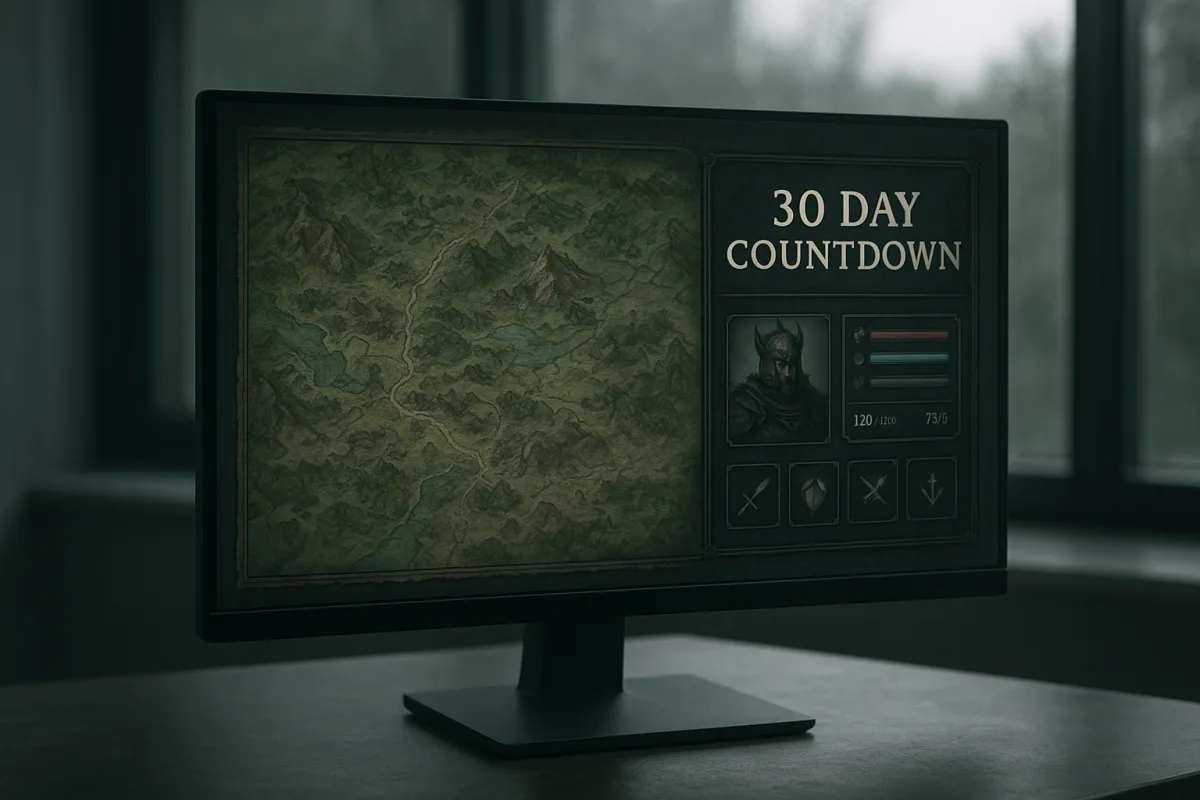
The shift is real: open worlds are starting to make omission part of the point
The Blood of Dawnwalker’s most interesting contribution is not that it has vampires, sword trees, or another grim fantasy province full of armed men guarding inconveniently placed chests. It makes time a finite build resource.
After its prologue, Rebel Wolves gives protagonist Coen 30 in-game days to rescue his family. Each day and night contains eight time segments, producing 480 segments in total, and selected actions consume them. [5]
That sounds like a standard doomsday clock until you look at where the game does not apply it. Walking around, scouting terrain, fighting, and generally poking into dark corners do not advance time by themselves. [5]
That distinction is why the system has landed differently from a simple countdown. GamingBolt’s analysis identifies the same thing: the limit curbs exhaustive checklist play, rather than forcing players to sprint through every field and cave. [3]
IGN’s starter guidance reaches the same practical conclusion from another angle. Quest objectives display hourglass icons before they spend time, while shrines let players fast-travel, store gear, spend points, and, if necessary, deliberately pass time. [4]
The mechanical result is more severe than the publisher-friendly phrase “meaningful choices” suggests. A player cannot simply clear every marker, buy every efficient skill, save every stranger, and still expect the most complete ending route.
That matters because plenty of open-world RPGs sell consequence through dialogue, then quietly let players vacuum up every side quest before the final mission. Dawnwalker puts consequence earlier, at the moment you choose what deserves an afternoon.
What the timer actually changes in a match-sized slice of play
The cleanest way to understand the system is to stop thinking in calendar days and start thinking in action economy. Every quest step marked with an hourglass competes with progression, relationships, court targets, and future access. [4]
IGN calculates the 30-day structure as 480 available segments, but the important detail is that quests can consume several separate chunks. The listed cost for a first step is not necessarily the final cost of following that thread. [4]
Even levelling can carry an hourglass cost for some abilities. That turns a familiar RPG habit, spending points the moment they arrive, into a planning decision: a skill point is no longer the whole price. [2]
This quietly nerfs broad “do everything” character plans. A player investing in sword mastery, witchcraft, vampirism, manuals, corruption gates, medium armour access, and every convenient side activity is paying with more than XP and gold.
It also buffs focused routes. IGN’s early-build guide recommends treating Haste and Shapeshift as the effective mount system, one for daytime human travel and one for nighttime vampire travel, because there is no conventional mount. [2]
That is not merely quality-of-life advice. Faster movement does not directly refund spent time segments, since exploration is not on the clock, but it cuts real-world friction and helps players reach opportunities before committing to timed objectives.
The skill trees reinforce that split. Witchcraft is daytime-only, vampirism is nighttime-only, and sword mastery functions in both states, though several abilities require a weapon rather than Coen’s claws. [2]
Rebel Wolves director Konrad Tomaszkiewicz called the day and night design “almost two different games,” an expensive choice the studio believed was worth making because it was distinct. [9] The skill restrictions make that claim mechanically credible.
A daytime witchcraft route can lean into harvesting, crafting, merchant effects, and health-spending spells. A nighttime vampire route uses blood for healing and corruption-based ability gates, while sword skills remain the stable all-hours investment. [1][2]
There are balance consequences here that sound small in a guide but get large over a playthrough. IGN notes that Ravenous Flock requires two activation charges and costs 40% of current health, a very deliberate early-game tax. [1]
That means the obvious “area damage solves groups” plan is not free. It pushes players toward Sustained Focus for extra charges, health management, and perhaps Soul Reaping, which IGN recommends because food heals poorly during combat. [1][2]
Meanwhile, corruption makes vampirism progression partly behavior-driven. Feeding through Voracious Bite fills the meter and raises corruption at thresholds, so a player regularly using vampire healing accelerates access to stronger vampire skills. [1][2]
The game is therefore not just asking whether Coen is merciful or ruthless in a dialogue scene. It is asking whether your survival loop and travel preferences naturally produce the build you think you want.
The sales evidence says interest is high, not that every claim is settled
The commercial signal is strong, with an important caveat about precision. Gadgets360 reported more than one million copies sold in two days, while The FPS Review described Rebel Wolves celebrating that milestone within the first day. [1][2]
Those reports agree on the meaningful part, which is that the game crossed one million very quickly after its September 3, 2026 launch. They disagree on timing, so “within the first couple of days” is safer than repeating either version as settled fact.
The launch price was $69.99, according to PC Central. [3] That makes the sales result notable for a new RPG property, but it does not permit a confident revenue estimate.
No official first-month revenue figure has been disclosed, and there is no public sales split for PC, PlayStation 5, or Xbox Series X and S. Multiplying a million units by $69.99 would be bad reporting, not financial analysis.
Discounts, regional pricing, retailer shares, platform fees, refunds, taxes, and edition mix all intervene before a headline sale becomes publisher revenue. The exact number is unknown, and the available reporting does not change that.
Still, rapid sales explain why the design conversation has escaped the usual review-week bubble. A system that asks players to accept missed content has reached enough people to generate guides, debates, performance fixes, and targeted mods almost immediately.
GamesRadar reported “Mostly Positive” Steam reviews, alongside praise comparing the game’s appeal to elements associated with The Witcher and Vampire: The Masquerade, Bloodlines. [4] That is useful reception evidence, though not a comprehensive sentiment survey.
The mod scene is the more revealing reception metric
The biggest early mod is also the clearest evidence of friction. PC Gamer reported that Better Story Timer has exceeded 13,000 downloads, extending the limit from 30 days to 90 and increasing daily segments from eight to 32. [6]
That is not a modest interface tweak. It effectively converts the 480-segment campaign structure into a much roomier schedule, preserving the game’s framework while heavily reducing the opportunity cost that makes it distinctive.
Community panic goes too far when it treats that download count as proof that the core system has failed. A timer-extension mod is exactly what players will install when a game deliberately refuses their preferred completionist rhythm.
Publisher framing goes too far in the other direction when it assumes resistance is simply a failure to understand the artistic intent. Accessibility, anxiety around permanent missables, and limited replay time are practical objections, not player illiteracy.
The useful read is that Dawnwalker has found a sharp design boundary. Some players value the forced trade-offs because they create replayable, imperfect stories. Others want to explore a premium-priced RPG without feeling punished for curiosity.
The broader mod ecosystem is small but active rather than mature. DawnwalkerTips counted 74 Nexus Mods entries, including performance fixes, quality-of-life changes, gameplay balance work, ReShade presets, localisations, and tools. [7]
CurseForge listed 14 projects, including overtly powerful gameplay additions such as MH God Sword and MH God Armor. [8] That is the familiar first-wave pattern: fix rough edges, widen player choice, then let somebody make an absurd weapon.
Modding is also doing work that patches should not be asked to replace. Balance preferences are healthy territory for mods. Stutter, crashes, broken shader compilation, and unstable frame pacing are not, especially at a $69.99 entry price. [3][10][11]
PC performance is the constraint on the trend
The technical reception complicates every celebration of the game’s systems. GamesRadar, Tom’s Guide, and community-maintained launch guidance all describe reports of stuttering, crashes, texture pop-in, and uneven frame pacing. [4][10][11]
Dawnwalker Wiki’s listed minimum specification is an Intel Core i5-11400F or Ryzen 7 2700X, 16GB of RAM, and a GTX 1060 or RX 580 with 6GB VRAM, plus a 60GB SSD. [12]
Its recommended specification rises to an Intel Core i7-11700K or Ryzen 7 5700X and an RTX 4060 or RX 7600 XT with 8GB VRAM, while retaining 16GB RAM and a 60GB SSD requirement. [12]
Those figures describe the target hardware, not guaranteed smoothness. Reports of issues even on recommended-class systems are why prospective PC players should distinguish “the game launches” from “the game presently delivers stable frame pacing.” [10][11]
Rebel Wolves has acknowledged problems, offered temporary workarounds including fullscreen mode and BIOS updates, and promised further patches. [4][10] As of the available early-September reporting, there is no evidence that a permanent fix has landed.
That puts the studio’s patch cadence under a harsher spotlight than usual. Dawnwalker’s timer asks players to trust its rules and accept irreversible outcomes. Technical instability makes that ask feel less like authored tension and more like avoidable risk.
What developers should borrow, and what they should not
For teams planning their own open-world RPG, the lesson is not “add a 30-day timer.” A naked countdown is a blunt instrument, and players have spent years learning that timed quests often exist to manufacture stress.
The transferable lesson is to make a scarce resource produce different stories, not merely fewer activities. Dawnwalker’s strongest move is allowing free exploration while charging time for commitments, so curiosity remains safe even when completionism is not. [5]
The second lesson is to surface costs before the player locks in. The hourglass icon, stated time segments, shrine functions, quest warnings, and court progress structure give players enough information to own their choices. [1][4]
Opaque fail states would have killed the idea. If a player loses a companion route because a quest silently expired during ordinary wandering, that is not tension. It is a wiki dependency wearing a dramatic cloak.
Build systems should also reflect the same trade-offs. Dawnwalker’s manuals, corruption requirements, activation charges, health-cost spells, armour proficiency, and day-night skill availability stop the timer from being an isolated campaign gimmick. [1][2]
Expect the meta to move slowly in games built this way. Players first optimise safety, then build routing knowledge, then decide whether they enjoy the intended pressure. The Better Story Timer mod shows that the negotiation has already begun. [6]
Finally, do not copy the tension while underfunding the technical layer. A game asking for repeat runs, risky choices, and strict resource accounting needs dependable saves, transparent state changes, stable performance, and quick patch communication.
The evidence suggests The Blood of Dawnwalker has created a useful argument about open worlds, rather than settled one. Its sales show attention, its mods show resistance, and its performance problems show how quickly a strong system can lose goodwill.
Frequently Asked Questions
How does the 30-day time limit affect gameplay in The Blood of Dawnwalker?
The 30-day time limit divides each day and night into eight segments, totaling 480 segments that advance only through quest-related actions. Exploration, combat, and roaming do not consume time, allowing players to freely explore without penalty. This system limits completionism by forcing players to prioritize which quests and activities to spend their limited time on, making choices more meaningful.
What are the key gameplay mechanics in The Blood of Dawnwalker?
Key mechanics include a unique time management system where quests and certain actions consume discrete time segments, while exploration and combat do not. Players must manage their action economy carefully, as even leveling up some abilities can cost time. The game also features a day and night cycle that influences gameplay, and a branching quest system with consequences tied to time spent.
How does the day and night cycle impact character abilities in The Blood of Dawnwalker?
The day and night cycle creates almost two different gameplay experiences, affecting how players approach exploration and combat. While the article and research brief highlight the cycle as a significant design element, specific impacts on character abilities are not detailed in the provided material.
What should PC players know about performance issues in The Blood of Dawnwalker?
PC players should be aware that the game currently experiences stuttering, crashes (including shader compilation failures), texture pop-in, and inconsistent frame pacing, even on recommended hardware. These issues have affected player experience, and it is advised to wait for patch notes or hotfixes before purchasing if performance is a concern. The developer is actively working on fixes and has released some early hotfixes.
How does The Blood of Dawnwalker limit completionism with its time system?
The time system restricts players from completing every quest and collecting every skill by imposing a finite number of time segments that quests and leveling consume. Players must make strategic decisions about which objectives to pursue, as spending time on one activity means less time for others. This design shifts consequence from dialogue choices to the moment players decide how to allocate their limited in-game time.
How we researched this
This article was assembled from 4 video sources across 2 channels, 8 published articles, 12 cited references.
Nothing here is based on hands-on testing. Where a figure or finding appears, it belongs to the source cited beside it, and the writing says so rather than implying otherwise. Every source is listed below so you can check it.
Sources
The Blood of Dawnwalker: 10 Things You NEED to Do First — IGN
The Blood of Dawnwalker - Early Game Skill Tree Guide | Best Early Skills — IGN
The Blood of Dawnwalker Has Solved One of Open World RPGs' BIGGEST Problems — GamingBolt
The Blood of Dawnwalker: 8 Things You Need to Know Before Starting — IGN
Deliver packages in foresty mountains and avoid thieving boars in the Death Stranding-adjacent and quite calm-looking Pinetrail — Rock Paper Shotgun
GTA Cheat Codes Taught a Generation How Much Fun It Is to Break a Video Game — Polygon
Dutch artist responds to the White House's Build the Wall game with Build that Bridge — Eurogamer
Insomniac Clears the Air After Marvel's Wolverine Fans Confuse Lady Deathstrike for Psylocke — IGN
Former Old School RuneScape Developer Sentenced For Stealing In-Game Gold From Players — Kotaku
Double Fine's first game post-Xbox split is a goofy bus driving sim all about slapping passengers who don't follow the rules and doing a good job — Rock Paper Shotgun
8 Years Later, the Most-Near-Perfect Mystery Thriller of the Century is Officially Free on Streaming — Polygon
The Blood of Dawnwalker Sells 1 Million Copies in Just 2 Days of Launch | Technology News
The Blood of Dawnwalker Sets September 2026 Launch Date at $69.99
The Blood of Dawnwalker Mods, Nexus Mods and Trainers: What Exists So Far
The Blood of Dawnwalker PC Requirements & Fixes | Dawnwalker Wiki
Watch The Blood of Dawnwalker: Innovative Open-World RPG and Its Reception on Youtube
Also from the sources
Related Articles

The Blood of Dawnwalker RPG Reception and PC Requirements
Explore The Blood of Dawnwalker RPG reception, edition differences, 30-day time limit, and recommended PC specs for the upcoming vampire RPG.
Control Resonant Gameplay and Graphics Review Deep Dive
Explore Control Resonant gameplay, Gravity Shift mechanics, graphics settings, and edition comparisons for an optimized PC gaming experience.

Wardogs Early Access Preview: Tactical FPS and Cash Economy
Explore Wardogs Early Access preview covering its tactical FPS gameplay, cash economy, roles, PC requirements, and known launch issues.

GTA 6 Extended Gameplay Features and Relationship System
Explore GTA 6 extended gameplay features, including the relationship system, map size, and performance insights for PC and consoles.