
Wardogs Launch Impact: Sales, Players, and Server Challenges
Explore the Wardogs launch impact with sales, player peaks, and server issues shaping this multiplayer shooter’s early success.
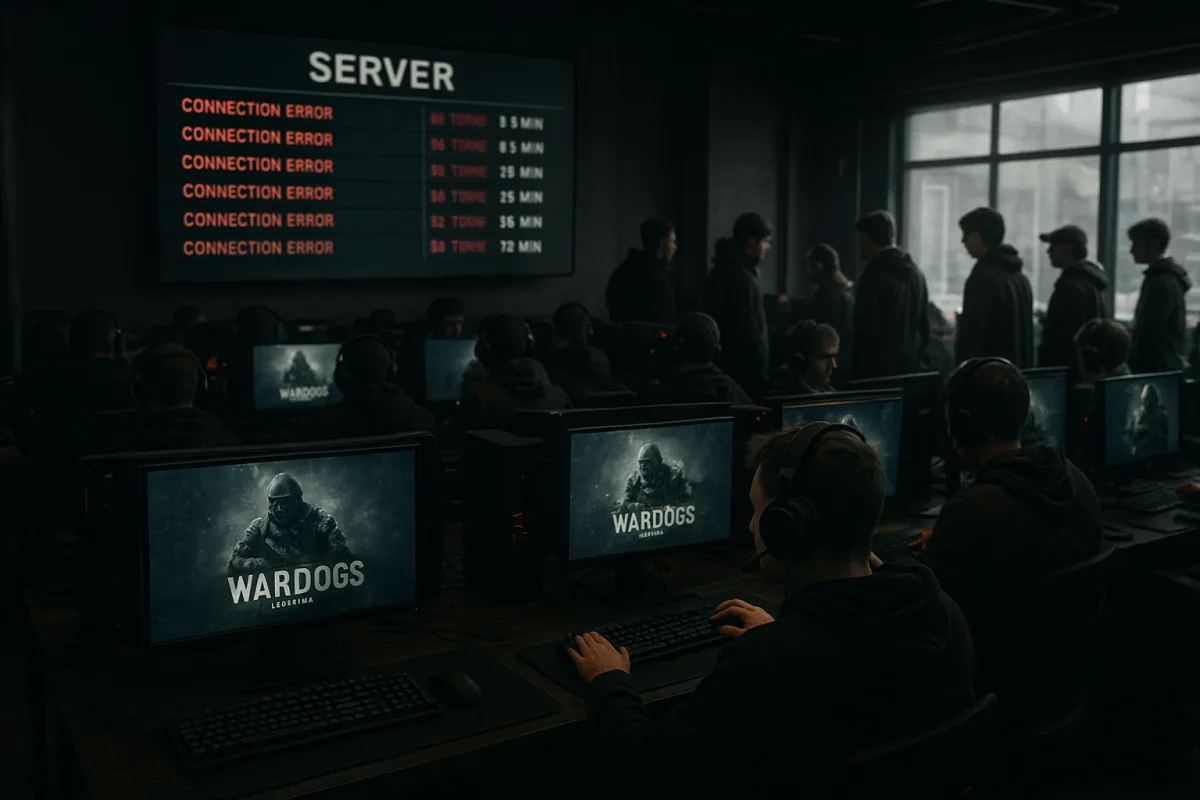
The shift is real: players are not done with big multiplayer shooters
Wardogs has changed the immediate conversation around multiplayer FPS games. After a run of shooters struggling to hold players, Bulkhead’s early-access tactical shooter arrived on Steam on 10 September with enough demand to overwhelm its own launch systems.
The hard evidence is not just one flattering Steam chart. Bulkhead said Wardogs sold 1.25 million copies in its first 24 hours, while third-party Steam tracking recorded a 340,171 concurrent-player peak. [1][2]
Those are different measures, and both matter. Sales show people committed money, while concurrent users show a startling proportion were trying to play at the same time rather than merely buying into launch-week curiosity.
The sensible reading is not that Wardogs has permanently won the shooter market. It is that a PC-first, early-access tactical shooter can still cut through when much of the genre has been teaching players to expect either extraction fatigue or another battle pass.
PC Gamer framed Wardogs as a rare bright spot after weak or short-lived launches for Highguard, Last Flag and Empulse, plus Marathon’s more muted performance relative to its publisher’s likely expectations. [1] That contrast is why Wardogs’ numbers landed so loudly.
Capcom’s Onimusha: Way of the Sword reportedly also cleared one million day-one sales, but its 85,081 Steam concurrent peak was far below Wardogs’ roughly 340,000. [2] That comparison does not establish quality, but it does show unusually concentrated PC engagement.
There is a caution attached to every one of these numbers. Verified public sales data stops at 1.25 million copies in the first 24 hours. There is no official updated total as of 13 September, so claims that Wardogs has sold several million copies are speculation.
Wardogs sold a match story, not just a genre pitch
Wardogs’ strongest design choice is that it gives players a reason to need strangers. Its 100-player, three-team battles combine infantry fights, helicopters, vehicles, forward bases, destructible terrain and rotating hot zones, but the economy is the connective tissue. [1]
Players can spend in-match cash on transport, gear and support, then reward other players for services. That turns the helicopter pilot, medic, base builder and supply runner from background jobs into people whose contribution has a visible price.
That sounds dry in a feature list. In a match, it changes behaviour. A player who normally treats a public lobby as a deathmatch now has a reason to wait for a helicopter, defend a base builder, or revive somebody useful.
StoneMountain64’s Wardogs stream shows the less glamorous version of that loop. He found that choosing the weaker blue team created a reliable passenger supply for helicopter transport, while more organised teams had several pilots competing to pick up the same players.
That is an economy finding, not merely a funny lobby anecdote. If one side has more competent pilots, the transport role becomes less profitable and less influential, while the undermanned faction quietly gets an incentive for experienced players to fill its logistics gap.
The same stream also shows how quickly players identified the air-game progression. Armed helicopters become available after a team reaches 20 points, so early match decisions matter: transport and setup first, then the lobby begins producing real anti-air and air-support pressure.
That creates a familiar multiplayer pacing curve, but it is not quite Battlefield’s. The opening is an economy and construction phase, the middle becomes a fight over established positions, and the late match rewards teams that have protected the people generating mobility and supplies.
DrDisRespect’s Wardogs footage lands on the other half of the equation: readable chaos. Helicopter insertions, missed parachutes, impromptu pushes and a crowded hot zone are easy to understand even when the players are absolutely not operating with military precision.
That accessibility matters more than the “tactical” label. Players do not need a regular squad, a spreadsheet, or an hour of drills before they can contribute something memorable. They can fly, ride, build, revive, raid a forward base, or simply make a dangerous drop.
Why this happened now
Bulkhead did not market Wardogs as a guaranteed forever-game. According to Eurogamer’s launch reporting, the studio repeatedly explained what the game was and was not, even publishing a “10 Reasons NOT to Buy” trailer before early access.
That is a sharper strategy than it first appears. After years of roadmap promises and live-service relaunches, narrowing expectations is not anti-marketing. It filters out buyers looking for a polished, fully featured military simulator on day one.
It also gives early access a clearer job. Wardogs launched as a game with a compelling core loop, obvious rough edges and a large audience ready to stress every system simultaneously. That is more honest than calling a beta a full launch.
The August playtest had already attracted around half a million players, according to PC Gamer. [1] That gave Bulkhead a demand signal, but the release still exceeded its practical capacity, which is exactly where a successful beta can become misleading.
A large test tells you people are interested. It does not necessarily tell you how many will log in during the same hour, hammer the server browser, party together, browse multiple regions, reconnect after a crash and flood support channels.
Wardogs also benefited from a specific market opening. Players who want large combined-arms fights have options, but few recent games have offered Battlefield-style immediacy, ArmA-adjacent scale and a player-driven economy without asking them to inhabit a punishing simulation first. [1]
That does not mean the game has discovered a secret genre that competitors cannot copy. It means Wardogs combined familiar parts in a way that produces stories fast, which is still the most reliable fuel for streaming, clips and word of mouth.
The launch did not break Steam, it broke under Steam demand
“Wardogs broke Steam” is a good headline and a bad diagnosis. Steam did not stop functioning. Wardogs experienced login queues, join errors, server-browser trouble and overloaded match capacity as hundreds of thousands of players arrived together. [3]
LevelCapGaming’s launch coverage recorded queues in the hundreds of thousands and developer updates about capacity work with Valve. Shroud’s stream caught the player-side experience, including servers emptying after kicks, broken XP progression and long attempts to enter a functioning match.
Bulkhead deployed Launch Stability Hotfix #1 at 20:20 UTC on launch day. The patch targeted join failures, mid-match kicks and long login queues, required a restart, and introduced controlled batch admissions rather than letting everybody stampede into servers at once.
That was necessary triage, not proof the problem was solved. Bulkhead CEO Joe Brammer acknowledged the disruption publicly, and the available information does not document precise capacity upgrades or a complete backend fix after that first hotfix.
The community reaction was unusually divided because both sides had a point. Players stuck in queues or kicked from active games had every reason to leave negative reviews, while players who got into stable matches were finding a systems-heavy shooter they wanted to keep playing.
Shroud’s footage also raises a more avoidable launch concern: streamer whitelisting. He argued that preferential access makes more problems than it solves, and that is broadly right. If ordinary customers face a queue while promotional broadcasts are protected, trust takes immediate damage.
The publishers’ usual framing would call this “unprecedented demand.” It was that, but unprecedented demand is not a force of nature. It is the exact commercial outcome a multiplayer developer says it wants, and capacity planning has to treat it as plausible.
PC performance is part of the match balance
Wardogs’ technical issues are not limited to servers. Current player troubleshooting points to crashes and failed launches involving Easy Anti-Cheat conflicts with the Windows kernel driver inpoutx64.sys, corrupted files, overlays, old drivers and Windows update KB5121003. [4][5]
Some workarounds are practical, including updating drivers, disabling overlays or browser hardware acceleration, and checking game files. Others, such as uninstalling a Windows update, are more invasive and should be treated as temporary troubleshooting rather than a normal game requirement. [4][5]
The server browser has its own odd failure state: selecting multiple regions can return no servers, while picking a single region can restore the list. Voice chat can also fail mid-match, with players using the temporary scoreboard-plus-double-U reset workaround.
Those faults have competitive consequences. A player unable to hear a pilot, medic or squad leader is not merely losing atmosphere. In Wardogs, they are losing access to the coordination that makes the cash economy, base assaults and hot-zone rotations work.
Hardware requirements are also high enough to shape the playable population. Bulkhead’s minimum target is roughly 60 fps at 1080p Low with an Intel Core i5-8600 or Ryzen 5 3500, 16GB RAM and a GTX 1660 or RX 590. [6]
The recommended target is 70-plus fps at 1440p Medium using an Intel Core i7-12700K or Ryzen 7 5700X, 16GB RAM and an RTX 3070 or RX 6700 XT. The game needs about 50GB of storage and is Windows-only at launch. [6]
That does not make Wardogs unusually extravagant by 2026 standards, but it is demanding for a game built around spotting infantry, tracking aircraft and reacting to destruction. Low frame rates are not cosmetic when helicopters and fortifications determine who controls space.
StoneMountain64’s decision to lower shadows for visibility is a small but revealing example. Players will quickly strip settings that obscure enemies or destabilise performance, and that means developers should expect the competitive visual meta to diverge from trailer settings within days.
What a multiplayer team should copy, and what it should not
The lesson for a developer planning its own project is not “make a 100-player tactical shooter.” Big maps, destructibility and vehicles multiply network, performance and moderation costs. Wardogs succeeded because its parts reinforce a shared match loop, not because the parts are individually new.
Copy the legibility. Players should understand within one round what a useful contribution looks like, whether that is driving, scouting, healing, building, piloting or providing ammunition. A role that only matters in a design document will be ignored in public matchmaking.
Copy the incentive structure, carefully. Wardogs’ cash system gives cooperation a personal payoff, but its launch streams already suggest optimisation will follow fast. Team selection, transport supply and XP rewards can create uneven incentives long before a formal meta guide appears.
Do not assume the current helicopter-heavy play is settled balance. Players are still learning anti-air counters, base layouts and air control. StoneMountain64 was identifying C-RAM positions, lock-on weapons and flare timing in real time, which is the definition of an immature meta.
The first meaningful Wardogs balance shift will probably arrive once organised squads standardise fortified bases and dedicated anti-air coverage. When that happens, solo helicopter farming and casual hot drops may weaken, while engineers, scouts and coordinated infantry quietly gain value.
That process normally takes weeks, not one weekend. First, players find the obvious strong tools. Then community groups build repeatable counters. Only after both sides have solid habits can Bulkhead tell whether a weapon, vehicle or reward system is genuinely overtuned.
Wardogs has earned attention, not a victory lap. Its first-day sales and concurrent player peak are exceptional, but its long-term test begins after queues shorten, novelty wears off and players decide whether the same messy stories still happen on an ordinary Tuesday night.
Frequently Asked Questions
How successful was the Wardogs launch on PC?
Wardogs sold 1.25 million copies within its first 24 hours and reached a peak of approximately 340,000 concurrent players on Steam. This level of engagement marked it as a commercial hit and a bright spot in a year where many multiplayer shooters struggled to attract and retain players.
What impact did Wardogs have on multiplayer shooters?
Wardogs demonstrated that players are still interested in large-scale tactical shooters when the game design encourages meaningful teamwork rather than just demanding it. Its success challenged the recent trend of multiplayer shooters facing player fatigue and showed that a PC-first, early-access tactical shooter can still generate significant player enthusiasm.
What server problems did Wardogs face at launch?
At launch, Wardogs experienced server queues, frequent kicks, crashes, voice chat failures, and long login queues that overwhelmed its infrastructure. Despite a hotfix aimed at stabilizing servers and controlling player admissions, many issues persisted, including problems with server browsing and voice communication during matches.
Why did Wardogs attract so many players at launch?
Wardogs attracted players by offering a unique 100-player, three-team battle format with an in-match economy that incentivized teamwork and diverse roles like helicopter pilots, medics, and base builders. This design gave players clear reasons to cooperate with strangers and created a dynamic gameplay loop that was accessible without requiring extensive prior coordination.
How does Wardogs' launch compare to other multiplayer FPS games?
Wardogs significantly outperformed recent tactical FPS launches such as Highguard, Last Flag, Empulse, and Marathon, which had weaker player counts and engagement. Even compared to Capcom’s Onimusha: Way of the Sword, which also sold over one million copies on day one, Wardogs had a much higher concurrent player peak on Steam, indicating unusually concentrated PC engagement.
How we researched this
This article was assembled from 5 video sources across 4 channels, 3 published articles, 6 cited references.
Nothing here is based on hands-on testing. Where a figure or finding appears, it belongs to the source cited beside it, and the writing says so rather than implying otherwise. Every source is listed below so you can check it.
Sources
🔴DR DISRESPECT - WARDOGS - THE GAME THAT BROKE STEAM — DrDisRespect
WARDOGS: A DrDisrespect Action Movie — DrDisRespect
WARDOGS BIG Money and LEARNING — StoneMountain64
The WARDOGS Launch Literally Broke Steam — LevelCapGaming
UK studio Bulkhead's Wardogs sells over a million copies and tops 350,000 concurrent players on launch day — Eurogamer
1.25 million copies sold, and a peak of 340,171 | WARDOGS Hub
WARDOGS Guide: How to Fix Crashing or Not Launching on PC | GAMES.GG
Watch Wardogs Launch and Impact on Youtube
Also from the sources
Related Articles

Wardogs Early Success and Gameplay Insights on PC
Explore Wardogs early success, launch player stats, gameplay mechanics, and PC system requirements in this detailed Early Access overview.
Wardogs Early Access Preview: Tactical FPS and Cash Economy
Explore Wardogs Early Access preview covering its tactical FPS gameplay, cash economy, roles, PC requirements, and known launch issues.
Halloween The Game Review: Editions, Gameplay, and PC Specs
Read our Halloween The Game review covering editions, gameplay impressions, PC specs, and early access issues before buying.
Wardogs Tactical FPS Gameplay Guide: Maps, Economy & Combat
Explore Wardogs tactical FPS gameplay, including maps, economy, combat, and base building strategies for PC players.