
Wardogs Early Success and Gameplay Insights on PC
Explore Wardogs early success, launch player stats, gameplay mechanics, and PC system requirements in this detailed Early Access overview.

The shift is real, but the useful metric is not the sales headline
Wardogs has moved from promising tactical-shooter curiosity to one of Steam’s active multiplayer events. More than one million copies sold on its September 10 Early Access debut is a serious commercial result, especially for a paid shooter entering a crowded PC FPS market. [1]
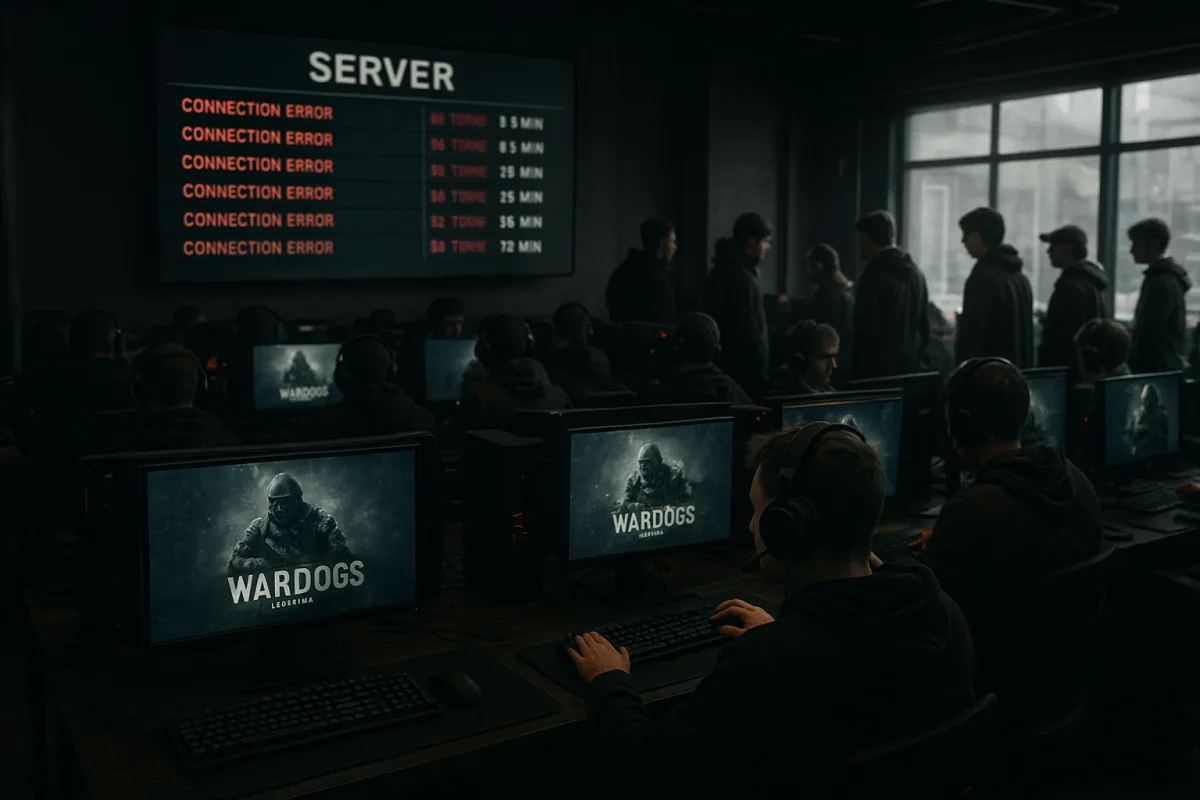
The more revealing number is concurrent play. PC Gamer reported that launch-day demand pushed Wardogs beyond 300,000 simultaneous Steam players, enough to contribute to server disruption as players attempted to enter at once. [2]
That figure is not hanging on a single outlet’s counter. AskTraders independently reported the million-copy launch result, while Techtroduce logged an earlier launch-stage concurrency milestone above 225,000, and WardogsHQ recorded a 245,118-player closed-beta peak on September 5. [1][3][4]
Those measurements describe different moments, not conflicting ones. The beta topped out at 245,118, early launch reporting caught 225,000-plus players online, and the eventual launch rush exceeded 300,000. The clean read is accelerating demand through the beta into release. [2][3][4]
That puts Wardogs well beyond the usual scale of the tactical combined-arms niche. WardogsHQ’s comparative figures list historical Steam peaks near 28,000 for Squad, 36,000 for Hell Let Loose, and 57,000 for Arma 3. [4]
It does not make Wardogs the new universal FPS king. Battlefield 6 reached 747,000 concurrent Steam players after release, a much higher benchmark, while Overwatch’s reported Steam resurgence reached 165,651 and Wuthering Waves reached 49,497. [5][6][7]
The point is not that every shooter must beat Battlefield. It is that Wardogs has clearly reached beyond the normal audience for slower, logistics-aware military sandboxes, without yet proving it can hold that broader audience once launch-week novelty expires.
There is no retention dataset in the supplied reporting, no comprehensive sentiment study, and no reliable post-launch player-decay curve. Anyone calling Wardogs permanently established after one day is getting ahead of the available evidence.
Why Wardogs is catching players who normally skip tactical shooters
Bulkhead’s pitch occupies a space that many FPS players recognize immediately: the scale and vehicle spectacle associated with Battlefield, plus the weight, transport, construction, and consequence usually reserved for more simulation-minded games.
Matches put 100 players across three teams into a moving King of the Hill fight. That third faction matters mechanically, because two teams can spend resources blunting each other while the third captures territory or builds a better route into the active zone. [4]
That structure makes the usual two-team front line less reliable. In a conventional conquest match, the enemy in front of you is normally the whole problem. In Wardogs, winning a firefight can leave your exhausted squad exposed to a fresh third-party push.
The roaming hot zone makes that even sharper. According to jackfrags’ practical guide, actions inside the highlighted area are worth double, meaning teams that identify the next rotation early can turn a support job into accelerated income and match leverage.
Wardogs also attaches actual purchasing power to roles that many FPS games treat as background chores. StoneMountain64 highlighted the persistent cash economy, where players buy each life’s weapons, ammunition, armor, gadgets, and sometimes vehicles, then lose that investment on death.
That changes what “winning a gunfight” means. A rifle kill is useful, but a helicopter pilot moving teammates, a player repairing a vehicle, or a scout spotting enemies can create income that keeps a whole squad equipped for the next push.
PC Gamer previously observed a helicopter pilot earn $35,000 in 40 minutes without scoring a kill during the alpha, as cited by StoneMountain64. That is the design thesis in one number: logistical contribution is not merely role-play.
The catch is that this can create an early economic gap. Shroud’s gameplay conversation identified the obvious risk: once a meaningful portion of the server has accumulated cash and equipment, poorer players can feel like they are feeding better-funded squads.
That is not community panic, it is a genuine economic design problem. It also is not solved simply by saying players should “play smarter,” because a cash advantage translates into optics, bags, smoke, ammunition, armour, transport, and more chances to recover loot.
Bulkhead appears to understand the issue. The Early Access plan includes seasonal resets that convert cash and XP progress into gold bars, while the developer says resets let newer players re-enter on more equal terms and enable progression overhauls. The cadence remains uncertain.
A monthly wipe would limit snowballing, but it would also reduce the satisfaction of building a large cash reserve. A longer season rewards investment, but makes the initial economy harder on late arrivals. That tension is core to Wardogs, not a minor tuning value.
The gameplay loop quietly buffs teamwork over pure aim
The early best practices are unusually clear because the systems reinforce one another. Jackfrags’ advice to carry ammunition stacks rather than overfilling a starter bag with magazines is less glamorous than a recoil chart, but it preserves inventory capacity and reduces needless spending.
At the vendor, players below level nine receive a 50 percent new-recruit discount, according to jackfrags. That is the moment to experiment with tools and weapons, not the moment to treat every respawn as an invitation to buy the maximum possible kit.
Weight is the first balance check on expensive shopping. Tactical sprint consumes stamina and can become unavailable when equipment is too heavy, so a fully loaded bag is not a free upgrade. It buys options while making rotations and escapes worse.
This quietly favors specialized squads. One player can carry medical tools, another ammunition and construction materials, and another optics or anti-vehicle equipment. A lone player bringing everything pays twice, first in cash and then in mobility.
The revive system reinforces the same behavior. Anyone can revive a teammate by hand, but jackfrags notes that the free, one-use emergency resuscitator revives much faster. Healing allies also generates cash, making the medic impulse economically sensible rather than charitable.
Recon has a similarly practical entry point. Binocular spotting grants XP and cash, with extra rewards when marked enemies are killed, and it progresses recon access toward stronger sniper equipment. That makes observation valuable even for players who cannot consistently win long-range duels.
The transport game is where Wardogs looks most likely to produce its repeatable stories. Shroud’s squad session shows players improvising rooftop pickups, vehicle breaches, damaged-truck escapes, base raids, and helicopter assaults, rather than simply funneling through a prescribed capture lane.
That chaos is not automatically good balance. Air power coordinated by a large voice group can dominate an unorganized server, as Shroud’s group openly noted while rolling opponents. The question for patches is whether counters are accessible before a team is already trapped.
Spawn vehicles are a useful example. Jackfrags points out that destroying their radar dish prevents spawning until repairs are made, even with gunfire if explosives are unavailable. That gives infantry a counterplay objective, but it also makes neglected vehicle security match-defining.
Players planning a project around these systems should notice the difference between “sandbox” and “anything goes.” Wardogs gets value from making each improvised action legible through money, XP, supply counts, spawn access, and objectives. The game pays players for understanding its machinery.
Early Access risks are visible in the patch notes, not hidden by the launch rush
Wardogs is not arriving as a content-complete, technically settled competitive shooter. Players have reported server queues, browser issues, crashes, inconsistent frame times, and high RAM or VRAM use carrying over from beta into Early Access. [10]
The listed specification sheet is modest enough to invite broad interest: a Core i5-8600 or Ryzen 5 3500, 16GB of RAM, and GTX 1660 or RX 590 at minimum, with 50GB of storage required. [8]
The recommended line asks for a Core i7-12700K or Ryzen 7 5700X and an RTX 3070 or RX 6700 XT, still with 16GB RAM. Those targets are stated for roughly 1440p medium at 70 fps, not a guarantee in every 100-player collapse. [8]
CPU performance deserves more attention than the GPU names suggest. Large player counts, destruction, vehicles, physics, and building all compound simulation load, and the Wardogs Wiki notes that the minimum target is 1080p low at about 60 fps. [8]
Use an SSD even though it is not listed as mandatory. That will not cure stutter caused by CPU, memory, or shader behavior, but it is the sensible baseline for a modern multiplayer game with large maps and repeated deployments.
The balance complaints are also specific enough to watch. AllThings.How identified disparities in Anti-Tank, Recon, and Support unlock paths, alongside voice-chat interruptions and early economy friction that can affect team composition and access to necessary counters. [9]
This is where Season 1 matters more than launch chatter. GfinityEsports’ changelog coverage says the patch addressed exploits, economy, performance, and XP adjustments, while AllThings.How likewise identifies Season 1 fixes touching the most visible Early Access pain points. [9][12]
Those changes will probably move the meta faster than a small weapon-damage tweak would. If an XP adjustment makes anti-tank tools arrive earlier, helicopters and armour become less safe. If economy rewards change, expensive smoke-heavy and vehicle-heavy loadouts become either routine or risky.
Do not assume the first popular build is the best build. Wardogs’ launch environment is still shaped by players discovering vendor costs, unlock routes, supply chains, and counters. The meta will take weeks of patch response and player adaptation to become recognizable.
What Wardogs means for PC FPS projects
The immediate lesson is not “make a giant map and add helicopters.” Plenty of shooters have scale, military equipment, and proximity chat. Wardogs’ early appeal comes from tying several familiar systems together so that more players can make a useful contribution.
A project aimed at this audience needs a role for the player who cannot or does not want to be the lobby’s best aimer. Spotting, reviving, delivering fuel, constructing defenses, repairing vehicles, driving spawns, and moving squads are all productive actions here.
It also needs visible consequences. A destroyed spawn radar, an open base gate, a fuel-starved forward operating base, or a mortar supplied by a logistics player creates problems teammates can understand and solve. That makes coordination teachable without a formal class lock.
The caution is that Wardogs has not demonstrated long-term content durability. Bulkhead has been candid about Early Access limits, while Shroud’s discussion raised modding and wipe cadence as possible answers to players exhausting official content or outgrowing the economy.
That is a better starting point than pretending launch content is infinite. A multiplayer project should plan its post-launch loops before selling the fantasy of persistent progression, particularly when that progression can turn into a power gap between regulars and newcomers.
Wardogs’ price also matters. The standard Early Access edition costs $39.99, while the Supporter Edition costs $49.99, and some players consider the entry price high relative to the currently available content. [11] A paid launch raises expectations for stability and update speed.
Finally, avoid treating a console port as part of the present success story. Bulkhead has said it intends to bring Wardogs to PS5 and Xbox Series X or S, but reporting finds no official date, console beta, cross-play commitment, or detailed feature roadmap. [13][14][15]
For now, Wardogs is a convincing demonstration that PC players will show up for a slower, more systemic FPS when the game gives them meaningful jobs between gunfights. Whether they stay depends on performance, progression fairness, counterplay, and patch discipline.
Frequently Asked Questions
How many players did Wardogs have at launch?
Wardogs sold over one million copies on its Steam Early Access launch day, September 10, 2026. Concurrent player numbers peaked at more than 300,000 simultaneous players on launch day, surpassing earlier closed beta peaks of around 245,000.
What factors contributed to Wardogs early success?
Wardogs attracted unusually high pre-launch interest and converted that into strong sales and player concurrency. The game’s appeal as a tactical combined-arms shooter with large-scale battles helped it reach a broader audience than typical military sandbox games. However, retention beyond launch novelty remains unproven.
What are key gameplay mechanics in Wardogs?
Wardogs features a three-team objective mode with roles such as pilots, builders, scouts, medics, and infantry. Players earn in-game cash through support play, which they use to buy loadouts and equipment, encouraging team-based strategy and progression.
What are the PC system requirements for Wardogs?
The minimum PC specs include Windows 10 64-bit, Intel Core i5-8600 or AMD Ryzen 5 3500, 16 GB RAM, NVIDIA GTX 1660 or AMD RX 590, and 50 GB storage. Recommended specs are Windows 11 64-bit, Intel Core i7-12700K or AMD Ryzen 7 5700X, 16 GB RAM, NVIDIA RTX 3070 or AMD RX 6700 XT, and 50 GB storage. These target roughly 60 fps at 1080p low settings and 70 fps at 1440p medium settings.
How does Wardogs economy and progression work in Early Access?
Players must fund their equipment and upgrades with in-game cash earned through gameplay, especially support roles. Early Access balance is still evolving, with developers addressing progression, economy, and exploits in Season 1 patches. Some players find early funding challenging, but guides exist to help optimize earnings.
How we researched this
This article was assembled from 4 video sources across 4 channels, 3 published articles, 15 cited references.
Nothing here is based on hands-on testing. Where a figure or finding appears, it belongs to the source cited beside it, and the writing says so rather than implying otherwise. Every source is listed below so you can check it.
Sources
WARDOGS Pro Tips and Tricks... — jackfrags
WARDOGS Has Lived Up To The Hype... — StoneMountain64
How To Win EVERY Wardogs Game — shroud
Does WARDOGS Look Potato Mode? Level With Me Ep. 151 — LevelCapGaming
A Brand-New Early Access FPS Is Topping the Steam Charts — Polygon
The iPhone Duo Might Be One of the First Foldables That's Good For Gaming — IGN
Everplay's Wardogs Tops One Million Sales on Steam Early Access Debut | AskTraders.com %
Wardogs servers go down as over 300,000 people rush to play on launch day | PC Gamer
WARDOGS Surpasses 225,000 Concurrent Players on Steam at Launch - Techtroduce
WARDOGS Early Access Pain Points and What Season 1 Already Fixed
Is WARDOGS on PS5, Xbox or Game Pass? Console and Crossplay Status
Watch Wardogs Early Success and Gameplay Insights on Youtube
Also from the sources
Related Articles
Wardogs Launch Impact: Sales, Players, and Server Challenges
Explore the Wardogs launch impact with sales, player peaks, and server issues shaping this multiplayer shooter’s early success.

Wardogs Early Access Preview: Tactical FPS and Cash Economy
Explore Wardogs Early Access preview covering its tactical FPS gameplay, cash economy, roles, PC requirements, and known launch issues.
Phantom Blade Zero PC Gameplay and Performance Guide
Explore Phantom Blade Zero PC gameplay, system requirements, and optimization tips to ensure smooth performance and master combat mechanics.

Wardogs Gameplay, Popularity, and Crunch Controversy
Explore Wardogs gameplay, its rise in popularity, helicopter mechanics, and the developer crunch controversy in this detailed PC gaming overview.