
Steam Next Fest 2026 AI Controversies in Indie Games
Explore Steam Next Fest 2026 AI controversies, demo risks, and Steam's AI disclosure rules affecting indie game developers.
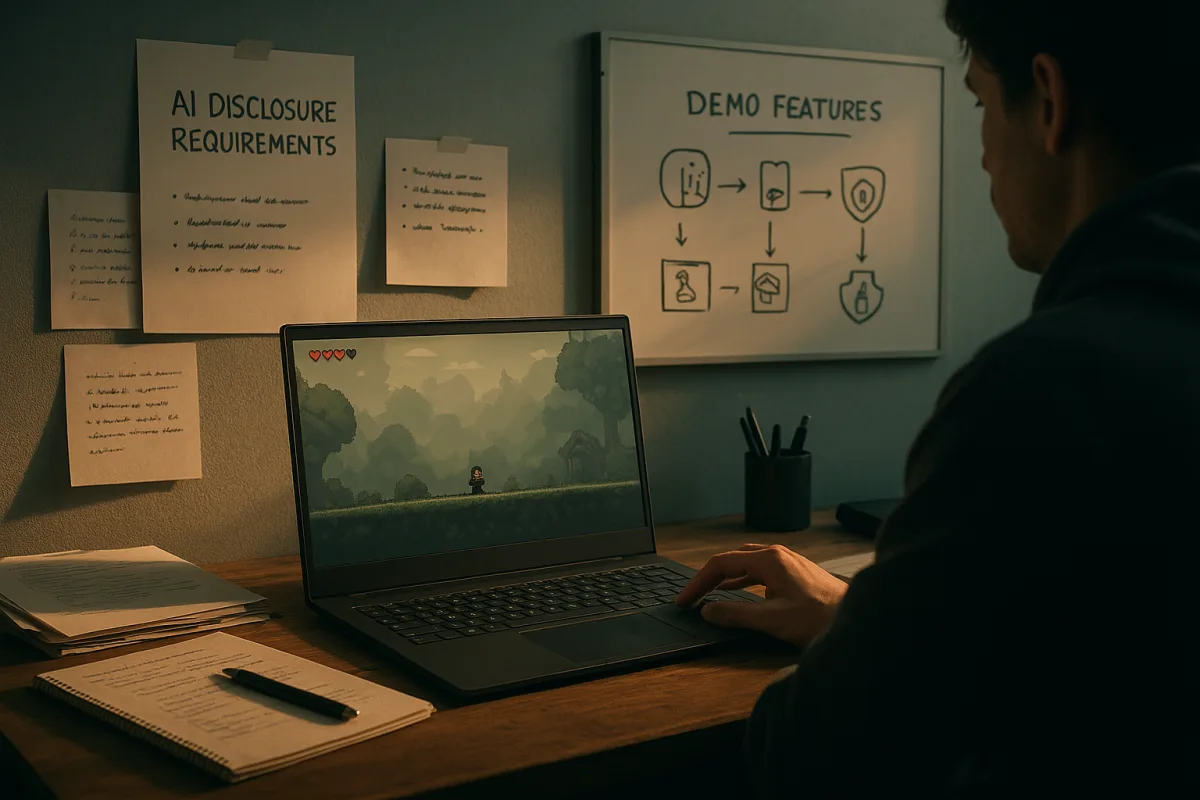
Steam Next Fest has become bigger, but not necessarily clearer
The shift is plain: Steam Next Fest is moving from a useful demo showcase toward a crowded, less predictable acquisition channel. More developers are shipping playable slices, while more developers are also asking whether publishing one creates a new risk.
The evidence is not a single angry social-media thread. Reports around the October 19 to 26 event describe developers limiting public access, players complaining about low-effort submissions, and third parties building tools specifically to monitor increasingly crowded Steam markets. [3][7][8]
That does not mean Next Fest is “ruined,” which is the usual community overcorrection whenever Steam gets harder to browse. It means the old advice, upload a demo and wait for the algorithm, is weaker than it was.
There is an immediate numbers problem, too. Eurogamer reported 8,202 demos, but independent research found Valve had not publicly released an exact 2026 demo count. Treat that figure as unverified rather than using it as a foundation for market analysis.
The absence matters because the size of the event determines what “expanded” actually means. Previous Next Fests had more than 1,000 demos, but no official total currently establishes how much larger October 2026 is than earlier editions.
Still, you do not need a clean denominator to see the directional change. Festival participants are talking less about merely qualifying for the event and more about how to survive the feed, convert a short burst of attention, and prevent imitation.
The demo is now both a pitch and an exposed build
For most indie teams, a Next Fest demo remains a sensible trade. Players get a low-friction trial, creators have something streamable, and the Steam page has a stronger reason to collect wishlists before launch.
That is the intended loop. A player sees a demo, understands the hook, follows the game, and returns at release. It is still a better conversion path than asking strangers to wishlist a trailer and a paragraph.
But a demo also reveals the game’s interaction loop, visual language, progression rhythm, and the specific moment likely to travel on social media. For conventional projects, that is marketing. For some projects, it is also a blueprint.
Alliance Arts pulled the planned October 19 public demo for Drunken Goddess Reflux, a horror drinking game developed with Who You, shortly before Next Fest. The publisher cited concerns over uncontrolled footage and AI-assisted imitation. [3][4]
The game had already accumulated more than 25,000 Steam wishlists, according to Polygon’s reporting, which makes this a particularly useful example. This was not an unknown team abandoning exposure because it had nothing to lose. [3]
Alliance Arts instead directed interested players toward controlled test sessions through the developer’s Discord. That is not a universal replacement for a public festival demo, but it shows the emerging protective playbook: narrower access, rules, and direct community management. [3][4]
The important qualification is that fear of clones is better documented than the actual scale of completed AI clones on Steam. No reliable 2026 dataset establishes how many clone games released, how many were genuine copies, or what Valve removed.
So do not make a production decision based on the fiction that every demo will be copied overnight. Make it based on your project’s exposure profile: how much of its value lies in a novel, easily replicated premise?
AI disclosure is more limited than players assume
Steam’s 2026 AI policy is often described as a label for “AI games,” which is not what the rules say. Valve asks developers to disclose generative AI used for player-visible material, including art, audio, text, and marketing assets. [1][2][11]
It does not require disclosure when generative tools are used only behind the scenes for development efficiency, such as coding support or debugging. That distinction is meaningful, especially for small teams using tools in ways players will never encounter. [1][2]
If a game generates content live during play, developers must also explain the safeguards intended to prevent inappropriate output. That is a sensible disclosure requirement, but it is primarily about user-facing safety and transparency, not plagiarism enforcement. [1][11]
Steam’s policy does not promise that a game with no AI disclosure was made without AI assistance. Nor does an AI disclosure tell you whether a developer used it for a placeholder texture, a central character portrait, or procedural dialogue.
That ambiguity feeds the current player distrust. A 2025 study of roughly 10,000 Steam games found AI-disclosed games received about 53 percent fewer reviews and lower average user scores, 84.6 percent versus 88.3 percent for non-disclosed titles. [5]
Those numbers deserve careful reading. They identify a serious stigma effect, but they do not prove that disclosure itself makes a game worse, or that every lower-reviewed game was rejected primarily because of its AI use.
There is also a business irony here. Developers may disclose visible generated material because Valve requires it, then suffer reputational damage for being transparent while undisclosed behind-the-scenes usage remains outside the label’s scope.
More AI-flagged releases do not equal more successful games
The broader release pipeline is clearly changing. One analysis of 53,597 Steam games found AI-flagged titles rose from 10.9 percent in 2024 to 30.8 percent in 2026, with AI-assisted games making up 60 to 90 percent of new monthly releases. [6]
That is enough volume to make browsing feel different, particularly during a demo festival where every page competes for the same finite player attention. It is also a credible explanation for the rising complaint that discovery has become more labor-intensive. [7]
It is not proof that AI-made games are conquering Steam commercially. The same research says 94 percent of revenue goes to the top 1 percent of titles regardless of AI use, which is a familiar winner-take-most storefront pattern. [6]
In balance-patch terms, this is not a buff to every developer using generative tools. It is a buff to release volume. The visible effect is more entries in the queue, while most of those entries still do not break through.
That matters for a Next Fest plan because players do not experience the storefront as a market-wide revenue chart. They experience it as a scrolling list of capsule art, trailers, demos, and tags, with limited time to investigate.
The meta therefore moves slowly for established games with strong wishlists, identifiable art direction, and a clear creator network. It moves quickly for new projects whose only differentiator is a familiar genre premise and polished-looking promotional images.
Valve has not supplied the anti-clone patch
Steam’s rules address disclosure, not clone prevention. Valve has not publicly introduced tools that identify AI-generated copies, protect a festival demo from extraction, or automatically enforce originality claims between competing Steam listings. [1][2]
That leaves developers assembling their own monitoring stack. Playmetric positions its dashboard as a way for indie developers to track Steam metrics, while Steamroll offers market and competitor analysis that can help identify suspiciously similar releases. [8][9]
Players are also filling the information gap. The AI Warning For Steam browser extension alerts users when a Steam game has disclosed generative AI use, based on information available on the store page. [10]
None of these tools establishes theft, and none should be treated as an accusation machine. A genre trend, shared mechanics, or similar screenshots are not proof of copying, especially in genres built from decades of common conventions.
They are early-warning tools, not moderation tools. If a developer finds a suspected copy, the useful response is documentation, timestamps, archived store pages, and legal advice where appropriate, not a public thread built on inference.
What an indie team should change before the next festival
First, decide what the demo is for. A ten-minute vertical slice designed to prove movement and combat is different from a prologue meant to sell atmosphere, and both are different from a stress test gathering systems feedback.
Then decide what information is strategically safe to reveal. If the game’s appeal is primarily execution, tone, and feel, a public demo likely helps. If it hinges on a hidden structure or exceptionally simple viral premise, consider gated testing.
Do not confuse secrecy with protection, though. Closed tests reduce exposure but also reduce streamer reach, player feedback, and festival momentum. They are a trade, not an automatic upgrade, and Alliance Arts’ choice reflects its circumstances rather than a template. [3][4]
Second, make the Steam page do more work before the demo goes live. The first screenshots, trailer opening, short description, tags, and capsule art need to identify the game quickly, because discovery pressure is increasing even if the exact demo count is unknown.
Third, build owned channels before the event. A Discord server, mailing list, creator contacts, and a regular development presence give players a route back to the project after Next Fest’s temporary front-page traffic fades.
Finally, be precise about AI use. If player-visible generative material is present, disclose it accurately under Steam’s rules. If it is not present, avoid vague “AI-free” claims unless the team can define and substantiate what that means. [1][2]
The useful planning assumption is not that generative AI has ended indie discovery, nor that the concern is imaginary. Steam Next Fest is becoming a more contested storefront moment, and a demo now needs a distribution plan, an exposure plan, and a clear reason to exist.
Frequently Asked Questions
What are the AI controversies surrounding Steam Next Fest 2026?
The main controversy involves fears that public demos can be easily copied or cloned using AI tools. Developers and players have reported concerns about low-effort AI-generated submissions flooding the event, as well as the risk of AI-assisted imitation of unique game concepts. This has led some developers to cancel or restrict demos to avoid exposing their work to cloning.
How does AI cloning affect indie developers at Steam Next Fest?
AI cloning creates a risk that indie developers’ game concepts and unique mechanics can be quickly copied and released by others, undermining their competitive advantage. This risk has caused some developers to cancel public demos or limit access to controlled tests, prioritizing protection over broad exposure.
What are Steam's AI disclosure requirements for games in 2026?
Steam requires developers to disclose any generative AI used for player-visible content such as art, audio, text, or marketing on the store page. AI used solely for coding or debugging does not require disclosure. If AI generates content live during gameplay, developers must explain safeguards to prevent inappropriate outputs.
Should indie developers release public demos at Steam Next Fest 2026?
Releasing a public demo can still be beneficial for exposure and wishlist conversion, but developers with easily copied concepts should carefully weigh the risks. Some choose to limit public demos in favor of closed tests or controlled sessions to protect their intellectual property from AI cloning.
How can indie developers protect their games from AI cloning during Steam Next Fest?
Developers can restrict demo access through closed tests or invite-only sessions, manage communities directly to control sharing, and use third-party tools like Playmetric or Steamroll to monitor for suspicious activity. Valve has not introduced official clone-detection or demo-protection systems, so proactive community measures are currently the main defense.
How we researched this
This article was assembled from 8 published articles, 12 cited references.
Nothing here is based on hands-on testing. Where a figure or finding appears, it belongs to the source cited beside it, and the writing says so rather than implying otherwise. Every source is listed below so you can check it.
Sources
Drunken Goddess Reflux Devs Cancel Steam Next Fest Demo Over AI Clone Concerns — Polygon
Video Game Decomp Hub Closes Due To AI: ‘The Community Aspect Of Decompilation Has Been Broken’ — Kotaku
D&D's New Arcana Unleashed Feats Are Breaking the Game, but There's an Easy Fix — Polygon
A Remaster Of The Best Shrek Game Ever Just Leaked — Polygon
Forza Horizon Is No Longer the King of Video Game Road Trips — Polygon
11 Years Later, Dragon Ball Super: Beerus Finally Nails Akira Toriyama's Original Vision — Polygon
Devs are canceling their demos to stop AI users from stealing their games
Playmetric - The All-in-One Dashboard for Indie Game Developers
This Browser Extension Will Clearly Warn You If A Steam Game Uses AI - GameSpot
Valve Changes AI Disclosure Guidelines on Steam for Game Developers | Technology News
Related Articles
Indie Games Highlights and Industry Events in 2026
Explore key indie games, demos, and industry events in 2026 with detailed highlights and release info for PC gamers.
October 2026 PC Game Releases and Sales Guide
Discover October 2026 PC game releases, early access, and Steam Autumn Sale dates to plan your gaming and save on top titles.
Gamescom 2026 Indie and Strategy Games Highlights
Explore key indie and strategy game highlights from Gamescom 2026, including gameplay, release info, and PC hardware insights.
Gamescom 2026 Theft Impact on Indie Developers and Security
Explore how Gamescom 2026 thefts affected indie developers and the event's security measures to protect exhibitor equipment.