
Wardogs Season 2 Updates
Explore Wardogs Season 2 updates including new weapons, rain effects, meta shifts, and community reactions to gameplay and progression changes.
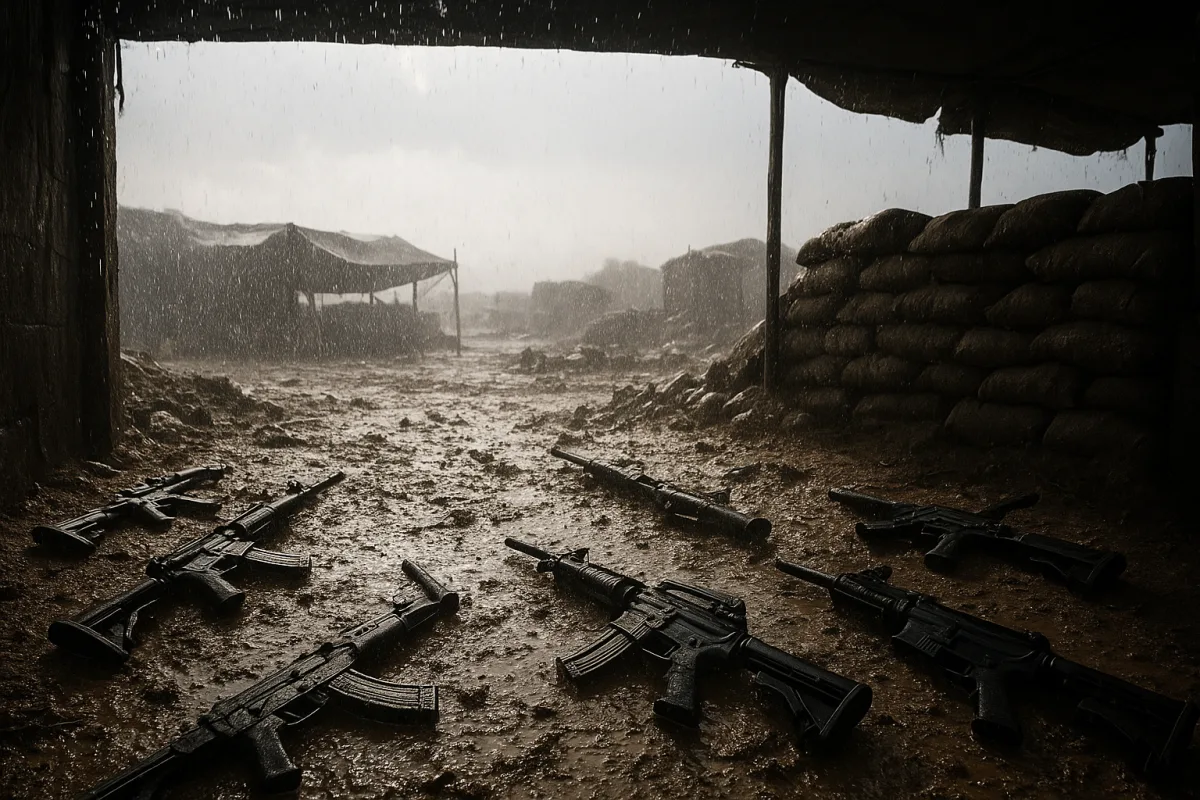
Wardogs Season 2 is pushing the game away from clear-sight infantry brawls and toward a messier combined-arms sandbox, where weather, logistics and progression decisions matter as much as raw aim.
Rain changes the match before it changes the frame rate
The headline shift is not the four new guns or the tank, although both will get more clips. It is rain. Wardogs has added a weather condition that breaks long sightlines, complicates aircraft insertion and makes the map soundscape less reliable. [8]
That is visible across independent player footage, not merely in Bulkhead’s framing. Jackfrags’ Season 2 session shows rain as a visibility and audio-layer change, while Shroud’s matches repeatedly turn into close-range searches around warehouses, roofs and bushes rather than clean ranged picks.
The common reaction was not, “rain looks nice.” It was, “where did that player go?” Shroud’s group repeatedly lost visual tracking at ranges where they would normally expect to beam targets, then ran into prone defenders and short-angle ambushes.
That does not prove rain is perfectly balanced. It does show a real behavioural change across unrelated sessions: players are taking closer routes, using hard cover longer and communicating uncertainty rather than exact targets. That is what a meaningful weather system looks like in a PvP shooter.
Rain also has mechanical effects beyond visibility. The Season 2 weather condition dampens Molotov usefulness and adds server-synchronised thunder strikes that can mask footsteps, which matters because audio has often been the deciding warning system in Wardogs engagements. [8]
The useful scepticism here is technical. No official benchmarks identify what rain does to CPU use, GPU load, VRAM allocation or frame time consistency, and Bulkhead has not issued weather-specific system requirements. Anyone claiming a precise FPS penalty is guessing.
Shroud did comment that the game felt dramatically different in rain, but that is a play-feel observation, not a benchmark. His group also encountered moments of poor visibility and difficulty reading opponents, which are intended gameplay consequences, not evidence of bad PC optimisation.
For players, the practical adjustment is simple. Bring optics that fit mid-range fights rather than assuming every match supports long-angle farming, keep squads closer, and expect less dependable audio tracking during storms. The rain does not erase skill, it narrows the space in which sightline skill dominates.
The new equipment points toward fortified short-range fights
Bulkhead’s content drop supplies the tools for that more compressed game. The TCX-SPR assault rifle, PP-19 Bizon SMG, Evo 3 Ultra LMG and M14 marksman rifle all arrived with Season 2, alongside the Wolf 110 vehicles, Flakpanzer anti-air platform and T-72B3 tank. [6]
The TCX-SPR costs $3,200 per life, uses 7.62x39mm ammunition and requires Assault level 20 plus $100,000 to unlock. Its new muzzle attachments cost $780 to $1,350, making it a late-progression assault-rifle choice for players who can afford repeated losses. [6]
That price matters more than launch-day recoil impressions. Jackfrags found the TCX-SPR immediately comfortable in a firing-range demonstration, but without published damage, fire-rate and recoil tables, there is no honest basis for declaring it the new best-in-slot rifle.
The PP-19 Bizon is the opposite proposition. It costs $1,000 per life, takes 9x19mm ammunition and is available by default to the Medic role, making it the accessible close-range option for players who expect to revive, resupply and fight inside rain-shortened engagements. [6]
Shroud’s squad was openly unimpressed with the Bizon during one early session, though that reaction came while using HP ammunition and learning the season’s armour interactions. That is exactly the sort of clip that starts a “dead gun” consensus before anyone has isolated ammo, range and hit-location variables.
The Evo 3 Ultra LMG has no confirmed public price in the supplied Season 2 reporting. Jackfrags described substantial vertical recoil and a four-slot backpack footprint, so it appears to suit a planted defender or FOB gunner more than a lone player rotating through rain.
The M14 marksman rifle also lacks a confirmed public cost and detailed stat table. Jackfrags found its recoil demanding under rapid fire, while Shroud’s group broadly complained that marksman rifles felt weak beside assault rifles and SMGs in their early games.
That criticism may be directionally correct, but it is still early evidence. Rain removes some of the long-range conditions that make semi-automatic rifles comfortable, so a DMR can feel worse even if its raw values have barely moved. The meta needs more than a day to separate weather pressure from weapon tuning.
Vehicles and buildables make the FOB game more important
The Wolf 110 is a new light jeep with space for a driver and three passengers, while the armed Wolf 110 adds an M2 Browning. Neither vehicle has a confirmed Season 2 purchase price in the provided public reporting, but both suit quick squad transport and perimeter pressure. [1]
The Flakpanzer anti-air vehicle has no confirmed public price either, but its role is clear. Jackfrags’ early firing-range look suggested it can put sustained automatic fire into helicopters, which means pilots can no longer treat a developed enemy FOB as a free parachute-delivery target.
The T-72B3 is the Season 2 vehicle getting the most attention, mostly for the wrong reason. It is a cheaper, slower and more fuel-efficient alternative to the existing heavier tank according to Bulkhead’s stated design, but no detailed armour, damage or mobility statistics have been published.
What is confirmed is the unlock gate: Driver level 20, 111,500 XP and $250,000 cash. [3] That is a meaningful late-game investment, or at least it should have been before players discovered that logistics streaks could accelerate Driver XP far beyond intended progression.
Bulkhead’s response was unusually direct. Fewer than 1,000 exploiters received resets and 24-hour bans after the backend fix, while vehicle progression was pulled back toward Season 1 rates as an immediate containment measure. [3]
StoneMountain64 independently observed tanks appearing almost immediately after the wipe, which matched the player concern. This was not a broad tank-balance verdict, it was a progression integrity issue: a supposedly late-match power piece was arriving before matches had developed answers to it.
The three new buildables push in the same direction. Wooden steps enable elevation behind cover, large metal shelters protect assets and enable multi-level construction, and the M2 Browning nest gives squads a fixed defensive firing point. [11]
Shroud’s group quickly identified the obvious use case, building compact MG-covered compounds with revivers and supplies behind them. It will take longer to learn whether these structures create interesting sieges or merely amplify the strongest organised squads, but the initial direction is unmistakable.
Progression is faster, which is why mistakes arrive faster too
Season 2 wiped progression, reset players to roughly $10,000 starting cash and accelerated the curve through the middle ranks. The XP curve for levels 10 through 50 was halved, while delivery payouts were halved but repeat-run bonuses now stack. [9]
That combination changes the economic loop. A player can lose an expensive TCX-SPR kit and feel the sting, but teams that run supplies, revive regularly, repair vehicles, spot targets and hold zones can rebuild more quickly than they could in Season 1. [10]
Bulkhead’s intent was understandable: more players should reach role-defining unlocks rather than watching dedicated players monopolise the interesting toys. StoneMountain64 cited the developers’ estimate of roughly 33% faster general unlocking, though their own broader explanation was that the curve needed to serve ordinary players as well as high-hour streamers.
The problem is that progression changes interact with every other system. Faster Driver progression meant faster vehicle access, and stronger logistics rewards made the driving exploit more rewarding. A progression curve is not a separate menu system when it decides when tanks enter a match.
The LevelCapGaming report also highlighted thermal rangefinders now using batteries that drain in 80 seconds. [8] That is a sensible resource-based answer to Season 1’s permanent thermal spotting, because it creates an operating cost rather than pretending the information advantage never existed.
Jackfrags noted that players can carry spare batteries, so thermals are not gone, merely priced in inventory space and consumables. That should reduce universal always-on scanning, but dedicated recon and support builds may quietly benefit because they can support the battery burden better.
The Blue Team reversal is the real community story
The most revealing Season 2 change lasted one day. Bulkhead gave Lonestar, the Blue Team, a 5% cash bonus and 2.5% XP bonus as a “social experiment” intended to improve a faction with a poor reputation and weaker results. [2]
The community response was immediate because the incentive was visible at the match lobby. Players attempted to join Blue, then left when it filled, producing delayed starts because Red and Green could not field enough players. Rock Paper Shotgun reported the same queue effect. [2]
Bulkhead CEO Joe Brammer publicly admitted the team was wrong and removed the reward experiment within 24 hours. [2] That response deserves credit for speed, but it does not make the initial idea harmless, because some high-performing players accumulated unusually large rewards before removal.
The developer position was that the percentage bonus looked minor for a median player. Yet top players earning very large XP totals could convert small percentages into hundreds or thousands of extra progression points, which is exactly why average-player arithmetic is dangerous in competitive economies. [2]
The panic that “Blue is permanently dominant” is not supported by current evidence. Bulkhead has not published updated faction population or win-rate data after the bonus removal, so nobody can responsibly claim that the experiment solved or destroyed Lonestar’s long-term balance.
Bulkhead did keep more conventional changes, including altered spawn locations on the Bakuriani map. [2] That is likely the better route. Spawn geography affects travel time, objective access and reinforcement routes without directly paying skilled players to select one faction.
What the Season 2 trend means for multiplayer projects
Wardogs is currently demonstrating a broader early-access pattern: players increasingly judge seasons by the systems beneath the content. A rainstorm, a rifle and a tank are attractive patch-note bullets, but progression incentives, queue health and counterplay decide whether the update survives first contact.
For a team planning its own multiplayer sandbox, the lesson is not “never experiment.” It is to test rewards where they cannot destabilise matchmaking, and to model high-volume players separately from averages. The players who optimise every route expose the real economy first.
Weather is also a useful example of layered design. Wardogs’ rain works because several independent effects point in the same direction: obscured sightlines, altered sound, reduced fire utility and a stronger reason to use cover. It changes decisions rather than simply changing screenshots.
The evidence is thinner on long-term weapon balance. Assault rifles and SMGs look favoured in early rain matches, DMR players are unhappy, and helicopter crews have a credible new anti-air threat. But no public statistical dataset yet establishes pick rates, kill rates or faction-adjusted win impact.
That means the sensible forecast is modest. Expect players to settle into close-range assault and FOB-heavy play quickly, perhaps within a week, while tank, thermal and marksman-rifle balance may take several patches to stabilise. Wardogs Season 2 has moved the game, but it has not finished moving the meta.
Frequently Asked Questions
What are the major changes in Wardogs Season 2 updates?
Season 2 shifts gameplay away from long-range infantry fights toward a combined-arms experience emphasizing weather, logistics, and progression choices. Key updates include the addition of rain as a tactical factor, new weapons like the TCX-SPR assault rifle and PP-19 Bizon SMG, new vehicles including the T-72B3 tank, and a faster XP curve for mid-level progression. The meta favors assault rifles, SMGs, prepared FOBs, and short-range engagements.
How does rain affect gameplay in Wardogs Season 2?
Rain reduces visibility and breaks long sightlines, encouraging closer-range fights and more cautious movement using cover. It suppresses Molotov effectiveness and adds server-synchronized thunder that can mask footsteps, making audio cues less reliable. While rain changes the feel and tactics of matches, no official data on its impact on PC performance or frame rates has been released.
What new weapons and vehicles were added in Wardogs Season 2?
Season 2 introduced four new weapons: the TCX-SPR assault rifle, PP-19 Bizon SMG, Evo 3 Ultra LMG, and M14 marksman rifle. The TCX-SPR is a late-progression rifle costing $3,200 per life, while the PP-19 Bizon is a more accessible SMG available by default to Medics. New vehicles include the Wolf 110, the Flakpanzer anti-air platform, and the T-72B3 tank, which requires Driver level 20 and significant in-game currency to unlock.
How has the meta shifted in Wardogs Season 2?
The meta has moved toward assault rifles, SMGs, fortified FOBs, and short-range combat, as rain limits long-range engagements. Unsupported use of DMRs and helicopters has become riskier. Players now favor mid-range optics and closer squad formations to adapt to weather and audio changes.
What is the community reaction to Wardogs Season 2 changes?
Players have noted that rain meaningfully changes gameplay by reducing visibility and altering audio cues, leading to more cautious, close-quarters tactics. Some early impressions of new weapons like the PP-19 Bizon and M14 rifle are mixed, with complaints about recoil and perceived weakness compared to assault rifles. The rapid removal of the Blue Team cash and XP bonus after one day reflects ongoing balance challenges and community feedback.
How we researched this
This article was assembled from 5 video sources across 4 channels, 1 published article, 11 cited references.
Nothing here is based on hands-on testing. Where a figure or finding appears, it belongs to the source cited beside it, and the writing says so rather than implying otherwise. Every source is listed below so you can check it.
Sources
WARDOGS Season 2 Gameplay and Impressions... — jackfrags
WARDOGS Season 2 is off to an INTERESTING start — StoneMountain64
WARDOGS Season 2 Mixed Reviews — LevelCapGaming
"We were wrong": Wardogs devs end Season 2's team-specific cash and XP bonus experiment after a single, tumultuous day — Rock Paper Shotgun
'We f**ked up': 1 day into Wardogs Season 2, the Blue team bribery bonus is being dropped
Wardogs Season 2 Tank XP Exploit Fixed — Here’s What Happened
Wardogs boss says balance is always guesswork and "we won't even get it right" by season 2
WARDOGS Season 2 Patch Notes — New Weapons, Rain, and the Lonestar Experiment
WARDOGS Season 2 Industrial Update: What Changed for Logistics and Building
Watch Wardogs Season 2 Updates and Community Reaction on Youtube
Also from the sources
Related Articles
Mortal Shell 2 Balance Patch Updates: Gameplay Insights
Explore the Mortal Shell 2 balance patch updates and their impact on gameplay, including community reactions and gameplay changes.
Modern Warfare 4 Beta Updates: Key Changes Explained
Explore the latest Modern Warfare 4 beta updates, including gameplay changes, shader pre-loading, and balance adjustments.
Castlevania Belmont's Curse Gameplay and Community Tips
Explore Castlevania Belmont's Curse gameplay, weapon strategies, PC control fixes, and community insights for better play.
Ocarina of Time Switch 2 Remake Features and Gameplay
Discover key features of the Ocarina of Time Switch 2 remake, including the jump button, puzzle redesigns, and updated combat mechanics.