
Indie Games Highlights and Industry Events in 2026
Explore key indie games, demos, and industry events in 2026 with detailed highlights and release info for PC gamers.
The quick list
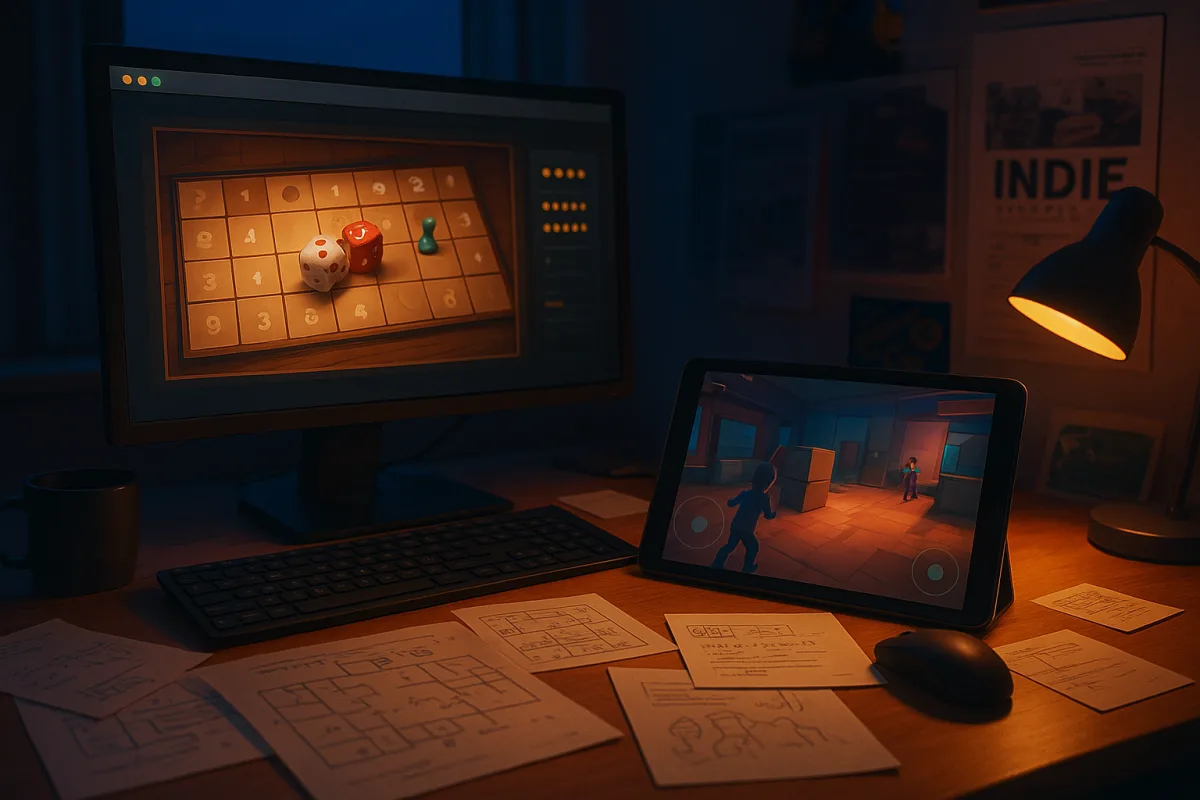
Best overall: The Zibbo Show, for deck-builder players who want tactical positioning rather than another lane of cards and random relics.
Best value: Mimic Busters, for groups wanting a playable Steam game now, with the usual cost caveat that no price was supplied in IGN’s showcase.
Best for co-op chaos: Waltz and Jam, for two-player platforming fans who prefer a companion built into the movement and puzzle kit.
Best long-haul RPG: The Lich Wars, for readers happy to wait for a branching gothic campaign instead of chasing a near-term release.
Best management sandbox: Food Truck Empire, for automation players who enjoy fixing bottlenecks before expanding across a map.
Best reason to wait on a demo: Drunken Goddess Reflux, for horror-curious players who should not mistake a closed play session for a public launch.
Indie showcase season is less about asking, “Which trailer looked good?” and more about deciding where to spend attention. A finished multiplayer game, a demo, an unpriced announcement, and a delayed project all ask for different levels of commitment.
That matters because festival feeds flatten everything into the same rapid-fire format. A logo, a cutscene, “wishlist now,” then another logo. The useful comparison is not visual polish. It is whether the game has a playable build, what kind of repeatable decision-making it offers, and whether its release plan is firm enough to plan around.
| Game or event | Current availability | Price | Format and scale | What makes it distinct | Main trade-off |
|---|---|---|---|---|---|
| The Zibbo Show | Demo on Steam and consoles, launches October 29, 2026 | Unannounced | Single-player roguelike deck-builder, about 16 hours cited by IGN | Dice placed on a 3x3 board, cards, chips and betting | Long-form campaign claim is untested until release |
| Mimic Busters | Out now on Steam | Unannounced | Multiplayer hide-and-seek and party mode | Players sculpt disguises for 60 seconds, hunters lose health for missed shots | Depends heavily on player creativity and matchmaking population |
| Food Truck Empire | Steam demo available, full release later in 2026 | Unannounced | Food-truck management and spatial automation | Kitchen layout, fleet expansion, city events and rivals | No firm release date or price |
| Waltz and Jam | Steam demo available, consoles and Steam release planned | Unannounced | Adventure platformer | Companion-assisted traversal, combat and puzzles | Details on campaign size remain thin |
| Coral Island | Nintendo Switch 2 version and update due in winter | Existing PC price not supplied by the showcase | Farming and life simulation with cross-play | Family-growth update, hobbies, multiplayer support | Switch 2 version is a platform expansion, not a new game |
| The Lich Wars | Announced, no date | Unannounced | Branching interactive-fiction RPG | 30-year career, three paths, nine skills, 300,000 words | No playable release window |
| Drunken Goddess Reflux | Public demo cancelled, closed session planned | Unannounced | Horror game built around Russian Roulette and gambling | Demon bartender premise and high-concept presentation | No public demo during Steam Next Fest |
Showcase standouts: playability beats trailer density
IGN’s Indie Loop puts The Zibbo Show at the top of the practical shortlist because it has both a specific release date, October 29, 2026, and a demo already available. Its pitch is not merely “roguelike deck-builder with dice,” a phrase that could describe half a Steam tag page.
The board is only 3x3, but that small layout is doing the work. You place dice for score, match values for multipliers, destroy opposing dice through placement, then modify those interactions with cards. That is closer to a compact tactical board game than a conventional deck-builder’s familiar cycle of draw, energy, attack and block.
IGN says a run can involve about 16 hours of gameplay across increasingly specialised opponents. That figure should be read as a developer-facing scope claim, not a review-backed completion estimate. Still, it separates The Zibbo Show from smaller score-chasing roguelites that expect players to manufacture replay value themselves.
The monetisation question remains open. The broader premium deck-builder market usually lands between $5 and $30, often adding optional DLC later, but free-to-play exceptions exist and there is no announced price for The Zibbo Show. [1] Do not let a demo’s polished loop trick you into assigning it a value before the store page does.
Mimic Busters, also featured by IGN, is the immediate alternative for players who want something social rather than solitary. It is already out on Steam, which is a much more meaningful status than “coming soon,” even though the showcase did not provide a price.
Its useful wrinkle is that the mimic side gets 60 seconds to use simple 3D modelling tools, turning a blank cube into a prop. The hunters hear a squeak from hiding players every 30 seconds, but indiscriminate shooting costs the shooter health when they miss.
That missed-shot penalty is the balance lever worth watching. Standard prop hunt rewards hunters for systematically deleting suspicion from the map with ammunition. Mimic Busters makes every speculative shot a resource loss, so a good hunter is pushed toward visual reads and sound tracking rather than spraying every chair.
The mimic scoring also avoids one of prop hunt’s dullest equilibrium states. Larger shapes earn more points, and being near hunters doubles the payout. Hiding as a tiny cube in an unreachable corner should keep you alive, but it should not make you the match’s economic winner.
It is early to declare that this fixes prop hunt. These systems tend to settle fast once regulars learn the maps, and the first balance patch will probably hinge on whether hunters can reliably triangulate the 30-second squeaks. But the incentives at least point players toward interaction, not inactivity.
Automation, platforming and life sims are not interchangeable comfort games
Food Truck Empire, another IGN Indie Loop selection, is for people whose idea of relaxation involves discovering that the fryer blocks the assembly counter. It begins in one truck, where players organise prep, cooking and assembly routes, then expands into multiple trucks, districts, recipes, equipment and research.
The interesting trade-off is expansion versus local efficiency. More trucks promise more customers, but also more preference management and more places for a bad layout to reproduce itself. City events briefly raise activity in neighbouring areas, while rival fleets can poach customers unless reputation holds.
That makes Food Truck Empire sound more like a network-management game than a pure cooking game. The demo is available on Steam and the full release is slated for later in 2026, though no exact date or price was given. Wishlist it for the layout puzzle, not because “food trucks” alone guarantees cosy vibes.
From The MIX Fall Showcase, Waltz and Jam looks like the cleaner option for co-op platforming. Waltz’s companion, Jam, can boost him over cliffs, smash obstacles and offer a lift, while the pair use toys for combat and puzzle-solving. A Steam demo is available, with Steam and console versions planned.
The design question is whether Jam is a real co-op role or a mechanically useful mascot. The showcase establishes traversal, combat and environmental puzzle applications, but not campaign length, drop-in support, or the division of control. Those are the things that decide whether a platformer survives beyond a demo evening.
Coral Island, shown during The MIX Fall Showcase, is more concrete because it is an existing farming and life-simulation game receiving an expanded platform release. Its Nintendo Switch 2 version is due in winter alongside a major update that lets children grow through life stages and choose hobbies influencing their futures.
That update is substantial in tone more than raw systems count. Farming sims regularly promise endless content while leaving relationships frozen in time. Coral Island’s family progression aims at the opposite, though players should wait for the patch notes before assuming every spouse, child path and milestone has equal depth.
The Switch 2 release will support cross-play, according to The MIX presentation, so it makes sense for friend groups split between PC and console. It is not automatically the best version for a PC-focused reader, though. Cross-play is useful only if your actual group uses it, and the presentation supplied no performance comparison.
Other narrative names from The MIX, including Mr. Records, Thank You Bus Driver, Never Alone 2, Dancing with Ghosts, and The Marvelous Room, deserve a watchlist rather than a purchase recommendation. The broadcast establishes their presence, and Mr. Records’ team claims 49 original songs, but it does not provide reliable pricing, release timing or enough mechanical detail for a meaningful value call.
The longer bet: The Lich Wars
Rock Paper Shotgun’s coverage of Psychic Software’s The Lich Wars gives it the clearest identity among the non-playable announcements. It is a standalone prequel to The Necromancer’s Tale, set across two undead conflicts and following a musketeer through a 30-year career.
Unlike its predecessor’s more navigable 3D town structure, The Lich Wars appears to favour hand-drawn storybook presentation, maps and tabletop elements. That could be a quiet buff, not a downgrade. If the strength is writing, character states and ritual-driven choice, trimming 3D walking can remove dead space between meaningful decisions.
Psychic Software’s stated scope is 300,000 words, nine RPG skills and three main paths. [8] Those are genuinely large numbers for interactive fiction, but branching-game arithmetic is cruel. More words can mean more reactive storytelling, or it can mean three routes that rejoin after every expensive scene.
The sensible expectation is a slower meta shift than with a deck-builder demo. Narrative RPG audiences need time to compare outcomes, test whether skill checks are cosmetic, and map the real consequences of character death. With no release date, there is no reason to rush ahead of the evidence.
Demo cancellations and event calendars: do not overread either
Kotaku reported that Alliance Arts cancelled Drunken Goddess Reflux’s planned October 19 public demo and instead chose a closed play session for limited participants. The studio said it feared the demo’s presentation and gameplay could be imitated or replicated with AI-assisted tools before the full launch.
The game reportedly already had more than 25,000 Steam followers and ranked 65th among Steam’s most wishlisted titles when Kotaku published its report. That attention makes the concern understandable, but it does not prove that withholding a demo prevents copying, nor that other developers will follow suit.
Steam’s AI-related disclosure requirements have made publishing more operationally complicated for indies, particularly around declaring AI-assisted development and explaining safeguards around live-generated material. [6] The policy landscape is moving, but “all demos will vanish because AI” is community panic, not a demonstrated industry trend.
Event calendars need the same restraint. Game Developer’s event listings identify gamescom, ChinaJoy, BitSummit, gamescom latam, The Game Awards and Game Conference MX as important industry fixtures, but the supplied excerpts do not provide schedules or programme details worth inventing.
The one firm diary entry is gamescom 2027: it is scheduled for August 23 to 29 at Koelnmesse in Cologne, with gamescom dev on August 23 and 24, and public days from August 26 through 29. [5] That is useful planning information. It is not evidence that a specific indie will appear there.
Recent delays are a reminder that showcase windows are marketing targets, not contracts. No More Room in Hell 2 moved its 1.0 launch into 2026, while Directive 8020 was delayed to 2026 amid studio layoffs. [10] [11] A date can shift for sensible production reasons, but readers are right to discount unspecific “later this year” language.
Who each option suits
The Zibbo Show suits players who want a premium-style roguelike deck-builder with visible board-state tactics, and who are comfortable trying a demo before any price is announced.
Mimic Busters suits friend groups seeking an available multiplayer game where bluffing and custom disguises matter more than twitch aim alone. It is a weaker recommendation for solo players or anyone without a regular group.
Food Truck Empire suits builders who enjoy diagnosing conveyor-belt logic, pathing and service bottlenecks. It is not the pick for players wanting manual cooking minigames or a fully confirmed release schedule.
Waltz and Jam suits co-op platforming fans looking for a demo now, especially those drawn to asymmetric movement tools. It needs more campaign and control detail before it becomes a firm full-price recommendation.
Coral Island suits farming-sim players who value relationships, family progression and cross-platform play. Existing PC players should treat the Switch 2 announcement as a reason to check update notes, not as a reason to re-buy automatically.
The Lich Wars suits readers who prioritise reactive writing, long character arcs and gothic military fantasy over immediate availability. It is the most promising narrative gamble here, but still a gamble until Psychic Software names a release date.
Drunken Goddess Reflux suits horror fans prepared to follow a project from a distance. The cancelled public demo makes it notable, but not more proven. Until a wider playable build returns, its AI-protection strategy is part of the story, not evidence that the game itself will land.
Frequently Asked Questions
What are the top indie games showcased in 2026?
The top indie games highlighted include The Zibbo Show for its tactical deck-building with dice, Mimic Busters as a multiplayer prop-hunt variant, Waltz and Jam for co-op platforming, The Lich Wars as a deep narrative RPG, and Food Truck Empire for management and automation fans. Each offers distinct gameplay styles and varying levels of release readiness.
Which indie games have demos available in 2026?
Demos are currently available for The Zibbo Show, Mimic Busters, Food Truck Empire, and Waltz and Jam. However, Drunken Goddess Reflux canceled its public demo, opting for a closed session instead, reflecting concerns around AI imitation and compliance with Steam’s new rules.
What indie games are releasing in late 2026?
The Zibbo Show has a confirmed release date of October 29, 2026. Other games like Food Truck Empire and Waltz and Jam are planned for release in 2026 but lack specific dates. Several announced projects remain without firm release windows.
How do indie game showcases impact release plans?
Showcases help players decide where to focus attention by revealing whether a game has a playable build, a clear release date, or just an announcement. This affects how much commitment players might give, as demos and firm dates allow for better planning compared to early or delayed announcements.
What are notable indie game industry events in 2026?
While Gamescom 2027 is confirmed for August 23–29, 2027, details for late-2026 and early-2027 MIX events have not been announced. Showcase dates should be treated as provisional until officially published by organizers.
How we researched this
This article was assembled from 2 video sources, 8 published articles, 11 cited references.
Nothing here is based on hands-on testing. Where a figure or finding appears, it belongs to the source cited beside it, and the writing says so rather than implying otherwise. Every source is listed below so you can check it.
Sources
The Zibbo Show, Mimic Busters, Food Truck Empire | Indie Loop 8 — IGN
gamescom — Game Developer
The creator of last year's cult hit RPG The Necromancer's Tale is back with The Lich Wars, a storybook RPG that follows 30 years of undead botheration — Rock Paper Shotgun
Anime Gambling Horror Game Ditches Free Steam Demo So It Doesn’t Get Ripped Off By AI — Kotaku
ChinaJoy — Game Developer
BitSummit — Game Developer
gamescom latam — Game Developer
The Game Awards — Game Developer
Game Conference MX (GCMX) — Game Developer
250+ Best Roguelike Deck Builder Apps & Games for iPhone (2026) | Free & Paid
Steam AI Disclosure: What Indie Developers Must Declare Under the 2026 Rules | IndiePilot
Fellow Traveller's 2026 Story-Rich Showcase: Top Indie Narrative Game Announcements – Archyde
Supermassive Games Delays Directive 8020 To 2026 Amid Studio Layoffs
Watch Indie Games and Industry Events Highlights on Youtube
Also from the sources
Related Articles
Gamescom 2026 Indie and Strategy Games Highlights
Explore key indie and strategy game highlights from Gamescom 2026, including gameplay, release info, and PC hardware insights.
October 2026 PC Game Releases and Sales Guide
Discover October 2026 PC game releases, early access, and Steam Autumn Sale dates to plan your gaming and save on top titles.
New and Upcoming PC Game Reviews and Previews 2026
Read detailed new and upcoming PC game reviews and previews for 2026, including Valheim 1.0, Aliens Fireteam Elite 2, NHL 27, and more.
Gamescom 2026 Game Previews: New RPGs and Unique Titles
Explore detailed Gamescom 2026 game previews covering new RPGs, unique gameplay, and PC requirements revealed at the event.