
Steam AI Game Discovery Problem and Battlefield 6 Server
Explore Steam's AI game discovery problem, Valve's submission changes, and Battlefield 6's server browser update for PC gaming trends.
Steam’s Filter Problem, Battlefield’s Browser Fix, and Why Old PC Game Ideas Are Back
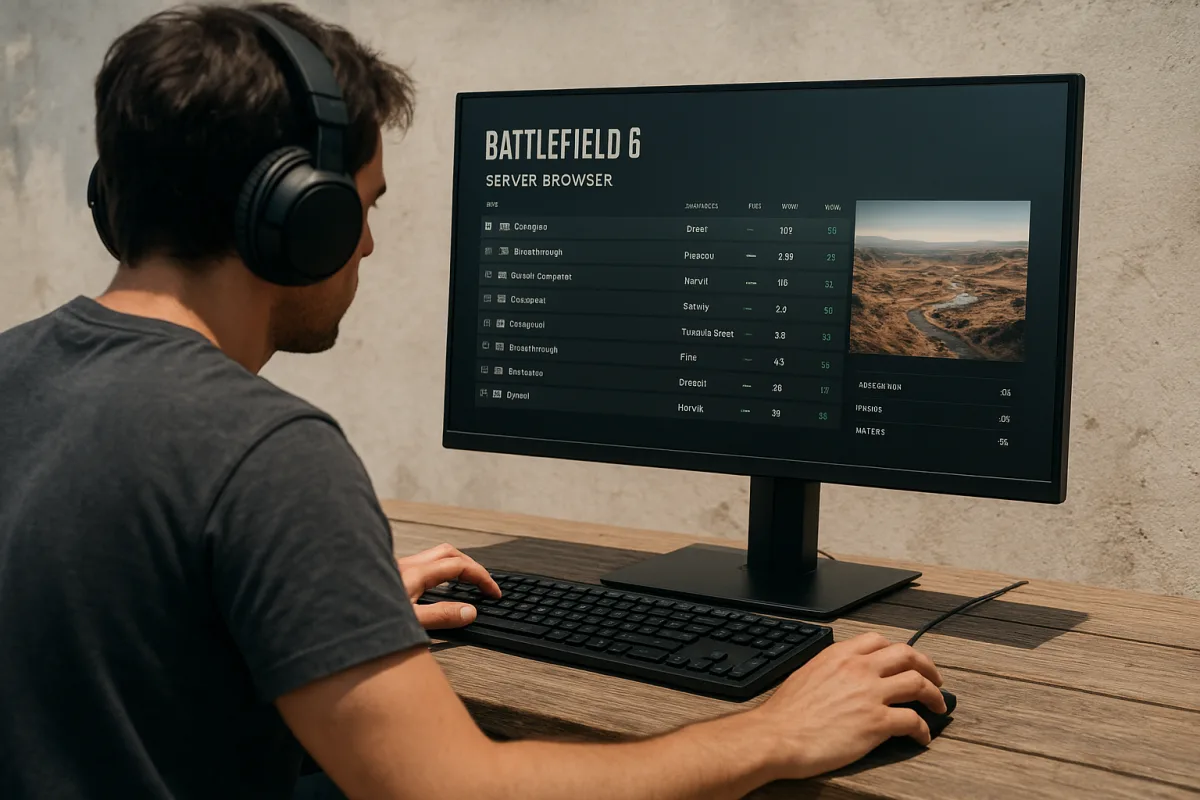
Battlefield 6 is putting player choice back on the menu
Battlefield 6’s server browser is scheduled to begin a limited rollout shortly after the Season 5 Phase 2 update on November 10, moving ahead of its previously expected December window. Tutorial.Games reports that the broader launch depends on live-test stability. [3]
That is a mundane feature with a large effect on how a multiplayer game feels. A browser lets you select the map, mode, ping, player count, and ruleset you want, instead of repeatedly feeding Quickplay and hoping matchmaking lands correctly.
The announced system puts official Battlefield Studios servers and official player-hosted servers in one browser tab. Both can award full XP, weapon mastery, and challenge progress, matching normal matchmaking progression. [4]
That full-progression rule is the important part. It prevents the usual split where the populated official queue gets all the rewards while community servers become novelty modes, empty experiments, or places you visit only after finishing a battle pass.
Battlefield 6 will also restore persistent lobbies, keeping your squad on the same server through its map rotation instead of throwing everyone back to menus after a round. GameRiv reports that filtering and sorting will include map, mode, ping, population, and server name. [5]
For regular players, that means fewer warm-up rounds wasted on a map you dislike and more chances to learn a lobby’s rhythm. You can recognize the same names, notice a good medic squad, and leave when a server’s balance turns into a spawn trap.
Jackfrags correctly frames this as the return of an older Battlefield loop: find a reliable 64-player Conquest server, favorite it, and keep playing. That routine was central to Battlefield 3 and Battlefield 4 communities, even if it has been oddly absent from recent entries.
The details also show why Electronic Arts is rolling it out carefully. Empty player-hosted servers can remain visible in the browser, but automated matchmaking backfill begins only after someone joins, while inactive servers can be delisted after seven days. [4]
That creates a meaningful threshold for small communities. A group running an obscure mode such as Obliteration will need players willing to seed it, then keep it active, before the browser’s discoverability can do any work.
The browser separates official, verified community, and heavily customized Portal experiences. Official servers receive full progression, while verified community servers receive XP progression but not necessarily the complete mastery track described for official listings. [4]
That distinction will shape the meta faster than most weapon-tuning patches. Full-progression servers will attract the grinders, while custom hardcore, infantry-only, or roleplay servers must offer rules strong enough to overcome reduced rewards and weaker matchmaking support.
We would start with official browser listings, sort by ping and player count, then favorite a few active rotations before committing to a community server. A seven-day persistence window is useful, but it does not guarantee that a niche mode will find a stable population.
Direct measurements for browser latency, queue quality, and retention have not been published yet. Until the global release lands, the evidence shows a promising feature list, not proof that Battlefield 6 has repaired its social layer.
Steam’s AI problem is becoming a discovery problem
Steam Next Fest is supposed to be a rare chance for unknown developers to reach players through demos. LevelCapGaming reported that its early featured days were flooded by quickly cloned, barely functional AI-made games, burying projects built over years.
Valve has acknowledged a discovery problem around low-quality and AI-generated submissions, according to GamersExtra, but its stated preference is smarter recommendation and storefront systems instead of a sweeping ban. [10]
That is the difficult route, but the right broad target. Steam has always carried bad games, abandoned projects, and asset flips, yet automated production lowers the cost of making thousands of plausible-looking store pages at once.
The damage is not confined to player annoyance. Windows Central reports that games disclosing AI use receive roughly 53 percent fewer reviews and lower average scores than non-AI games, while established studios using it have reportedly seen sales declines of 40 to 60 percent. [8]
Those numbers do not show that every use of generative software makes a game worse. They show that buyers increasingly treat AI disclosure as a risk marker, often because they expect stolen-looking art, inconsistent writing, or a developer who will not support the game.
That stigma can hit legitimate teams as well. Creative Bloq notes that developers have objected to “AI slop” as an accusation applied without evidence, especially when viewers mistake ordinary procedural tools, stock assets, or stylized work for generated material. [11]
So the player-facing rule is straightforward: judge the build, the developer’s disclosures, and its support record. Do not assume every inexpensive game is garbage, but do not give a store page the benefit of the doubt when it cannot show real play.
Valve has also reportedly tightened Steam submission requirements, including a five-minute runtime check, redistributable checks, achievements, and Steam Cloud support. GamesRadar says Valve has not explicitly tied those steps to generative AI, but they raise the floor for throwaway submissions. [9]
Those requirements will not stop competent scammers. They do increase the effort needed to ship something that boots, exposes a store listing, and vanishes before a player can refund it, which is enough to slow down the lowest-effort flood.
Other storefronts are taking blunter action. GamesRadar reports that Itch.io removed about 2TB of AI-generated content that violated spam policies and added search filters so users can avoid AI-tagged work. [9]
That is a stronger intervention than Steam has announced, though raw storage size is not a quality metric. The stronger evidence is that two major PC storefronts are spending time on filtering, disclosure, and submission friction instead of treating the volume as temporary noise.
If you are making a game, show work that a clone cannot easily imitate. A playable demo, visible patch notes, a clear development history, recognizable art direction, and responsive forums all give players reasons to believe there are people behind the executable.
We would disclose any generative tools used in production plainly and narrowly, then explain what was authored, edited, and owned by the team. Hiding the detail may avoid a search filter today, but it risks a much harsher reaction when players uncover it later.
PC players are buying focused games and returning to older habits
The comeback story is not one genre suddenly conquering Steam. It is several old PC habits returning together: computer RPGs, linear campaigns, expansion packs, couch co-op, destructible environments, handheld play, and persistent multiplayer servers.
Gameranx’s roundup points to the same pattern in games as different as Baldur’s Gate 3, Cyberpunk 2077: Phantom Liberty, Split Fiction, and Battlefield 6. Players are responding to games that know what they are trying to be.
The financial backdrop supports part of that argument. Newzoo reports that mid-tier and catalog games generated 56 percent of PC revenue in Western markets during 2025, up from 48 percent in 2024. [12]
That is a significant move away from the assumption that only new, giant releases can command attention. Older games, remasters, expansions, and mid-budget releases have become a larger share of spending, because players already have libraries and do not reset their tastes every launch season.
Newzoo also reports that 92 percent of player hours are spent in games more than two years old. [12] If you are making a new project, you are competing with a player’s established habits, favorite mods, friends list, and backlog, not only this month’s releases.
A full-price game with 80 hours of map icons is no longer automatically safer than a tight 15-hour campaign. A focused game can win if its combat, writing, buildcraft, or co-op loop gives players a reason to recommend it immediately.
This is why computer RPGs are thriving again. Baldur’s Gate 3 did not revive interest in dense systems by simplifying them into an action game, it proved that players will learn messy inventories, party composition, dialogue checks, and turn economy when choices feel consequential.
The quieter benefit is for smaller teams. You do not need to build a continent when a strong district, dungeon, ship, or tactical map can deliver replayability through character builds and systemic interactions instead of expensive scenery.
McKinsey identifies “content lovers,” 13 percent of consumers, as players drawn toward rich intellectual property and premium experiences. [13] That is not the whole market, but it helps explain why recognizable mechanics and well-supported worlds retain attention longer than disposable trends.
Classic design is also becoming easier to access across devices. BCG points to platform convergence and cloud gaming as factors increasing access to game catalogs, so players can revisit older genres without maintaining period-correct hardware. [14]
Handheld PCs fit this nostalgia-and-convenience loop, but their economics are getting worse. ShouldIBuyThisGame.com reported a Steam Deck OLED increase from $549 to $789 in May 2026, a 44 percent jump, though Valve’s current store pricing must settle the exact SKU and regional figure. [15]
The high end is worse. PC Gamer reviewed MSI’s Claw 8 EX AI+ CG3EM at $1,800, driven in part by expensive LPDDR5X memory, which puts it closer to a premium laptop purchase than an impulse companion for your Steam backlog. [16]
There is also a longevity concern for Windows handheld buyers. Tom’s Hardware reports that AMD has reportedly ended driver support for the Ryzen Z1 Extreme, the chip used in devices including Asus’s ROG Ally X and Lenovo’s Legion Go. [17]
That makes a cheap clearance handheld less attractive if you expect years of new-game compatibility fixes. We would favor a supported machine with a clear software roadmap over chasing peak benchmark numbers, especially when portable performance is already constrained by battery and heat.
Retro hardware has limits too. T3 reports that Blaze delayed its Spectrum and C64 Handhelds from October 2026 to April 2027 for quality-control reasons. [19] Old ideas are back, but the manufacturing, support, and pricing problems are thoroughly modern.
What to build, and what to avoid
The common thread across Steam’s filtering problem, Battlefield’s browser, and older game styles is player agency. People want to choose a trustworthy game, a server with rules they understand, and a play session that respects their available time.
For a multiplayer project, build server discovery and persistence into the plan from day one. If your game depends on community modes, do not bury them behind a separate menu with weak progression and expect players to maintain the population for you.
For a single-player game, spend on the repeatable core before spending on scale. A great tactical encounter, a sharp character build, or a small co-op campaign will age better than a giant world whose activities are indistinguishable after hour three.
For a Steam launch, assume discovery is getting noisier and trust is getting expensive. Your page needs footage, a demo when possible, accurate tags, visible support plans, and a clear explanation of what players are actually buying.
The evidence is thinner on whether these trends will expand the overall PC audience or only redistribute spending among existing players. What is clear is that the old assumption, bigger map, more automation, fewer player choices, is no longer a safe default.
Frequently Asked Questions
What is Steam's AI game discovery problem?
Steam is facing a discovery problem caused by a flood of low-quality and AI-generated games. These games often have quickly cloned, barely functional content that buries projects developed over years. Valve aims to address this through smarter recommendation and storefront systems rather than banning AI-made games outright.
How does AI affect game sales and reviews on Steam?
Games that disclose AI use receive about 53 percent fewer reviews and lower average scores compared to non-AI games. Established studios using AI have reportedly seen sales declines of 40 to 60 percent. This reflects a market stigma where buyers often view AI disclosure as a risk marker, expecting lower quality or lack of support.
What changes has Valve made to Steam's submission process?
Valve has tightened submission requirements by enforcing a minimum 5-minute run time, redistributables checks, achievements, and Steam Cloud support. These measures aim to reduce low-quality or AI-generated submissions, although Valve does not explicitly link these changes to AI content.
When will Battlefield 6's server browser be fully available?
Battlefield 6’s server browser began a limited rollout shortly after the November 10, 2026, Season 5 Phase 2 update. The broader launch depends on the stability of this live test and is expected within approximately two weeks after the initial rollout.
How do server browsers impact multiplayer PC games?
Server browsers allow players to select maps, modes, ping, player count, and rulesets directly, reducing reliance on matchmaking and improving player choice. They help build community by enabling persistent lobbies and repeated play on favored servers, which can enhance the social experience and game retention.
How we researched this
This article was assembled from 3 video sources across 3 channels, 19 cited references.
Nothing here is based on hands-on testing. Where a figure or finding appears, it belongs to the source cited beside it, and the writing says so rather than implying otherwise. Every source is listed below so you can check it.
Sources
Battlefield finally has a real Server Browser again..., jackfrags
AI Slop is TAKING OVER Steam - Level With Me Ep. 159, LevelCapGaming
Steam Deck vs ROG Ally vs Legion Go: Which Handheld PC Should You Buy? - Switchblade Gaming
Battlefield 6 Server Browser Launch Moves Up to November | Tutorial.Games
Battlefield 6 Server Browser Arrives Earlier Than Planned, EA Confirms November Rollout - GameRiv
Battlefield 6 server browser: limited test after the November 10 Season 5 update - Update - Playnews
Battlefield 6 server browser rollout starts after November 10 with a limited test | JEU.VIDEO
Valve cracks down on Steam game submission process as AI clones and vibe-coded slop flood its store
Valve Says Steam's AI and Low-Quality Game Flood Needs Smarter Storefront Solutions | GamersExtra
"AI slop" has become a harmful insult hurled around with no evidence, game developers claim
Gaming’s next growth era: Unlocking the value of attention | McKinsey
Handheld Gaming Prices Are Out of Control (2026) | ShouldIBuyThisGame.com
Watch Steam and PC Gaming Trends: AI, Server Browsers, and Game Comebacks on Youtube
Also from the sources
Related Articles
Steam Next Fest 2026 AI Controversies in Indie Games
Explore Steam Next Fest 2026 AI controversies, demo risks, and Steam's AI disclosure rules affecting indie game developers.

Yogscast TTT: Mod Madness and Chaotic Banter
Join The Yogscast team in an exciting episode of Trouble in Terrorist Town. They play with a unique mod, face challenges, and engage in banter. The gameplay includes references to Avengers characters and discussions about languages and slang, creating a fun and dynamic atmosphere. The episode concludes with a chaotic vote, leading to unexpected outcomes.

Top Single-Player Games Under 20 Hours: A Game Ranks Countdown
Discover top single-player games under 20 hours in this engaging Game Ranks article. From action-adventure to puzzles, find the perfect game for a fulfilling gaming experience without the time commitment.

Discover 'Adam's Fall': Unique Post-Apocalyptic Game by Rebellion
Explore Rebellion's unique game 'Adam's Fall,' blending Fallout New Vegas elements with investigation gameplay in a post-apocalyptic English Countryside. Uncover mysteries, navigate nonlinear gameplay, and engage in strategic combat encounters in this immersive experience.