
Phantom Blade Zero PC Technical Issues and Review Summary
Discover Phantom Blade Zero PC technical issues, system requirements, and gameplay insights to decide when and how to play.
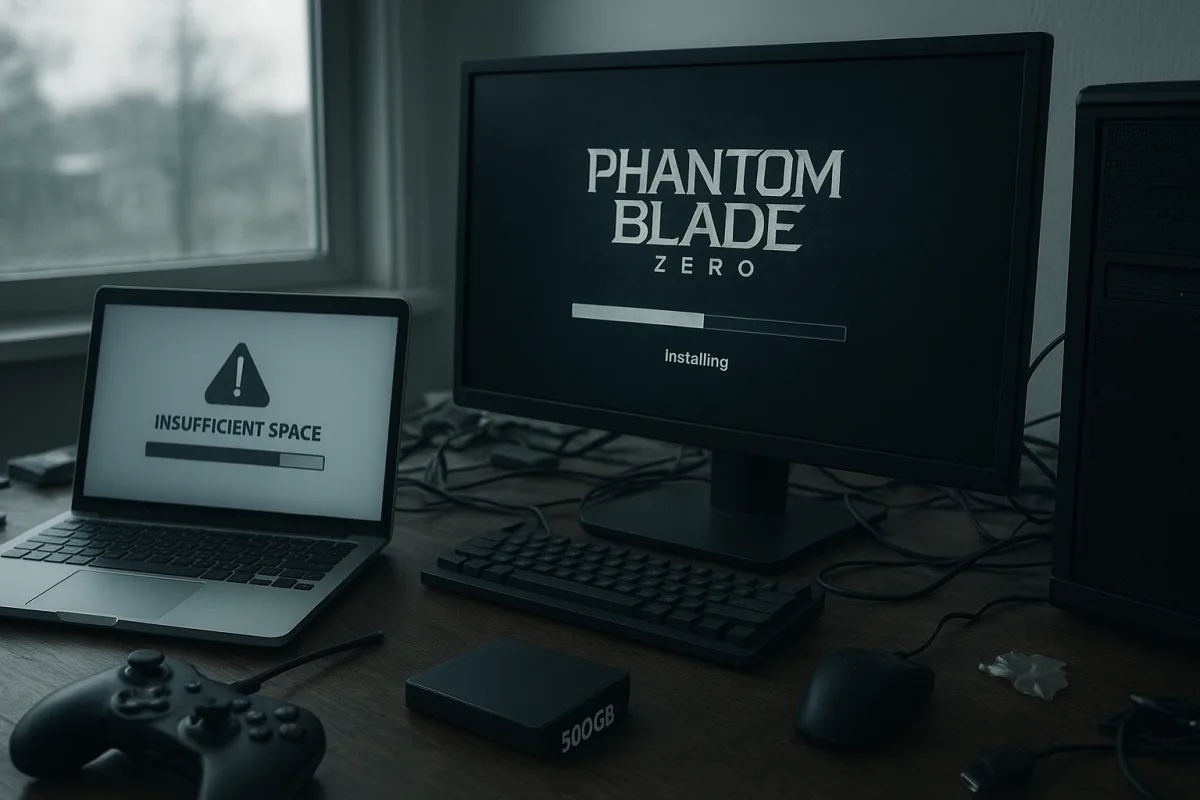
The decision: pre-load Phantom Blade Zero on PC, or wait for launch-day reports?
The sensible choice for most PC players is to wait until launch-day reports arrive. Phantom Blade Zero looks like a strong action game, but the pre-load’s 300GB free-space demand is a logistical tax, not an early-access perk worth reorganising your whole drive for. [5]
That is not a recommendation to skip S-Game’s wuxia action game outright. Reviews from GameSpot, IGN, Gameranx, Skill Up, and GamingBolt broadly agree that its combat is the main event, even where they disagree about story, difficulty, polish, and technical performance.
The complication is timing. Phantom Blade Zero officially launches on PC and PlayStation 5 on October 29, 2026, so there are no player-side reports yet establishing whether the launch build has widespread stutter, crashes, installation trouble, or progression bugs. [6]
That makes this a decision between convenience and information. Pre-loading gets you playing sooner, assuming you can satisfy its temporary storage requirement. Waiting costs a few hours or a day, but gives you the data review copies cannot provide: how the retail build behaves across ordinary PCs.
| Criteria | Pre-load before launch | Wait for launch-day reports |
|---|---|---|
| Required free SSD space | 300GB temporarily, then approximately 145GB installed. [[5]](https://www.techspot.com/news/114332-phantom-blade-zero-pc-requirements-reveal-145gb-install.html?utm_source=openai "Phantom Blade Zero's PC requirements reveal a 145GB install, 300GB for preloading, and upscaling | TechSpot") |
| Time-to-play | Best option if your connection is slow and your SSD has ample headroom. | Delayed by download time, but avoids clearing space for temporary files. |
| Combat confidence | Reviews strongly support the weapon swapping, parry system, boss design, and wuxia presentation. | Same game, plus a chance to see whether patches affect balance or performance. |
| Technical risk | You commit storage and bandwidth before knowing whether your hardware has issues. | Lets other players identify driver, GPU, ultrawide, and stutter problems first. |
| Story expectations | Go in for action first. Reviews consistently call the plot convoluted or slow to clarify itself. | Lets you decide whether the combat is enough to outweigh that narrative weakness. |
| Best suited to | Players with a roomy SSD, a slow connection, and a clear appetite for cinematic action games. | Players with limited storage, performance-sensitive hardware, or little tolerance for launch-week fixes. |
Combat: the reason to buy, not the reason to rush
S-Game’s central combat loop appears to have landed. GameSpot describes a system where light and heavy attacks can be interrupted instantly by a block or parry, avoiding the animation commitment that usually turns action games into a turn-taking exercise.
That is a meaningful mechanical difference. In Sekiro, a mistimed swing can put you on the defensive because you committed to the button. Phantom Blade Zero instead seems designed around pressing forward while still reading incoming attacks, then converting defense into offense mid-string.
The resource system gives that aggression some structure. Blocking and heavy attacks consume Sha-Chi, while successful parries damage an opponent’s meter. Swapping between the two equipped primary weapons restores Soul’s Sha-Chi, so weapon switching is a defensive reset as much as a style flourish.
That quietly kills the one-weapon comfort build. A player who finds a favourite sword and refuses to rotate will give up one of the safest ways to recover posture and maintain pressure. The game wants a two-weapon loop, not a single upgraded blade with backup equipment gathering dust.
GameSpot’s review highlights the Outlaw War Blade as an example of this trade-off. Its heavy attacks consume health for extra damage, while ordinary attacks restore health, creating a risk-reward pattern that becomes safer because the player can immediately rotate to another weapon.
IGN similarly found that the game frequently places useful tools close to the content that rewards them, including a water cannon before a fire-based boss. That can sound suspiciously convenient, but it is good onboarding for a combat system built around adapting loadouts rather than marrying one build.
The important caveat is encounter balance. GameSpot found regular enemies too easy even on the hardest available difficulty, while bosses remained demanding enough to force a drop back to medium. That is not a universal “too easy” verdict, but it suggests a lopsided curve.
In match terms, trash mobs are apparently where the game’s offense gets too safe, while bosses are where the system asks you to actually manage Sha-Chi, flashes, parries, dodges, and weapon rotations. If you want Devil May Cry-style combat depth in every hallway, temper expectations.
Gameranx’s Jake Baldino makes a similar distinction, calling ordinary enemies fodder and bosses the real challenge. He also notes that the parry timing is more forgiving than Sekiro’s, which suits players who want to look skilled without spending a night learning one boss’s delayed swing.
That is not the same as saying combat lacks depth. GamingBolt’s reviewer describes builds around corrosion, weapon-specific effects, accessories, defensive Sha-Chi management, and Phantom Edges such as ranged weapons, shields breakers, summons, and chain-based tools. The meta is experimentation, not pure reaction speed.
Story and exploration: good supporting systems, uneven delivery
The 66-day premise is clean enough: protagonist Soul is revived with an artificial heart after being framed for his master’s murder, but the heart gives him a limited lifespan. The world around that premise is more tangled than the premise itself.
IGN criticises the story’s heavy terminology, shifting timeline, and overloaded character roster. GameSpot reaches a similar conclusion, finding it difficult to track factions, motives, and events until late in the campaign. This is not a game to buy for crisp plot clarity.
Skill Up is more positive about the same material, particularly the environmental storytelling around puppets, corrupted bodies, and the process called transcension. That gap is revealing: players willing to read lore, inspect spaces, and connect names may find more than players following only cutscenes.
The better news is that exploration seems worth the detours. IGN reports eight maps with quests, secrets, hand-drawn maps, optional encounters, and missable content. GamingBolt also says the world opens substantially after its earlier regions, with later routes, keys, tools, and side content creating stronger discovery.
Estimated main-story length is around 25 to 30 hours, while multiple endings and the Sixty-Six Days permadeath mode are listed in launch information. [8] Skill Up’s longer estimate of roughly 40 hours, with a substantial optional final stretch, suggests completionist runs could run much longer.
Do not buy on the assumption of an endless live-service tail, though. There is no confirmed post-launch roadmap or long-term replayability plan beyond the launch modes and endings. [8] A permadeath mode can extend mastery, but it is not automatically new content.
The 145GB install is normal enough. The 300GB pre-load is not
Phantom Blade Zero’s 145GB installed size is hefty, but it is not the outlier some early reactions made it sound like. PC Gamer reports Final Fantasy VII Revelation at 200GB, which puts S-Game’s final install below the high end of current blockbuster PC storage demands. [1]
The obnoxious number is 300GB free space for pre-loading. According to S-Game’s requirements reported by TechSpot, temporary encrypted or compressed files and the finished game files must coexist while the game decrypts and unpacks, after which usage should fall to roughly 145GB. [5]
That is a known installation workflow, not evidence that the finished game secretly occupies 300GB. Large games sometimes need temporary duplication during updates or decompression, and Tom’s Hardware recently reported Helldivers 2 reducing its PC footprint by removing duplicated data originally retained for hard-drive optimisation. [2]
Still, “normal practice” is not the same as “player-friendly practice.” A 500GB SSD can technically run the final game, but a pre-load may require deleting several installed games, leaving insufficient headroom for Windows updates, shader caches, captures, or the inevitable day-one patch.
The storage pressure is worse because Phantom Blade Zero requires an SSD. [5] SSD capacity is not a free checkbox in 2026, and the research brief flags a constrained NAND market and sharply higher prices. That does not prove players cannot accommodate the game, but it makes casual advice to “just buy another drive” unserious.
What the reviews actually say about technical issues
The review evidence is mixed, which is exactly why waiting is the smarter default. Skill Up’s reviewer played roughly 40 hours on a high-end PC at 4K, with DLSS Quality and ray tracing plus path tracing disabled, reporting around 90 frames per second and no crashes, stutter, or progression bugs.
The same Skill Up review reports 4K at 60fps with path tracing enabled and DLSS Performance. That is useful as a high-end benchmark, not a recommended specification. It tells us the game scales up into expensive lighting features, not how a mainstream RTX 3060 or Radeon RX 6700 XT-class machine will fare.
IGN’s reviewer had a less clean experience, citing occasional performance issues and substantial geometry problems. Soul reportedly catches on small environmental objects, invisible barriers interfere with platforming, and enemies can become stuck in terrain. Those are polish problems, not merely an FPS counter complaint.
Gameranx independently mentions unreliable lock-on, cramped camera angles, and Soul getting snagged on scenery. GamingBolt adds pop-in, ghosting around faces and cinematics, low-resolution environmental textures, and rare enemies or bosses behaving badly around terrain. When several reviewers flag geometry, it deserves attention.
On the other hand, none of those observations establish a launch-wide technical failure. They were gathered from pre-release builds, and S-Game told Skill Up that review-period fixes had already addressed some progression and performance issues. The retail patch may improve matters, or introduce different problems.
This is where community panic tends to get ahead of evidence. There is currently no player dataset linking the 145GB install, the 300GB pre-load requirement, or the SSD mandate to crashes, stuttering, or failed installation, because the game has not launched yet. [5][6]
Who each option suits
Pre-load Phantom Blade Zero if
Pre-load if you have at least 300GB genuinely free on a fast SSD, a limited internet connection, and already know you want a cinematic action game. The reviews make the combat case well: fluid weapon swaps, adaptable builds, generous defensive options, and unusually imaginative bosses.
It also suits players who prefer action games that respect momentum over punishment. Phantom Blade Zero appears more interested in making a cool combo work than making you re-clear a boss’s first phase for the fifteenth time, which is a real quality-of-life buff.
Wait for launch-day reports if
Wait if freeing 300GB means uninstalling half your library, especially on a 500GB or 1TB SSD. The pre-load requirement is temporary, so waiting may let you download the 145GB final package without performing storage Tetris for a two-day head start. [5]
Waiting also suits players who are sensitive to stutter, visual artifacts, camera problems, or finicky collision. The review consensus says Phantom Blade Zero is probably worth playing for its combat, but the disagreement on technical polish is close enough that retail PC reports should decide the purchase timing.
Frequently Asked Questions
What are the PC system requirements for Phantom Blade Zero?
Phantom Blade Zero requires sufficient SSD space to accommodate a 145GB final install. While detailed CPU, GPU, and RAM specs are not provided, the game is a 2026 AAA action title likely demanding modern hardware. The main consideration highlighted is storage capacity, especially for pre-loading.
How much SSD space does Phantom Blade Zero need on PC?
The final installed size of Phantom Blade Zero is approximately 145GB. However, pre-loading the game requires about 300GB of free SSD space temporarily due to the need to store both temporary and final files during installation.
Are there known technical issues with Phantom Blade Zero on PC?
There are no confirmed widespread technical issues reported yet. Review copies showed some bugs, but these should not be taken as definitive proof of a broken PC port. Since the game launches on October 29, 2026, no player-side data on stability or performance is available at this time.
Should I pre-load Phantom Blade Zero on PC or wait for launch?
Most players are advised to wait for launch-day reports before pre-loading, especially if their SSD has less than 300GB free. Pre-loading allows earlier play but requires significant temporary storage, while waiting lets you avoid the storage hassle and see how the retail build performs on typical PCs.
How stable is Phantom Blade Zero on PC at launch?
Stability at launch remains uncertain. Reviewers have mixed opinions on stability based on review copies, and no post-launch player feedback is available yet to confirm how well the game runs across different PC configurations.
How we researched this
This article was assembled from 5 video sources across 5 channels, 2 published articles, 9 cited references.
Nothing here is based on hands-on testing. Where a figure or finding appears, it belongs to the source cited beside it, and the writing says so rather than implying otherwise. Every source is listed below so you can check it.
Sources
Phantom Blade Zero - Before You Buy — gameranx
I strongly recommend: Phantom Blade Zero (Review) — Skill Up
Phantom Blade Zero's Combat Is So Good, You Won't Care The Story Makes No Sense | Review — GameSpot
Phantom Blade Zero PS5 Review - An Absolutely Phenomenal Experience — GamingBolt
Demanding 300GB to install despite its actual size of 145GB, Phantom Blade Zero makes me question what a gigabyte is worth — Rock Paper Shotgun
Is 4TB SSD Enough for Gaming? Capacity Breakdown – Kingspec Tech
Las 6 claves de Phantom Blade Zero tras jugar las 6 primeras horas: ¿se viene otro candidato a GOTY?
Watch Phantom Blade Zero Reviews and Technical Issues on Youtube
Also from the sources
Related Articles
Phantom Blade Zero PC Gameplay and Performance Guide
Explore Phantom Blade Zero PC gameplay, system requirements, and optimization tips to ensure smooth performance and master combat mechanics.
Phantom Blade Zero Critical Acclaim and Review Overview
Explore Phantom Blade Zero critical acclaim, pre-launch reviews, edition comparisons, and PC requirements before its October 2026 release.
Ace Combat 8 Wings of Theve PC Reception and Features
Explore Ace Combat 8 Wings of Theve PC reception, system requirements, editions, and multiplayer features before its October 2026 launch.
Halloween The Game Review: Editions, Gameplay, and PC Specs
Read our Halloween The Game review covering editions, gameplay impressions, PC specs, and early access issues before buying.