
Ace Combat 8 Wings of Theve PC Reception and Features
Explore Ace Combat 8 Wings of Theve PC reception, system requirements, editions, and multiplayer features before its October 2026 launch.
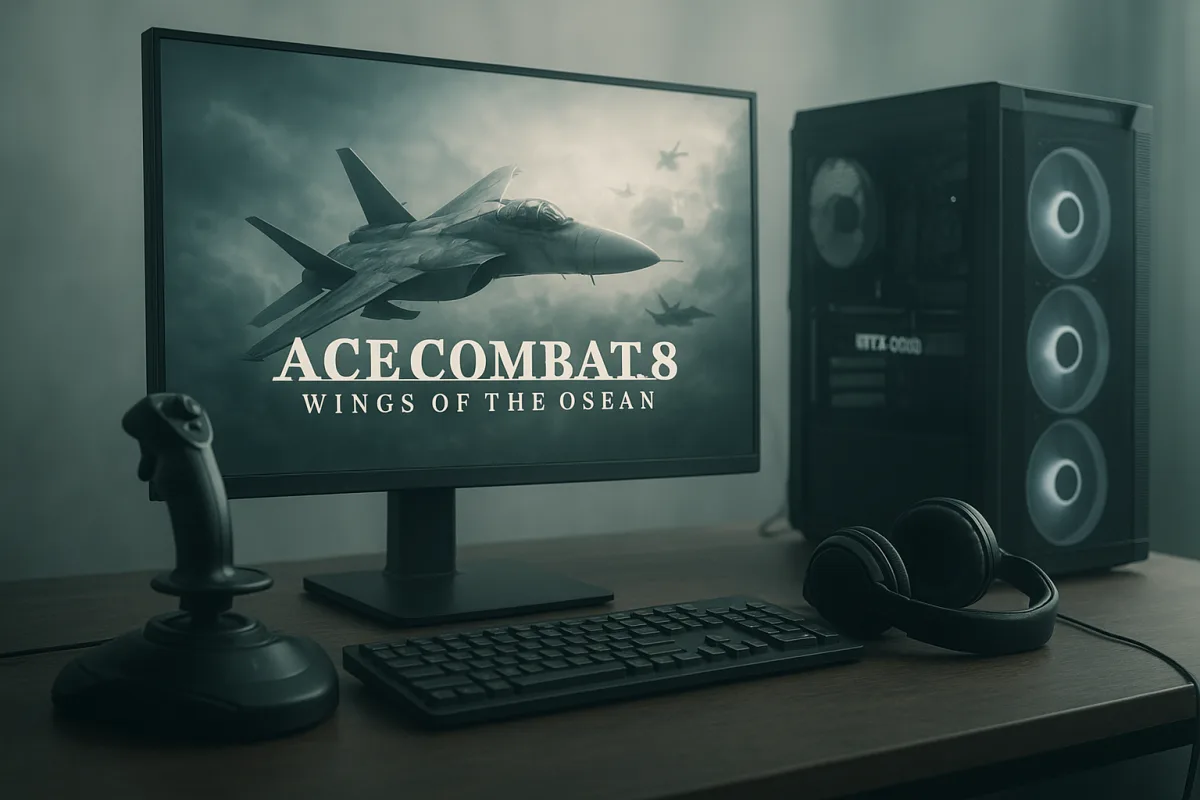
The quick list
Best overall: Ace Combat 8: Wings of Theve Standard Edition, for PC players willing to wait for launch-day reviews before buying the core game at $69.99.[9]
Best for early adopters: Ace Combat 8: Wings of Theve Deluxe Edition, for committed series fans who value early access and extras enough to pay $89.99.[9]
Best value: Xenonauts 2, for players who want a released, slower-paced tactical game at a $40 price point rather than a premium-priced aviation game.[6]
The question is not really whether Ace Combat 8 looks exciting. It clearly does. The question is whether its announced mix of arcade dogfighting, character-heavy campaign scenes, live-service multiplayer hooks, and demanding PC requirements is worth $69.99 before independent critics have finished it.
That distinction matters because the current “triumphant return” narrative is ahead of the runway. Ace Combat 8: Wings of Theve is scheduled for October 2, 2026, on PC, PlayStation 5, and Xbox Series consoles.[5] Late-September coverage is necessarily based on previews, controlled access, marketing material, or incomplete builds.
Comparison table
| Option | PC price | What is included | Campaign certainty | Online proposition | Best for |
|---|---|---|---|---|---|
| Ace Combat 8: Wings of Theve Standard Edition | $69.99 | Base game | Full length and final pacing unknown before launch | Cross-play and announced co-op modes, but no live-server data yet | Players who can wait for reviews and only want the game itself |
| Ace Combat 8: Wings of Theve Deluxe Edition | $89.99 | Base game, early access, and Deluxe extras | Same unknown campaign as Standard | Same multiplayer suite as Standard | Long-time Ace Combat players who specifically value early access or included bonuses |
| Xenonauts 2 | $40 | Released tactical strategy game | Already reviewable as a complete release | Not the reason to buy it | Budget-conscious players who prefer turn-based planning over real-time aerial action |
Ace Combat 8’s Standard and Deluxe editions are not different games, so there is no build-changing gameplay fork here. The $20 jump is about access timing and extras, not a better aircraft tree, extra campaign missions, or stronger multiplayer loadouts based on the available store information.[9]
That makes Standard the default recommendation, with one caveat: waiting is more useful than preordering. A day-one review can answer the things promotional footage cannot, including campaign duration, PC frame-time stability, flight-stick support, multiplayer queue health, battle-pass pressure, and whether the ending lands.
Xenonauts 2 is included because the $40 comparison point is useful, not because it is a substitute for pulling high-G turns through thunderheads. It is a turn-based alien-invasion strategy game, where deliberation and resource management replace immediate cockpit action.[6]
What is actually known about Ace Combat 8
Bandai Namco has positioned Ace Combat 8 as a continuation of the series’ familiar arcade-simulation middle ground. You are not learning a civilian flight sim’s startup procedures or managing every system in a cockpit, but aircraft choice, weapon selection, positioning, speed, and missile evasion should still matter.
The available material points to a campaign centred on Joker Flight and the inherited title of the Wings of Theve, a propaganda-created ace identity. The setting remains Strangereal, the series’ fictional geopolitical theatre, rather than a direct recreation of present-day conflict.[2]
That premise has obvious potential. Ace Combat has always worked best when its giant railguns, superweapons, doomed squadrons, and orchestral boss fights are anchored by pilots who sound like they have something to lose. It can also become very earnest, very quickly.
Pre-release commentary suggests substantially more first-person story sequences aboard the carrier and around the squadron than older games used. That could give wingmen more room to register as people rather than radio call signs, but it also creates the obvious pacing risk.
The warning signs are already visible in the critical discussion cited by TechRadar and TechSpot: long cutscenes, simple interactive prompts, uneven mission difficulty, and story themes that may not be developed beyond surface-level gestures.[7][8] None of that makes the game bad, but it does make “story masterpiece” a premature verdict.
The proposed social-media and propaganda angle is especially worth treating carefully. A game can say disinformation is dangerous, then immediately reward its heroes for using the correct version of it. If the writing never interrogates that contradiction, it is set dressing, not a theme.
The combat case is stronger than the review narrative
Where Ace Combat 8 looks most convincing is in the systems that make a single dogfight less rote. The new cloud technology is not just there for screenshots. Dense cloud cover is meant to interfere with missile locks, obscure vision, and turn altitude awareness into a live problem.[2]
That changes the usual rhythm. In a flatter Ace Combat encounter, an enemy gets behind you, the lock tone starts screaming, and your answer is usually speed, flares, or a hard turn. Here, a cloud layer can become emergency cover, but it also makes you temporarily blind.
That is the sort of feature that quietly buffs aggressive close-range play. If locking through clouds is unreliable, players who can identify an opponent’s exit vector, stay close, and use guns or quick reacquisition should gain an edge over pilots who depend on maximum-range missile launches.
It should also make slower, ground-attack-oriented aircraft more vulnerable in bad weather. A multirole jet carrying air-to-ground ordnance may be ideal when a mission asks for anti-ship or anti-armour work, but it has less room to improvise if fighters force the engagement into cloud layers.
Previews also describe two special-weapon slots and squad commands, along with aircraft-specific upgrade capacity rather than a completely interchangeable part system.[2][3] On paper, that should reduce the old all-purpose-loadout problem, where one favourite fighter can solve almost every sortie with minor adjustment.
Whether it actually changes the meta depends on numbers no preview can settle. The balance hinges on lock-on speed, special-weapon ammunition, damage breakpoints, aircraft handling, repair or respawn rules online, and how much squadmate damage matters. Those are patch-note-level questions, not trailer questions.
The same goes for the control schemes. The game offers a more accessible Basic scheme and a higher-control Expert scheme, with the latter giving more direct authority over pitch, yaw, and roll.[2] Expert controls are likely to be the ceiling-setting option, but that does not mean Basic is useless for campaign play.
If the input model is forgiving enough, Basic may be the better onboarding route for players who want the spectacle without spending their first hour fighting the camera. If multiplayer rewards tight reversals and energy management, the player base will likely drift toward Expert within weeks.
Multiplayer has the right shape, not yet the proof
The announced multiplayer design has more moving parts than Ace Combat 7’s relatively limited competitive offering. Co-Op Assault has teams compete through PvE objectives, while Co-Op Warfare adds direct player-versus-player combat into that scoring race.[3][4]
There are also limited-time modes described as Scramble and Emergency Sortie, plus an explorable air-base lobby supporting up to 100 players. Cross-platform play is planned between PlayStation 5, Xbox Series X|S, and Steam, which is the right call for a niche multiplayer flight game.[2][4]
Cross-play is not a magic fix, though. It can help the population pool, especially in off-peak regions, but it cannot prove that the netcode is stable, the matchmaking is fair, or the rewards are worth repeating missions for. None of those measurements exists before launch.
The battle-pass concern is also legitimate. An Ace Pass with free and premium tracks has been shown in pre-release material, alongside aircraft, cosmetics, currency, and progression systems.[2] The important question is not whether a pass exists, but what gameplay power it can accelerate.
If premium spending only changes paint schemes, pilot clothing, and other cosmetic items, it is background noise. If it shortens the path to the jets, parts, weapons, or consumables that define the multiplayer meta, the community will correctly treat it as a balance issue.
Do not let either publisher reassurance or forum panic decide that before players can inspect the actual shop. Multiplayer economies often look harmless in a preview build because the pressure points only appear when progression slows after launch.
PC hardware and storage trade-offs
Ace Combat 8’s official PC requirements are surprisingly substantial. The minimum specification calls for Windows 11 64-bit, an Intel Core i7-10700K or AMD Ryzen 5 3600X, 16GB of RAM, and either an RTX 2060 6GB or RX 6600 XT 8GB.[9]
It also requires DirectX 12, Shader Model 6.6, hardware ray-tracing support, and 125GB of SSD space.[9] That storage footprint is more than three times Xenonauts 2’s $40 price difference can explain, so make room before treating this as a casual impulse install.
The recommended specification steps up to an Intel Core i7-12700K or Ryzen 5 5600X, 32GB of memory, and an RTX 3070 8GB or RX 6800 16GB.[9] Those are not absurd 2026 targets, but they are not lightweight requirements either.
There is no credible pre-launch PC performance verdict yet. No one can tell you whether an RTX 2060 delivers a clean 60fps, whether ultrawide support is sensible, how the game handles cloud-heavy weather scenes, or whether frame generation causes input problems in high-speed dogfights.
That is another reason to separate official requirements from a recommendation. Requirements say the game should launch. A proper PC review needs to say how it performs across settings, resolutions, CPUs, and GPU classes when the sky is full of particles, contrails, clouds, and missiles.
Who each option suits
Ace Combat 8: Wings of Theve Standard Edition suits players who want the actual game, not preorder theatre. At $69.99, it is already premium-priced, so waiting for launch-day reports on campaign quality, performance, sticks, and multiplayer is the sensible move.[9]
Ace Combat 8: Wings of Theve Deluxe Edition suits established series fans with a specific reason to start early. Its $89.99 cost buys convenience and extras rather than a confirmed gameplay advantage, so it is difficult to recommend to anyone still deciding whether the campaign works for them.[9]
Xenonauts 2 suits the player whose priority is a cheaper, available strategy game. Its $40 price is materially lower, but its turn-based tactical structure is a trade-off, not a budget version of Ace Combat’s immediate missile-lock-and-afterburner fantasy.[6]
For everyone else, the best call is simple: keep Ace Combat 8 on the radar, but wait until October 2 and read full PC reviews. The combat systems sound promising, the campaign ambition is real, and the multiplayer could have legs. None of that is the same thing as a finished verdict.
Frequently Asked Questions
What are the PC system requirements for Ace Combat 8 Wings of Theve?
The minimum PC requirements include Windows 11 64-bit, an Intel Core i7-10700K or AMD Ryzen 5 3600X CPU, 16 GB of RAM, and a GPU such as NVIDIA RTX 2060 6 GB or AMD RX 6600 XT 8 GB. It also requires DirectX 12, 125 GB of SSD storage, hardware ray tracing, and Shader Model 6.6 support. Recommended specs call for an Intel Core i7-12700K or Ryzen 5 5600X, 32 GB RAM, and a NVIDIA RTX 3070 8 GB or AMD RX 6800 16 GB GPU.
How do the Standard and Deluxe editions of Ace Combat 8 differ on PC?
The Standard Edition costs $69.99 and includes the base game with the full campaign and cross-platform multiplayer. The Deluxe Edition is priced at $89.99 and adds early access plus extra bundled content. Both editions have the same campaign and multiplayer features; the price difference reflects early access and bonuses, not gameplay or content differences.
What multiplayer modes does Ace Combat 8 Wings of Theve offer on PC?
Ace Combat 8 features cross-platform multiplayer with co-op modes including Co-Op Warfare and Co-Op Assault, each supporting two teams of four players. It also includes a social lobby that can hold up to 100 players. However, no pre-launch data on server stability, matchmaking quality, or monetization has been released.
Is Ace Combat 8 Wings of Theve worth buying before launch reviews?
It is recommended to wait for independent reviews before purchasing, as the campaign length, frame-time stability, multiplayer health, and other key factors remain unverified. The game is priced at $69.99 for the Standard Edition, and no full critical assessment is available prior to its October 2, 2026 launch. Players seeking a complete and reviewed experience might consider alternatives like Xenonauts 2.
What are the known performance issues with Ace Combat 8 on PC?
No performance issues or audio/graphics problems have been reported before launch. The game’s demanding system requirements suggest it targets higher-end hardware, but concrete performance data will only be available after release and player feedback.
How we researched this
This article was assembled from 4 video sources across 3 channels, 2 published articles, 9 cited references.
Nothing here is based on hands-on testing. Where a figure or finding appears, it belongs to the source cited beside it, and the writing says so rather than implying otherwise. Every source is listed below so you can check it.
Sources
Ace Combat 8: Wings of Theve Review So Far - Full Campaign Review — IGN
Ace Combat 8 Is Utterly Absurd--And Better Off For it | Review — GameSpot
Ace Combat 8: Wings of Theve Review - The Final Verdict — GamingBolt
Why Ace Combat 8: Wings of Theve Is Shaping Up To Be One of the Biggest Games of 2026 — GamingBolt
Ace Combat 8 Reviews Officially Make It One of 2026’s Best-Reviewed Games — Polygon
Ace Combat 8: Wings Of Theve Reviews Love The Story As Much As The Dogfighting — Kotaku
Ace Combat 8: Wings of Theve – Release Date, Campaign, and Online Mode
ACE COMBAT 8 Multiplayer Modes Explained | ACE COMBAT 8 Wiki
Ace Combat 8: Wings of Theve review: soaring combat, snoreworthy story | TechRadar
Watch Ace Combat 8: Wings of Theve Critical Reception and Features on Youtube
Also from the sources
Related Articles
Ace Combat 8 Wings of Theve Gameplay and Franchise Revival
Explore Ace Combat 8 Wings of Theve gameplay, new weather mechanics, system requirements, and how it revives the arcade flight combat franchise.
Onimusha Way of the Sword Review and Edition Comparison
Read our Onimusha Way of the Sword review with edition comparisons, PC requirements, and gameplay insights to help you decide before launch.

Control Resonant Gameplay and Graphics Review Deep Dive
Explore Control Resonant gameplay, Gravity Shift mechanics, graphics settings, and edition comparisons for an optimized PC gaming experience.

Silent Hill Townfall Review
Read our Silent Hill Townfall review covering gameplay, editions, Scottish setting, and PC performance insights for this first-person horror game.