
Phantom Blade Zero Gameplay Guide: Combat, Weapons, and Tips
Learn key Phantom Blade Zero gameplay tips, weapon upgrade strategies, and difficulty advice to master combat and quests.
First, set expectations correctly
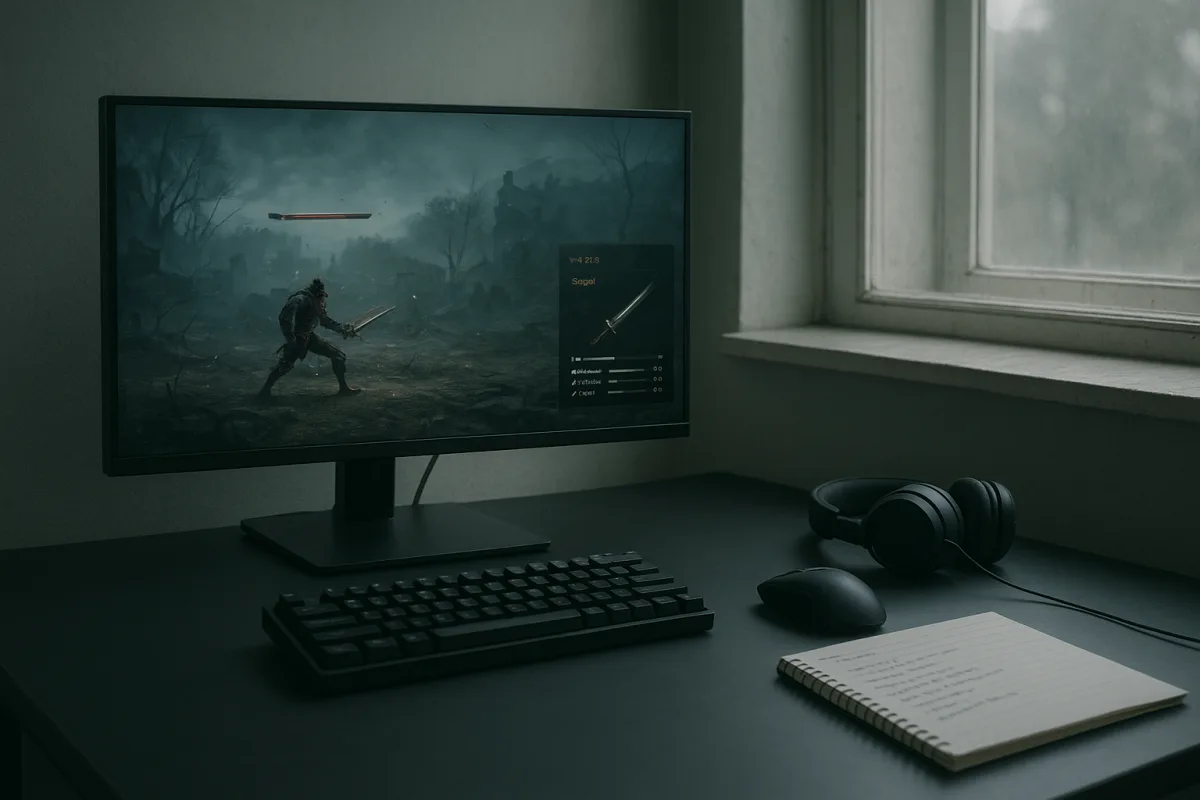
Phantom Blade Zero wants to look like the next endurance test for Souls veterans. It is not, at least not on its ordinary settings. Skill Up calls it a cinematic action game closer in structure to God of War than a game about corpse runs and repeated attrition.
That distinction matters immediately. Enemies do not respawn when you rest at bells, and dead regular enemies stay dead after you die. GameSpot found this makes routine encounters forgiving enough that you can gradually thin groups out instead of mastering every room in one clean attempt.
Bosses are the actual skill checks. IGN’s beginner guide notes that some multi-phase bosses even retain your progress past an earlier phase when you die, so the game is clearly trying to keep you moving rather than demanding flawless marathon attempts. [11]
There is some disagreement over the difficulty count. Skill Up reports four options, while GameSpot describes three, and GamingBolt names Pathbreaker, Hellwalker, and the 66 Days mode. The useful point is that difficulty can be changed, so do not mistake a bad matchup for a permanent build failure.
If normal enemy packs feel like decorative furniture, raise the difficulty for those stretches. GameSpot’s reviewer found that even the highest setting allowed too much button mashing against ordinary foes, while bosses became demanding enough to justify returning to medium.
Learn the resource loop before building bad habits
Your central meter is Sha-Chi. Heavy attacks and sustained blocking consume it, and an empty meter leaves Soul briefly helpless. Perfect parries deplete an opponent’s Sha-Chi instead, which is how you create the guard breaks that turn flashy offense into real damage.
The early mistake is treating this as a standard stamina bar, backing away every time it gets low. IGN’s guide identifies the intended reset button: switching primary weapons immediately refills your Sha-Chi. Use the swap proactively, not just because a weapon’s damage type looks better. [11]
A reliable beginner loop is simple. Spend Sha-Chi on two heavy attacks, use a Ghoststep or defensive movement to escape the answer, then swap weapons before the boss begins its next committed sequence. Community wiki advice specifically recommends planning around a 40-Sha-Chi spend rather than draining the bar thoughtlessly. [11]
Weapon swapping is therefore a quiet buff to aggressive builds. A player who alternates a fast blade and a slow heavy weapon gets two movesets, a fresh resource bar, and a way to keep attacking. A player who insists on one favorite sword gives up a large portion of the system.
GameSpot highlights the Outlaw Warblade as an example of why this matters. Its heavy attacks trade health for damage, while its ordinary attacks restore that health. That makes it a strong burst tool, but much safer when paired with a second weapon you can switch to for defense.
Do not hold block against every string. Blocking drains Sha-Chi, whereas a successful parry preserves yours while chewing through the enemy’s. Blue and red flash attacks are the game’s more explicit test: one response asks for a parry, the other for a dodge, with tighter timing than ordinary attacks.
Build around level-five unlocks, not raw attack numbers
Phantom Blade Zero has more than 30 primary weapons and 25 secondary Phantom Edges, according to the combat guide. The quantity can encourage hoarding materials, but that is the wrong read. The interesting parts of many weapons arrive through upgrade thresholds. [2]
Push a weapon to level 5 before deciding whether it deserves a permanent slot. IGN points out that Jagged Steel gains a heavy bleed-building effect against guard-broken foes at level 5, while Sanguin and Sanguin Twin gain a 20-second damage buff at that same breakpoint. [11]
This is where status builds become matchup-dependent rather than universally good. Bleed is valuable against living enemies, but Skill Up notes that puppets cannot bleed, because they are not living targets. Do not enter puppet-heavy areas with a bleed-focused setup and assume the numbers are broken.
The obvious counter is a raw-damage or guard-break weapon. GamingBolt particularly liked pairing corrosion-building dual blades with a heavy two-hander, using the first weapon to trigger a delayed damage burst, then swapping into the second to launch or stagger enemies.
Use the refund system aggressively in the early and mid-game. Weapons and Phantom Edges can be reverted from level 10 and below for a full material return, according to IGN. Past levels 10 and 20, reverting costs special consumables, so experimentation becomes less free but remains possible. [11]
This system quietly kills the usual action-RPG trap of committing to a weapon because you have already sunk upgrades into it. It also means a level-five test is cheap research. If a weapon’s alternate moves do not click, reclaim the materials and try the next one.
Phantom Edges are not just emergency damage. The Dread Axe can break shields and armor, the Hunter’s Chain Sickle can pull targets toward you, and GamingBolt highlights a flying sword that gives melee builds an answer to mobile enemies. Build a tool kit, not two versions of the same sword.
Accessories should solve a concrete failure. If blocking keeps breaking your guard, use Sha-Chi drain reduction and faster guard-break recovery. If you reliably land rapid strings, GamingBolt notes accessories that briefly raise melee damage after repeated hits can turn that consistency into damage.
Beat bosses by identifying the problem they are asking you to solve
Bosses are where the game earns its martial-arts reputation. The best fights let light attacks, heavy attacks, parries, dodges, weapon swaps, and cinematic finishers intersect instead of forcing the familiar wait, dodge, punish rhythm. GameSpot’s review rightly identifies that flow as the game’s strongest feature.
Still, spectacle can hide useful information. Community testing collected by the Phantom Blade Zero Wiki recommends listening as well as watching. Crimson Warden reportedly gives a low metallic ring before an overhead strike, a better parry cue than staring at a weapon through particle effects. [11]
After a successful guard break, do not automatically dump every attack. IGN notes that finishers make Soul fully invulnerable. If other enemies are attacking, wait a moment and trigger the finisher through incoming damage, turning the animation into a defensive escape. [11]
For Wan Jun Coppermaul, community players recommend sidestepping after parrying the boss’s combo, then punishing the recovery rather than trying to trade into the follow-up. That is a more dependable plan than attempting to win a damage race against a heavy weapon. [11]
Some encounters want a different loadout, not cleaner execution. GamingBolt describes a mounted, shield-carrying boss that struggles to close distance against the flying sword. That is the game quietly telling you that ranged Phantom Edges are tactical tools, not merely stylish cooldowns.
Watch the arena as closely as the boss. Community guidance calls out Hua’s spider lilies, which explode if ignored. Long boss health bars already make these fights demanding, and the independent research brief notes reports of some encounters becoming damage-spongey. Do not add avoidable environmental damage to that clock.
Explore now, then return with the right tools
The first regions teach a misleading lesson: keys and cranks are often near their locks. Later areas stop doing that. GamingBolt found that some gates remain closed for hours, while Phantom Edges can open routes into entirely new areas.
Treat red route markers as deferred content, not unfinished failure. IGN says inaccessible routes turn bright bluish green when you acquire the required tool. Return then, because these detours can contain upgrade materials, quest items, secret bosses, and weapons. [11]
Read scrolls and inspect glowing objects. They are not just lore delivery. IGN says these interactions commonly award Remnant Dust, the broadly useful currency for character and gear progression. In a game that sometimes makes upgrade materials feel scarce, free currency is worth the short pause. [11]
The Outpost cell is the first clean example. Polygon’s route has you find the key above the Outpost bell, on the path near Forge the smith, then return to the Outpost Courtyard cell for a Blackstone Fragment. Four fragments become a Blackstone that adds 10% attack and guard-break power. [11]
That reward makes this kind of detour more than completionist housekeeping. Ten percent guard-break power directly supports parry-oriented and heavy-weapon builds, because it gets you to the vulnerable state where your most damaging moves and finishers matter.
Do not lose side quests to story progress
Before ending a region, speak to every named NPC again and advance every active quest as far as possible. IGN warns that some side quests disappear when their associated character moves onward. Yu’er’s medicine quest is explicitly one of those cases. [11]
Polygon’s route for “A Healer’s Mercy” starts at the Thieves’ Camp in Crimson Forest after defeating Jing Ye, the Outlaw. You must give medicine to four wounded thieves, including Li behind blue flowers in the western cave from Outlaw Trap. [5]
The remaining route matters because the game does not make it obvious. Get the Crimson Forest Tunnel Crank in that cave system for Zhou, collect the Thieves’ Camp Dungeon Key from Cliffside Lodge’s basement route, then find the final thief outside that tunnel before returning to Yu’er. [5]
In Village of Lu, complete “Young Mistress” before the regional final boss. Polygon reports that finding all five ribbons adds an extra phase to that fight, but beating the upgraded version rewards Fiend Saws in addition to the regular Wild Oriole Sword. [8]
That is a useful warning against blanket advice to avoid optional difficulty. This quest makes the immediate boss harder, but it also converts exploration into a concrete weapon reward. Listen for the bells on ribbons and finish the search before entering Puppet Testing Grounds. [8]
PC and console settings: do not assume the shiny option is the good option
The official PC target is modest only if you read the fine print. Minimum specification is a GTX 1660 6GB or RX 5500 XT 8GB for 1080p at 30 FPS with upscaling, while the recommended RTX 3060 Ti or RX 6700 XT target is 1440p at 60 FPS with upscaling. [1]
The problem is not a lack of settings. It is a lack of broad independent benchmark coverage. Skill Up reported around 90 FPS at 4K maximum settings with DLSS Quality and ray tracing off on a high-end PC, but that is one reviewer’s system, not a buying guide.
The independent research brief also records frame-pacing and camera-stutter reports on high-end RTX 5080 systems with path tracing enabled. That should cool both the launch-day panic and the publisher-style assumption that a high average frame rate equals smooth combat.
Start with ray tracing and path tracing off, use an upscaler mode appropriate to your GPU, and prioritize stable frame pacing over screenshots. Combat built around tight parries is exactly where uneven delivery feels worse than a lower but consistent frame rate.
On PS5, reported 60 FPS performance is mostly stable, while the 40 FPS option has uneven pacing even with VRR. PS5 Pro improves image quality and ray tracing, but the research brief says it does not materially fix that 40 FPS issue. [6][7]
Storage is its own boss fight. Expect about 145 GB installed, and PC Gamer reports the pre-load process needs 300 GB free. Clear the drive before launch rather than discovering the requirement after downloading most of the game. [1]
The themed XR glasses are optional, and very specifically optional
Viture’s Phantom Beast XR Glasses cost $599 and began shipping on October 29, 2026. They offer a claimed 174-inch virtual display, Sony Micro-OLED panels, USB-C device support, spatial audio, and game-themed accessories including a scabbard-style case and metal blade replica. [8][10]
They suit a player who already wants portable display glasses for a laptop, handheld, phone, or compatible console, and who specifically values the Phantom Blade Zero styling. They do not increase frame rate, reduce input latency by magic, or fix the game’s uneven frame pacing.
For comparison, Viture’s non-themed Beast XR model costs $549 and suits buyers who want the same basic category without paying the Phantom Blade collector premium. Meta Quest 3, Apple Vision Pro, PlayStation VR2, and HTC Vive Pro 2 suit different VR or spatial-computing use cases, but the supplied research does not provide comparable current prices for all four. [8]
That distinction matters because the Phantom Beast is display hardware, not a full standalone VR platform. It has a narrower 58-degree field of view than Meta Quest 3’s cited 110 degrees, while PSVR2 is PS5-specific and HTC Vive Pro 2 demands a powerful wired PC. [8]
If you play Phantom Blade Zero at a desk, spend the $599 on storage, a better display, or hardware headroom first. If you travel with a handheld or laptop and already like XR display glasses, the Viture Phantom Beast edition is a themed luxury rather than an irrational one.
Frequently Asked Questions
How do I effectively use weapon swapping in Phantom Blade Zero?
Weapon swapping immediately refills your Sha-Chi meter, which is crucial for maintaining offensive pressure and defensive options. Use swapping proactively rather than only for matching damage types; alternating between a fast blade and a slow heavy weapon gives you two movesets and a fresh resource bar. This approach lets you keep attacking and manage Sha-Chi efficiently, avoiding the pitfalls of relying on a single weapon.
What are the best strategies for managing Sha-Chi in Phantom Blade Zero?
Sha-Chi is consumed by heavy attacks and blocking, but perfect parries deplete the enemy’s Sha-Chi instead. A good beginner strategy is to spend Sha-Chi on two heavy attacks, then use evasive moves like Ghoststep before swapping weapons to refill Sha-Chi. Avoid holding block too much since it drains Sha-Chi, and focus on timing parries and dodges to preserve your resource.
When should I upgrade weapons to level 5 in Phantom Blade Zero?
It is recommended to upgrade promising weapons to level 5 first because many weapons gain their defining properties at this threshold. After reaching level 5, you can freely refund early upgrades if the weapon’s moveset does not suit your playstyle. This strategy helps you focus resources on weapons that unlock meaningful abilities rather than just raw attack numbers.
How does difficulty affect enemy behavior in Phantom Blade Zero?
Difficulty settings can be changed and affect how challenging enemy encounters are. On normal difficulty, enemies do not respawn after resting, and dead regular foes stay dead, making encounters more forgiving. Raising difficulty increases the challenge of enemy packs and bosses, with bosses becoming demanding enough to require more skill, while ordinary enemies remain manageable.
What are the key tips for completing side quests in Phantom Blade Zero?
You should complete side-quest steps before finishing each region’s main objective because some NPC quest progress can disappear once the story advances. Clearing these quests early ensures you do not miss out on content or rewards tied to NPCs before the narrative moves forward.
How we researched this
This article was assembled from 4 video sources across 4 channels, 8 published articles, 11 cited references.
Nothing here is based on hands-on testing. Where a figure or finding appears, it belongs to the source cited beside it, and the writing says so rather than implying otherwise. Every source is listed below so you can check it.
Sources
I strongly recommend: Phantom Blade Zero (Review) — Skill Up
Phantom Blade Zero's Combat Is So Good, You Won't Care The Story Makes No Sense | Review — GameSpot
Phantom Blade Zero PS5 Review - An Absolutely Phenomenal Experience — GamingBolt
'A Healer's Mercy' quest walkthrough in Phantom Blade Zero — Polygon
Viture Phantom Beast XR Glasses Are Available for Preorder — IGN
Everything We Saw At Nintendo’s October Indie World Showcase — Kotaku
PS Plus November Games Include Dead Island 2 and Tomb Raider Remasters — IGN
Umamusume: Pretty Derby Cosplayer Details Brutal Arrest By ICE Agents — Kotaku
Where to find the Outpost cell key in Phantom Blade Zero — Polygon
Blizzard Sparks World of Warcraft Fan Backlash for 'Breaking Promise' Over Housing Microtransactions — IGN
Phantom Blade Zero Combat Guide: Gameplay and Combat Explained
Phantom Blade Zero review: S-Game makes its debut in style with one of the year's best action games
Phantom Blade Zero review: dark wuxia martial arts masters with an apprentice's execution
Phantom Blade Zero tested on PS5 and PS5 Pro – there are nuances
Phantom Blade Zero just got its own $599 XR glasses, and the case steals the show - PhoneArena
Phantom Blade Zero Normal Mode Tips For New Players | Phantom Blade Zero Wiki
Watch Phantom Blade Zero Gameplay and Guides on Youtube
Also from the sources
Related Articles
Phantom Blade Zero PC Gameplay and Performance Guide
Explore Phantom Blade Zero PC gameplay, system requirements, and optimization tips to ensure smooth performance and master combat mechanics.
Phantom Blade Zero Critical Acclaim and Review Overview
Explore Phantom Blade Zero critical acclaim, pre-launch reviews, edition comparisons, and PC requirements before its October 2026 release.

Control Resonant Gameplay and Graphics Review Deep Dive
Explore Control Resonant gameplay, Gravity Shift mechanics, graphics settings, and edition comparisons for an optimized PC gaming experience.
Phantom Blade Zero PC Technical Issues and Review Summary
Discover Phantom Blade Zero PC technical issues, system requirements, and gameplay insights to decide when and how to play.