
Gamescom 2026 Indie and Strategy Games Highlights
Explore key indie and strategy game highlights from Gamescom 2026, including gameplay, release info, and PC hardware insights.
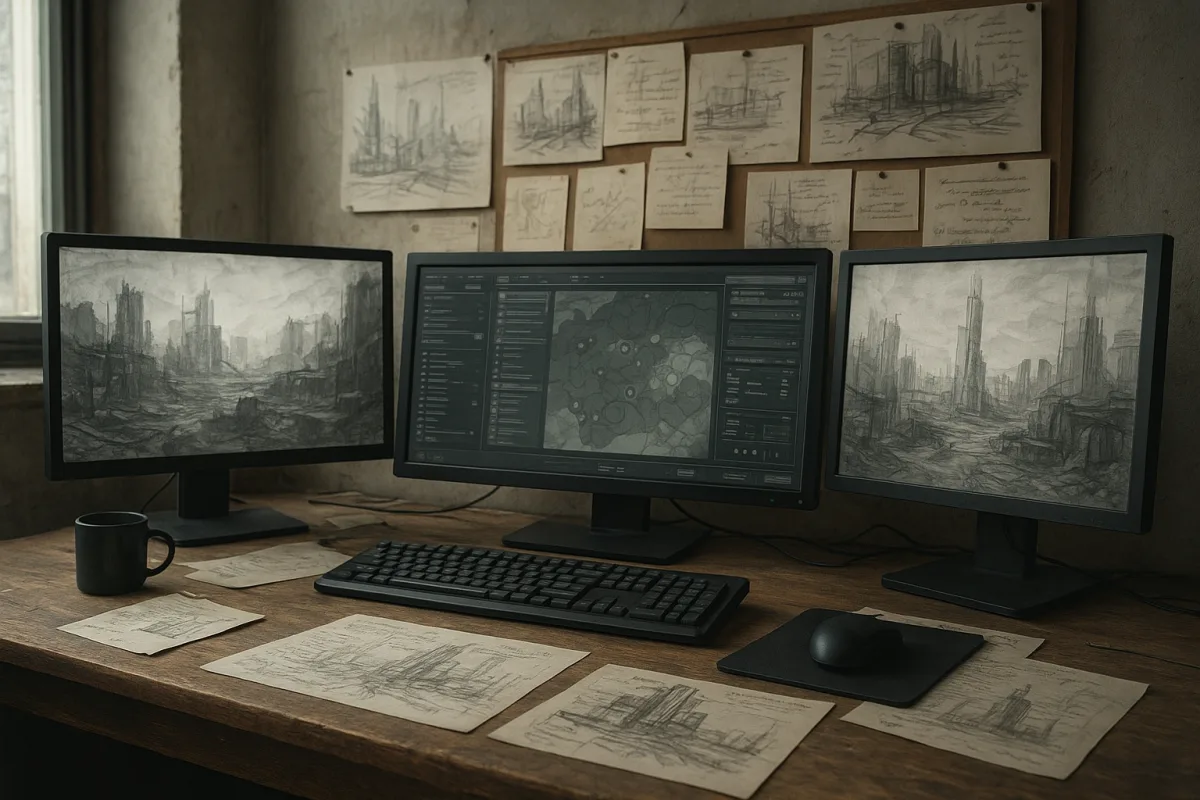
Indie and Strategy Game Highlights from Gamescom 2026
The quick list
- Best overall: Afterworld, for strategy players who want Paradox-scale social systems with a more readable early game.
- Best for detective fiction: Neo Berlin 2087, for players who prefer scanning scenes and following clues to managing a nation.
- Best for economic planners: Rise of the Merchants, for players who enjoy turning a small settlement into a trade network one convoy at a time.
Gamescom 2026’s useful question is not which of these games had the flashiest trailer. It is which one matches the kind of PC game you will actually stick with after the first evening, when menus, pacing, hardware demands, and repetition start to matter.
The three games occupy very different parts of the spectrum. Neo Berlin 2087 is a single-character cyberpunk investigation game built around authored scenes. Afterworld is an ambitious post-apocalyptic grand strategy game. Rise of the Merchants is a smaller-scale medieval economic and political simulation where individual workers, routes, and local votes matter.
That makes this less of a direct head-to-head than a choice between three kinds of mental load. Neo Berlin asks players to inspect. Afterworld asks them to adapt. Rise of the Merchants asks them to optimise.
Comparison table
| Game | Genre and scale | What the Gamescom material showed | Price | PC hardware picture | Main trade-off |
|---|---|---|---|---|---|
| Neo Berlin 2087 | Cyberpunk detective action game, focused on individual crime scenes and investigations | Scanning bodies, bullet damage, DNA traces, audio evidence, dialogue, and a District 13 murder investigation | Not announced | No official requirements. A community wiki lists 16GB RAM and 85GB SSD storage as minimum or recommended, but this is unverified | Strong atmosphere, but much less evidence so far of how its wider gameplay loop holds together |
| Afterworld | Post-apocalyptic grand strategy and 4X game across a procedural North American map | Exploration, settlement migration, resource management, social values, tribes, diplomacy, and eventual warfare | Not announced. Comparable 2026 strategy releases range from $19.99 to $29.99, but that is not a price confirmation | No official requirements announced | The deepest systems, but also the biggest risk of complexity and a longer wait for polish |
| Rise of the Merchants | Medieval trade, settlement, political, and economic simulation | Convoys, workers, production chains, bandit risk, elections, settlement needs, and regional trade | Not announced | No official requirements announced | More grounded economic play, but likely a narrower fantasy than conquest-focused strategy games |
Neo Berlin 2087: the cinematic option, with the largest PC-spec question mark
Elysium Game Studio’s Neo Berlin 2087, shown by IGN, is the clearest choice for players who want a story-led game rather than an open-ended simulation. Detective Nolan investigates a massacre through dialogue, forensic scanning, bullet analysis, blood evidence, and environmental clues.
The pre-alpha sequence is deliberately slow. Nolan checks armour-piercing impact damage, shell casings, blood spatter, shoe prints, strangulation marks, and possible neural implants. That puts it closer to a crime-scene adventure with action-game presentation than to a pure shooter.
The promising part is that the clues shown are not only decorative. The demo has Nolan infer that a victim’s gunfire does not match a straightforward one-attacker scenario, then later identify a death as suicide after examining evidence. That is the sort of layered investigation Neo Berlin needs.
The concern is scope. A polished detective scene can sell a premise, but it does not answer whether the final game has enough player agency between those scenes. The IGN demo establishes an atmosphere and a forensic toolset, not yet a full account of progression, combat depth, or replayability.
Hardware is also the area where readers should keep their wallet closed for now. Neither Elysium Game Studio nor publisher ByteRockers’ Games has announced official PC specifications. A community-maintained wiki updated on August 14 lists an Intel Core i5-10400 or AMD Ryzen 5 3600, plus a GTX 1660 Super or RX 5600 XT, as minimum hardware.
That same unofficial listing suggests 16GB of DDR4 memory and 85GB of SSD storage at minimum, with an RTX 3070 or RX 6800 XT for recommended settings. Its claimed ultra ray-tracing tier jumps all the way to an RTX 4080 or RX 7900 XTX, 32GB DDR5, and a Core i9-13900K or Ryzen 7 7800X3D.
Those numbers are plausible for a visually dense Unreal Engine-style cyberpunk game, but plausible is not the same as confirmed. Neo Berlin 2087 is currently targeting 2028, and requirements can move dramatically before release. Do not interpret a community wiki as a reason to upgrade.
That caution matters more in 2026 than it would have a few years ago. IDC’s revised forecast expects PC shipments to fall 11.3 percent amid memory shortages and rising component costs, even as the overall market’s value rises to $274 billion. [11] A game demanding 32GB DDR5 and high-end ray tracing would narrow its reachable audience.
Neo Berlin 2087 has no announced price, edition structure, or confirmed system requirements. For now, it suits players who are willing to wishlist a promising detective premise, then wait for the mundane but essential details before deciding whether it deserves 85GB of SSD space.
Afterworld: the strategy game trying to make the first ten hours less hostile
Paradox Interactive’s Afterworld is the most structurally ambitious game here. It is a grand strategy game set in a ruined North America, but its opening is not about inheriting a state with 40 menus and an ancient constitutional crisis.
Instead, the player begins with a tribe trying to survive. Eurogamer’s hands-on describes a Shelterborn origin, descendants of bunker residents forced onto the surface when their shelter fails. The early task is immediate and legible: explore five provinces, find resources, and choose somewhere safer to settle.
That is a meaningful layout decision, not merely tutorial dressing. Traditional Paradox games often introduce major systems early because the state already exists. Afterworld reportedly hides certain mechanics until exploration reveals the relevant idea, such as fishing after finding a river or mobile warfare after encountering roads and vehicles.
For new players, this may be the game’s best feature. The strategy layer is not removed, it is staged. Eurogamer reports that discoveries unlock Ideas, which then open research and societal options. The player learns because the wasteland presents a problem, not because a tooltip insists on explaining every subsystem immediately.
Afterworld’s real build-making happens through tribes and bands. IGN’s preview describes traditions as practical strengths, values as ideological preferences, and customs as the evolving story-driven traits that change both. Recruiting another band can expand your workforce quickly, but may introduce values that destabilise the wider tribe.
That is the balance lever to watch. A militaristic expansion path may solve labour shortages, but it can create cohesion problems. A humane settlement model may stabilise people through food, water, and amenities, but could leave a player weaker when a hostile power wants tribute.
The game also leans into mobility. A settlement can apparently be packed up and moved, and Eurogamer reports that radiation, fertility, roads, and resource access all matter when selecting territory. This is less about drawing perfect borders than surviving a map that may make your first home indefensible.
The Gamescom material points to three currently described starting origins. Eurogamer identifies the beginner-friendly Shelterborn, a religious group aligned with an Ancient, and a more militaristic group of wardens and prisoners. Those origins should alter the early route without locking the player into one final identity.
That is the quiet promise here. Afterworld wants player stories, not simply optimal opening builds. Game Developer reports that director Dan Lind sees the tribe origins as a role-playing on-ramp, a way to help people form goals before the full grand-strategy sandbox opens up.
Still, potential is not a balance pass. There is no published pricing, no formal release date, and no verified body of public alpha feedback or developer-disclosed balance data as of early September 2026. The available Gamescom hands-ons show early builds, not the settled economy or combat meta.
The price question is also open. Comparable 2026 indie strategy games range from Global Protocol: New World Order at $19.99 to Songs of Conquest at $29.99, so a $20 to $30 estimate is reasonable context, not a Paradox announcement. Do not treat it as a promised bracket.
Afterworld benefits from a market that is no longer exclusively top-heavy. Newzoo’s data, reported by TechSpot, shows games ranked outside the top 20 producing 56 percent of Western PC spending in 2025. [10] That is good news for niche strategy, although discoverability remains brutal.
Rise of the Merchants: the logistics game where one donkey can change the plan
Black Duke Games’ Rise of the Merchants has the most contained premise, which may make it the easiest recommendation for players who already know they enjoy economic simulations. You start with a run-down medieval settlement and aim to become an influential governor through trade, production, and politics.
The IGN reveal begins with about 20 settlers in Frankenhof. At that population, fulfilling a local demand takes three units of goods. That small number matters because it establishes the game’s scaling pressure: early trade is manageable, then demand rises as the settlement grows.
The core unit is the convoy. In the demonstration, a starter convoy has a range of 40 fields and capacity for eight units, using carriers and a guard. The player sends it eight fields to another settlement for stone and iron ore.
Route planning has actual trade-offs. Mountain terrain wears down vehicles more heavily, wooded terrain raises the chance of ambush, and guards reduce risk rather than erase it. This is not a game where the cheapest good automatically wins if the route burns time and protection.
The best early build in the reveal is not a flashy one. It is a compact loop of workers in ruins, a warehouse upgrade, a donkey and stable, then a fishing hut and smokehouse. Skilled workers improve production speed through strength and goods quality through dexterity.
That creates a recognisable economic spike. Quality smoked fish sells well when demand lines up, and the player can push that stock with a better convoy using an ox and cart for greater capacity and distance. The trade-off is investment: more infrastructure creates more goods, but also more storage and staffing pressure.
Politics works as another resource system. Building a town hall opens elections, and the shown Warden of Works position makes buildings cheaper and production faster. That can quietly strengthen a manufacturing-focused settlement more than simply hiring another worker, especially once materials become the bottleneck.
Rise of the Merchants also adds local events with consequences. A donation to a beggar can improve reputation but increase theft risk. A church helps settlers recover from grief. A tavern reveals character information and can build favour, but repeated visits risk making the merchant look unreliable.
This is the least obviously expensive game in the group, but it does not have a public price. Small economic simulations are often built under harsh constraints: industry reporting places median indie development costs around $30,000 to $60,000, while more than one-third of developers self-fund. [4] [5]
That context does not excuse rough launches, weak onboarding, or missing testing. It does explain why a simulation with worker traits, pathing, supply, local politics, events, and bandit encounters is a harder project than its peaceful medieval art style suggests. Pre-release testing is especially valuable in identifying what players misunderstand. [1]
Who each option suits
Neo Berlin 2087 suits players who want authored cyberpunk storytelling, detective work, and close environmental observation. It is the least suitable choice for anyone who wants confirmed performance data, a known price, or proof that its investigation systems stay interesting across a full campaign.
Afterworld suits players who want the broadest strategic sandbox and enjoy making social, ideological, and logistical decisions under pressure. It looks particularly relevant to newcomers intimidated by Crusader Kings or Hearts of Iron, but it remains an announced project rather than a finished strategy package.
Rise of the Merchants suits players who enjoy the satisfaction of efficient routes, improving worker quality, reacting to local demand, and converting commerce into political influence. It is likely the strongest fit for fans of economic strategy who prefer a settlement-scale game to continental conquest.
Frequently Asked Questions
What are the top indie and strategy games showcased at Gamescom 2026?
The top indie and strategy games highlighted at Gamescom 2026 are Afterworld by Paradox Interactive, Neo Berlin 2087 by Elysium Game Studio, and Rise of the Merchants by Black Duke Games. Each targets different player interests: Afterworld focuses on grand strategy with social systems, Neo Berlin 2087 is a cinematic cyberpunk detective game, and Rise of the Merchants centers on medieval economic and political simulation.
Which indie strategy games were highlighted at Gamescom 2026?
The indie strategy games highlighted include Afterworld, a post-apocalyptic grand strategy game with exploration and tribe-building, and Rise of the Merchants, which emphasizes trade routes, workforce management, and local politics. Both games offer distinct strategic experiences without announced release dates or prices.
What gameplay features do the Gamescom 2026 indie and strategy games have?
Afterworld features exploration, settlement migration, resource management, social values, diplomacy, and warfare on a procedural map. Neo Berlin 2087 focuses on forensic investigation with scanning evidence like bullet damage and DNA traces in a cyberpunk setting. Rise of the Merchants involves managing convoys, production chains, bandit risks, elections, and regional trade in a medieval context.
Are there any announced release dates or prices for Gamescom 2026 indie and strategy games?
No official release dates or prices have been announced for Afterworld, Neo Berlin 2087, or Rise of the Merchants as of Gamescom 2026. Neo Berlin 2087 is targeting a 2028 release window, while pricing for Afterworld might be similar to comparable 2026 strategy games priced between $19.99 and $29.99, but this is speculative.
What PC hardware requirements are expected for Gamescom 2026 indie and strategy games?
No official PC hardware requirements have been announced for Afterworld or Rise of the Merchants. For Neo Berlin 2087, only unverified community-sourced specs exist, suggesting minimum hardware like an Intel i5-10400 or Ryzen 5 3600 CPU, GTX 1660 Super GPU, 16GB RAM, and 85GB SSD storage. These requirements may change before its planned 2028 release.
How we researched this
This article was assembled from 3 video sources, 2 published articles, 11 cited references.
Nothing here is based on hands-on testing. Where a figure or finding appears, it belongs to the source cited beside it, and the writing says so rather than implying otherwise. Every source is listed below so you can check it.
Sources
Neo Berlin 2087 - Official Pre-Alpha Gameplay Demo | gamescom 2026 — IGN
Afterworld: The First Hands-On Preview: A (Probably Too Early) Taste of Paradox’s Next Big Thing — IGN
Paradox's Afterworld feels like the first grand strategy game I can properly wrap my head around — Eurogamer
Paradox Interactive's Afterworld wants to entice new players to grand strategy with tasty RPG hooks — Game Developer
Pre-Release Experimentation in Indie Game Development: An Interview Survey
Indie Game Development Costs 2026: $30K-$60K Median by Genre | Steam Page Analyzer
Why AAA Gaming Is in Crisis (And Why That's Good for Everyone Else) | GamerEmpire
10 ways 2026 will be a turning point for game design, according to indie devs
Watch Indie and Strategy Game Highlights from Gamescom 2026 on Youtube
Also from the sources
Related Articles
Gamescom 2026 Game Announcements and Highlights
Discover key Gamescom 2026 game announcements and highlights, including RPGs, strategy titles, and free-to-play releases for PC and consoles.
Gamescom 2026 Game Previews: New RPGs and Unique Titles
Explore detailed Gamescom 2026 game previews covering new RPGs, unique gameplay, and PC requirements revealed at the event.
Gamescom 2026 Theft Impact on Indie Developers and Security
Explore how Gamescom 2026 thefts affected indie developers and the event's security measures to protect exhibitor equipment.
New and Upcoming PC Game Reviews and Previews 2026
Read detailed new and upcoming PC game reviews and previews for 2026, including Valheim 1.0, Aliens Fireteam Elite 2, NHL 27, and more.