
GTA 6 Open World Innovations
Explore GTA 6 open world innovations including dynamic localized weather, water simulation, and their impact on gameplay and environment.
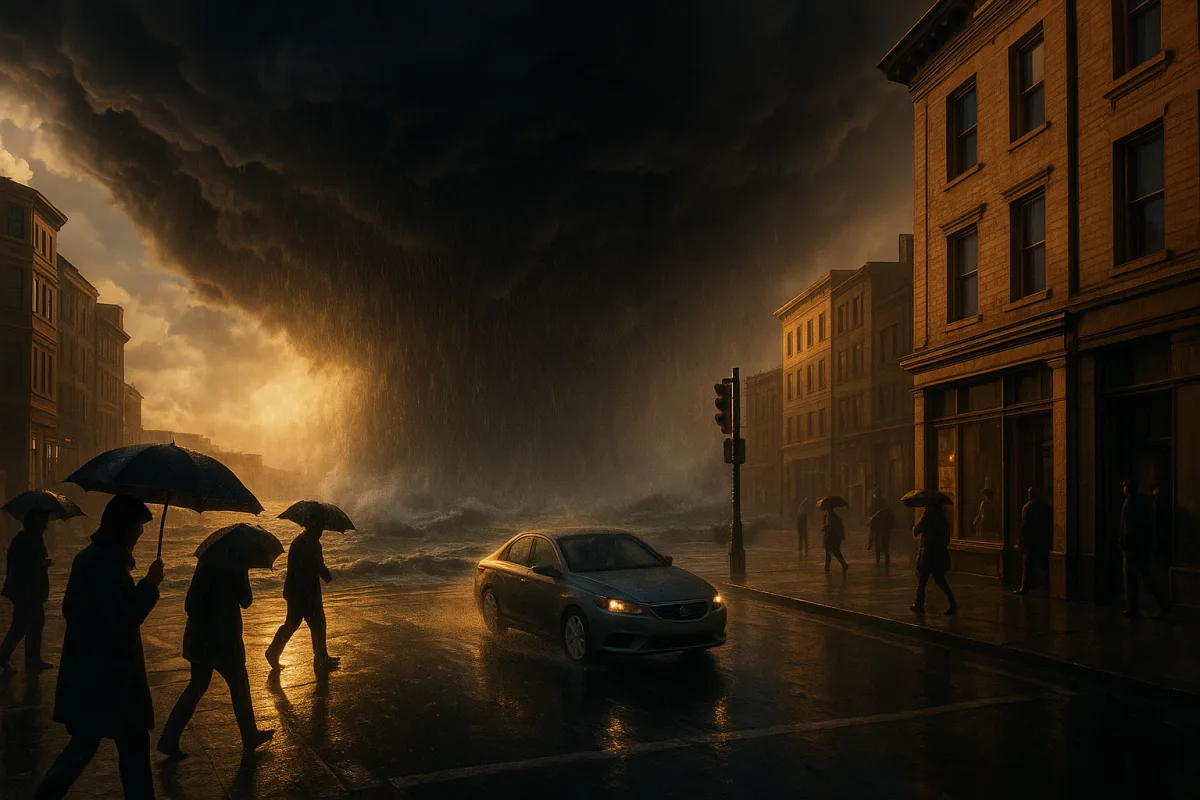
A storm over Leonida is the system to watch
A rainstorm rolls across a highway, the road turns slick, headlights stretch across wet asphalt, and nearby pedestrians abandon the sidewalk for shelter. A few miles away, the sun can still be out.
That is the clearest sign of what GTA 6 is trying to do differently with its open world. Rockstar’s Florida-inspired state of Leonida is not built around one global weather slider that changes the entire map at once. [5]
Previous Grand Theft Auto games had rain, fog, thunderstorms, wet roads, and shifting times of day. GTA 6 reportedly divides those conditions geographically, allowing sea fog around a beach, rain over a city district, and clearer weather elsewhere. [5][6]
That sounds cosmetic until you follow the knock-on effects. Weather affects what you can see, how a vehicle behaves, where crowds go, how water moves, and whether an aircraft or boat remains a good escape route. [6][7]
For an open-world crime game, it turns weather into a moving modifier on every improvised plan. A chase through dry downtown streets and a chase through a wet coastal highway may use the same car, but they should not play alike.
How localized weather changes an open world
The basic trick is geographic variation. Instead of asking the game to render one universal rain state across Leonida, the engine can maintain different weather cells, each with distinct clouds, precipitation, wind, visibility, and surface conditions. [5][6]
That creates transitions players recognize from real driving. You can approach dark clouds on the horizon, enter a rain band, watch puddles accumulate, and later leave the storm behind without the entire state abruptly changing mood.
GamingBolt’s comparison highlighted this split weather behavior, including storms over one area while another remains sunny, fog swallowing views near South Ocean Beach, and puddles remaining after rainfall moves on. The channel also reported hurricanes.
Persistent wetness is where the system starts costing performance. Rain needs to alter material response across streets, roofs, vehicle paint, windows, beaches, and interior thresholds, while puddles must remain visible as clouds and sunlight keep changing overhead.
A wet road is not only darker. It reflects headlights, signs, neon, sky color, brake lights, and passing traffic. Each reflection needs a plausible answer without making the console spend all its frame time tracing every ray in the scene.
GamingBolt says GTA 6 combines ray tracing, screen-space reflections, and planar reflections. That hybrid approach is familiar in modern rendering: use expensive techniques selectively, then cover the rest with cheaper methods that look convincing from the player camera.
Screen-space reflections can only reflect information already visible on screen. They are quick, but break down when the reflected object sits outside the camera view. Planar reflections work well on flat surfaces, such as water, at their own cost.
Ray-traced global illumination is the bigger visual lever. GamingBolt reports that GTA 6 uses it to make indirect light respond differently across skin, hair, fabric, glass, paint, and surrounding surfaces, especially in mixed indoor and outdoor scenes.
The result is not a checklist feature. It is the reason a wet roadside bar, a car hood under neon, and a character standing beneath colored signage can belong to the same lighting environment instead of looking separately lit.
The water has to simulate consequences
Leonida’s setting makes water central. Boats, jet skis, wetlands, beaches, coastal roads, diving, and low-lying city areas all become pressure points for a weather system that changes waves and wind. [6]
Reports describe individually moving waves and currents that affect boats, plus weather severe enough to make sheltered water navigable while open water becomes dangerous. Aircraft can also take damage if they stay in storms too long. [6]
That is a gameplay system, not ambient decoration. A boat route across calm water can turn into a worse option mid-escape, while a storm might give you cover from long sightlines but make vehicle handling and navigation harder.
GamingBolt specifically describes water behaving differently across swamps, coastlines, and clearer open water, with underwater flora and fauna lit by filtered light. Those different water bodies need their own look, density, waves, and surface response.
GTA 5 already had boat wakes, waves, diving, and underwater refraction. The leap here is the connection between water state and weather state, with wind and storms altering the conditions that actually matter while you are moving through them.
It also makes the map feel bigger without adding a single square kilometer. A coast you cross in sunshine, shallow water, and light traffic can become a different route in rough weather, poor visibility, and flooding conditions.
Why crowd density is the expensive part
A hurricane means little if every pedestrian keeps strolling at the same pace. GTA 6’s weather needs to tell nearby NPCs to seek shelter, alter their routes, and still avoid one another in a dense street. [6]
That work sits alongside ordinary crowd simulation: pathfinding, traffic behavior, animations, reactions to crashes, combat, police activity, and the player’s chaos. Add changing weather, and the CPU has a large number of simultaneous decisions to make.
GamingBolt’s footage analysis calls out packed sidewalks, malls, varied NPCs, and animations that continue even while the surrounding scene stays busy. It also notes that pedestrians react to storms by scrambling for shelter.
The visible destruction adds another layer. GamingBolt reports plaster coming off walls under gunfire, shattered jewelry cases, and tires losing rubber, with fragments and sparks appearing when a rim hits the road after a tire is shot.
None of those systems needs full physical simulation on every object forever. Games typically prioritize the action nearest you, simplify distant simulation, and remove debris after a period. The art is hiding those compromises before you notice them.
GamingBolt observed some pop-in on PlayStation 5 Pro, even while praising the overall visual leap. That is the tradeoff in plain sight: Leonida streams a huge amount of geometry, traffic, materials, animation, and simulation as you move.
Why 30 fps is part of the design budget
Rockstar said GTA 6 is capped at 30 fps on PlayStation 5 and PlayStation 5 Pro, with the Pro unable to reach 60 fps because of CPU limits. [8] The console reaction was predictable.
A 30 fps cap gives the engine roughly 33.3 milliseconds to finish each frame. At 60 fps, it gets about 16.7 milliseconds. Doubling frame rate means cutting, simplifying, or accelerating a lot more than the image resolution.
The CPU has to coordinate traffic, crowds, AI routines, physics, animation, streaming, mission scripting, weather transitions, and network-adjacent services. Ray tracing stresses the GPU, but a packed living city can hit CPU limits first.
IGN reviewer Luke Reilly argued that the frame-rate debate looks different once you see the game’s nighttime density and lighting in motion. His view was based on a PlayStation 5 playthrough, not a PC performance analysis.
That does not mean 30 fps is invisible or irrelevant. Reports since launch include drops to 23 fps on base PlayStation 5 during intense scenes, alongside floating objects, clothing pop-in, and NPC pathfinding failures. [8][9]
Mission blocks, weapon losses after restarting, and stat losses have also been reported, though Rockstar had not publicly acknowledged or patched many of these issues by November 20. [9][10] A spectacular simulation still needs reliable state handling.
The early post-launch meta, then, is not “30 fps ruins GTA 6” or “30 fps is fine because it looks good.” It is that Rockstar has spent its console budget on density and simulation, with visible compromises under stress.
Map size is the wrong headline number
Leonida may be enormous, but Rockstar has not published an official map measurement. Community estimates put it around 82.6 square kilometers, while other comparisons describe it as roughly twice GTA 5’s map or close to several Rockstar maps combined. [2][3]
Those figures are estimates, not measurements from Rockstar. They can be useful for setting expectations, but they do not tell you how much of the space has interiors, traffic, missions, navigable water, wildlife, activities, or meaningful simulation.
IGN’s Reilly described an opening that becomes geographically open after the first mission of Chapter One, even as the story initially keeps Jason, a small-time criminal, working within one area. That is stronger than a raw area statistic.
A compact district with shifting weather, crowds, accessible activities, and reactive traffic can occupy you longer than empty countryside. Reilly also singled out pool as the kind of side activity that encourages ignoring missions for an evening.
We would judge Leonida by that density first. Map-size arguments usually age badly because players remember where spontaneous chases, bad decisions, and side activities happened, not the number of virtual square kilometers on a fan-made chart.
What PC players should actually do now
GTA 6 launched on PlayStation 5 and Xbox Series X|S on November 19, 2026. [4] Rockstar has not announced a PC version, release date, hardware requirements, graphics settings, or performance targets.
Ignore every speculative PC “recommended build” currently making the rounds. No one can responsibly tell you whether GTA 6 will favor CPU cache, VRAM capacity, ray-tracing throughput, upscaling quality, or fast storage until Rockstar publishes a port.
The visual evidence points to a game with expensive ambitions: ray-traced global illumination, layered reflections, dense crowds, dynamic weather, water simulation, destruction effects, and long-distance streaming. GamingBolt’s PS5 Pro comparison found a major step beyond GTA 5 Enhanced on PC.
That still does not translate into an RTX number, a Radeon number, or a target frame rate. A PC port’s settings, optimization work, upscalers, driver behavior, and CPU scaling decide that outcome, and none is public.
For now, the cleanest recommendation is simple. If you have a current console and want Leonida immediately, the Standard Edition costs $79.99 in the US and includes the base game. [11][13]
The $99.99 Ultimate Edition adds exclusive in-game content, including vehicles, matching revolvers, and customization items. [11] We would skip the upgrade unless those items matter to you, because they do not change the weather simulation or the world systems doing GTA 6’s real heavy lifting.
Frequently Asked Questions
How does GTA 6's localized weather system affect gameplay?
GTA 6’s localized weather system changes visibility, vehicle control, water conditions, NPC behavior, and damage risks in specific parts of the map without altering the entire environment. This means a storm in one area can create slick roads and reduced visibility, affecting chases and navigation, while nearby areas remain clear, making each location feel distinct and dynamic.
What technical innovations does GTA 6 introduce in its open world?
GTA 6 features geographically divided weather cells with individually moving clouds, storms, and waves that impact gameplay and visuals. The game uses a hybrid rendering approach combining ray tracing, screen-space reflections, and planar reflections to realistically depict wet surfaces, reflections, and lighting changes, enhancing immersion and environmental realism.
How does GTA 6 simulate water and weather interactions?
The game simulates persistent wetness by altering material responses across streets, roofs, vehicles, and interiors, with puddles that remain visible as weather changes. Water dynamics include individually moving waves and currents that can damage boats and aircraft, while reflections on wet surfaces respond to changing light and objects in the environment.
What are the gameplay consequences of dynamic weather in GTA 6?
Dynamic weather directly influences gameplay by modifying vehicle handling on wet or slick roads, reducing visibility during storms or fog, and affecting NPC crowd behavior. Weather conditions can change escape routes and tactical options, making each encounter and chase unique depending on localized weather effects.
Does GTA 6 have different weather conditions in separate map areas?
Yes, GTA 6 divides its map into weather cells allowing different conditions to occur simultaneously in separate areas. For example, one district may experience heavy rain while another nearby area remains sunny, creating realistic transitions and varied environmental challenges across the open world.
How we researched this
This article was assembled from 5 video sources across 2 channels, 13 cited references.
Nothing here is based on hands-on testing. Where a figure or finding appears, it belongs to the source cited beside it, and the writing says so rather than implying otherwise. Every source is listed below so you can check it.
Sources
GTA 6 Broke the Open World Formula… It’s About Time | GTFM, IGN
Grand Theft Auto 6 Graphics Tech Detailed - Unlike Anything We've Seen [A Big Jump From GTA 5], GamingBolt
Grand Theft Auto 6 Graphics Tech Detailed - Unlike Anything We've Seen [A Big Jump From GTA 5], GamingBolt
Grand Theft Auto 6 Graphics Tech Detailed - Unlike Anything We've Seen [A Big Jump From GTA 5], GamingBolt
Grand Theft Auto 6 Graphics Tech Detailed - Unlike Anything We've Seen [A Big Jump From GTA 5], GamingBolt
PlayStation suffers major outage hours before "GTA VI" launch
GTA 6's Rebuilt Weather System Brings Local Storms to Leonida | Rockstar Report
GTA 6 dynamic weather: storms, rain and fog will directly affect gameplay
GTA 6 Bugs and Performance: 30 FPS Drops, Series S Struggles, Launch Glitches
GTA 6 price by country: UK, US, Europe, Canada, Australia and more | GTA6 University
Watch GTA 6 Open World and Technical Innovations on Youtube
Also from the sources
Related Articles
Ace Combat 8 Wings of Theve Gameplay and Franchise Revival
Explore Ace Combat 8 Wings of Theve gameplay, new weather mechanics, system requirements, and how it revives the arcade flight combat franchise.
The Blood of Dawnwalker Gameplay Mechanics and Time Limit
Explore The Blood of Dawnwalker gameplay mechanics, including its unique 30-day time limit and PC performance insights.
Blizzard Upcoming Games 2026
Discover Blizzard's upcoming games in 2026 including Diablo 5, StarCraft open-world shooter, and Overwatch's new hero Doctrine with release dates and
Diablo 5 Procedural Generation and Diablo 4 Updates
Learn about Diablo 5's procedural generation, caravan system, class updates, and Diablo 4's upcoming Season of Hell and Switch 2 release.