
Tomb Raider Legacy of Atlantis Remake Preview and Criticism
Preview and critique of Tomb Raider Legacy of Atlantis remake, focusing on gameplay, scanner use, and PC specs.
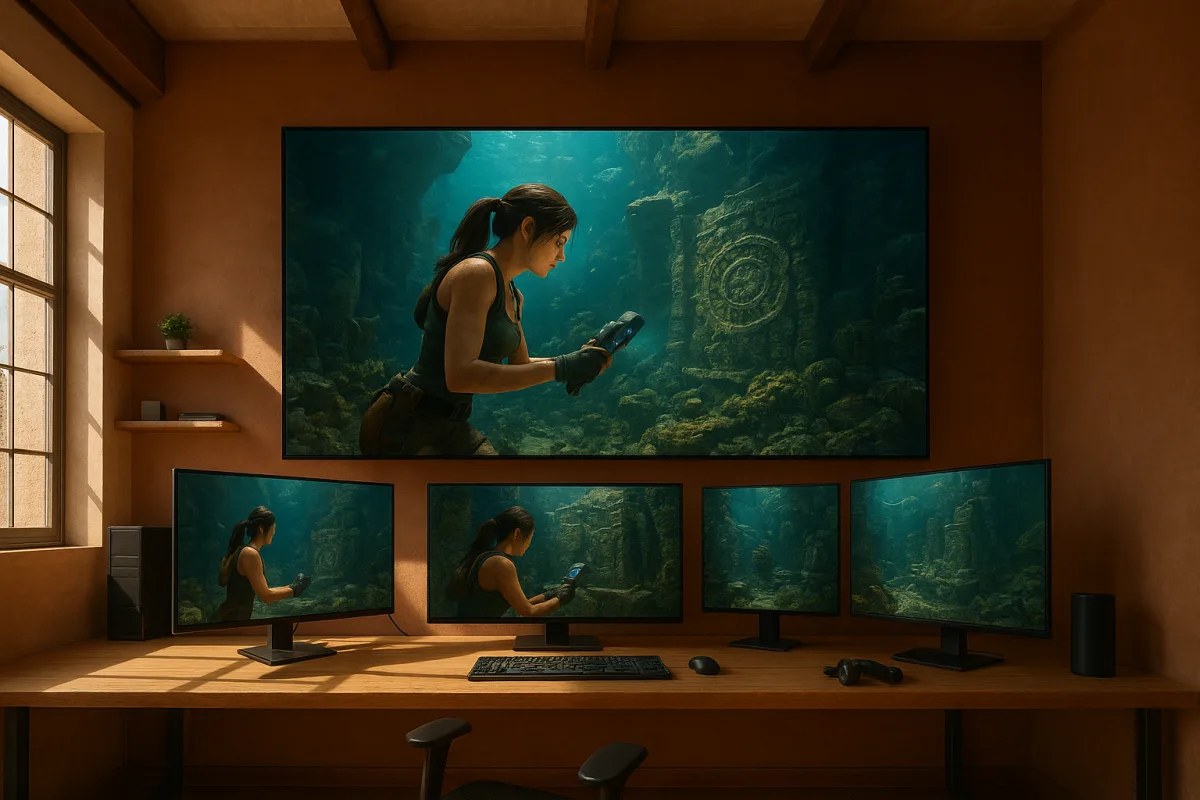
Tomb Raider: Legacy of Atlantis Needs to Trust Its Tombs
The scanner is the real remake argument
There are prettier arguments to have about Tomb Raider: Legacy of Atlantis. The Unreal Engine 5 lighting looks good. St. Francis’ Folly has gained waterfalls, vegetation, depth, and a genuinely imposing sense of scale in footage shown to GameSpot and Eurogamer.
But the scanner is the system worth watching. It is where this remake declares what it thinks the original Tomb Raider needed, and where the preview material most clearly exposes the tension between modern accessibility and old-school spatial problem-solving.
Legacy of Atlantis is not a simple remaster. Crystal Dynamics and co-developer Flying Wild Hog are rebuilding the 1996 game’s locations, movement, combat, progression, and story presentation for PS5, Xbox Series X|S, PC, and Nintendo Switch 2. [5][11][12]
That distinction matters because the original’s puzzles did not usually ask Lara Croft to identify an object type. They asked players to understand a place, remember its routes, judge jumps, and connect distant mechanisms with doors and keys.
The scanner appears to intervene at precisely that point. According to Crystal Dynamics experience director Jeff Adams in GameSpot’s Gamescom preview, its primary role is highlighting information considered crucial to environmental puzzles. That puts it in the same broad family as detective vision systems.
In practical terms, it can be used when a player is stuck, unsure what a mechanism does, or unable to visually parse a busy environment. A highlighted lever, climbable surface, key item, or relevant architectural feature can cut the search time dramatically.
That is the useful version of it. Big modern environments have more visual noise than their PlayStation-era equivalents, and Legacy of Atlantis is plainly going for denser scenes. A 1996 texture wall was rarely mistaken for an interactable object because it barely had enough pixels to be anything else.
What the scanner changes in a puzzle
The previews’ problem is not that a hint tool exists. The problem is the example Crystal Dynamics chose to show. In the St. Francis’ Folly sequence seen by GameSpot and Eurogamer, Lara scans a shut gate with four plainly visible slots.
The scan then explains that the gate remains closed and has four distinct slots. This is not a clue that asks the player to re-evaluate the room. It merely narrates information already communicated by the geometry.
That distinction sounds minor, but it changes the rhythm of play. A well-tuned hint system answers a question after the player has formed one: where have I not looked, what did that symbol mean, or what changed when I pulled that switch?
A weak hint system answers before the question exists. It says, in effect, that the player should not trust the room, their own observation, or Lara Croft’s supposed expertise. Pressing scan becomes a low-cost habit, not a deliberate fallback.
The direct mechanical cost appears to be nothing. Neither GameSpot nor Eurogamer reported a cooldown, consumable resource, charge limit, or failure state attached to scanning. If that remains true at launch, the only restraint is a player’s willingness not to use it.
That is why “optional” does not settle the issue. An optional feature can still affect level design, pacing, dialogue, UI clutter, and how aggressively a game signals interactable objects. Developers build around the tools they expect most players to use.
GameSpot’s preview noted that Crystal Dynamics says the scanner’s hint function is optional. Eurogamer reported a second use: scanning surroundings to reveal historical information and lore. This turns one device into both a progression tool and collectible-delivery channel.
The lore function is less obviously intrusive, but it still has consequences. In the original Tomb Raider, environmental storytelling was mostly environmental. A decayed chamber, an Atlantean relic, or an absurdly large mechanism invited players to draw their own conclusions.
A contextual scanner can make that history easier to access, which is welcome for players who want archaeology rather than guesswork. It can also flatten the sensation of discovering something strange if every object arrives with a tidy explanatory card.
Why this feels dated rather than modern
The strange irony is that the scanner’s design feels older than Tomb Raider’s original approach. The 1996 game could be brutally opaque, but it generally trusted its spaces to communicate through layout, landmarks, danger, and repetition.
Legacy of Atlantis’ scan prompt resembles the design language of the late 2000s and 2010s, when big action games often feared a quiet second. Objective markers, detective modes, glowing ledges, and voiced hints became the default antidote to friction.
That does not automatically make the remake worse. GamesRadar reported that the developers openly intend to adjust the original’s difficulty for modern player expectations, while maintaining the core things audiences expect from Tomb Raider. [4]
There is a sensible version of that project. The original’s camera, tank controls, save limitations, and occasionally hostile readability are not sacred simply because they are old. Modernizing movement and presentation can make the intended puzzle more legible, not less demanding.
The scanner becomes a problem only when it replaces the puzzle’s actual information economy. Tomb Raider’s best rooms give the player incomplete but meaningful evidence. You see a high ledge, a locked door, a movable block, and a switch beyond reach.
The outcome should depend on observation and navigation. A player succeeds because they recognize that a newly raised platform creates a route back to a previously unreachable ledge, not because a scan paints the platform and labels it “climbable.”
This is why the four-slot gate is such an unfortunate demonstration. It implies that Legacy of Atlantis may confuse basic comprehension with difficulty. Telling players that four sockets require four keys removes neither challenge nor frustration, it just wastes a line of dialogue.
The hidden cost is confidence
The usual defence is that experienced players can simply ignore the scanner. They probably can, just as experienced players can ignore waypoint lines and colour-coded loot rarity. But games train behaviour through convenience, not only compulsory rules.
If scanning reliably identifies the next relevant object, players learn that the fastest route to progress is checking the device first. The map becomes something to query rather than something to read. That can make even good puzzles feel pre-solved.
It also alters Lara’s role. In the original fantasy, Lara Croft is an extraordinarily capable explorer entering places no one understands. Eurogamer’s criticism lands because a scanner explaining obvious architecture makes her seem less observant than the player.
Crystal Dynamics is presenting a more character-driven Lara this time. IGN’s promotional feature introduces Adrienne Wilkinson’s Jacqueline Natla as a more emotionally expansive antagonist and a deliberate mirror to Lara, rather than merely a cartoonish endgame obstacle.
That could work well. The Scion hunt has room for clearer motivations and stronger connective tissue with later Tomb Raider continuity, even if detailed script comparisons are not yet available. The problem is that narrative depth does not require mechanical over-explanation.
If anything, a more confident Lara should need less machine-assisted interpretation. A scanner that provides optional historical background makes sense for a modern adventurer documenting discoveries. A scanner that identifies four visible keyholes makes her sound like a tutorial voice.
Other systems make the concern sharper
The scanner does not arrive alone. GameSpot saw Lara gather resources and craft a healing bomb, while Eurogamer described food recipes that offer temporary boons. Crystal Dynamics has also shown short-term resistance effects, including protection against traps.
These systems introduce preparation costs into a game once built around movement and immediate danger. If healing requires gathered materials and a crafted item, health recovery stops being a clean pickup economy and becomes inventory administration.
That could add tension if resources are scarce and recipes demand meaningful trade-offs. A player might choose between healing now, preserving materials for trap resistance, or pushing onward at low health. Nothing shown so far establishes that level of scarcity or choice.
Instead, the preview concern is redundancy. GameSpot questioned why Lara needs a Dead Eye skill to shoot distant Damocles swords when those shots appeared achievable without it. Eurogamer similarly noted the skill’s connection to safely dislodging the traps.
The Damocles room is a useful comparison point because it shows a better idea underneath the baggage. Legacy of Atlantis lets falling swords become platforms after Lara triggers them, changing the room’s traversal logic rather than merely decorating it.
That is a remake change with stakes. Players can take the risky route under the blades, then use their new positions to navigate. Shooting them from safety is a valid accessibility valve, but gating it behind a skill risks making caution feel like progression taxation.
The scan system has the same risk. If it is an emergency aid, it broadens the audience without wrecking the original’s exploratory rhythm. If its highlights are assumed by level design, the whole game shifts toward following sanctioned answers.
What to expect before release
It is too early to call Legacy of Atlantis a failure of design. The game is unreleased, the major Gamescom material was hands-off, and there are no player reports on bugs, balance, performance, or final puzzle tuning.
There is also no evidence that original puzzles have been removed wholesale. Reporting so far supports targeted expansion and modernization, not a documented list of cut rooms or simplified puzzle chains. Claims that every classic challenge has been gutted are premature.
The release timing is clearer. Steam and PlayStation Blog list the full launch as February 12, 2027, while February 10 applies to Deluxe Edition early access, not the general release date. [11][12]
The Standard Edition costs $59.99. The $69.99 Deluxe Edition includes the Parisian Fugitive Outfit and post-launch story DLC, but neither price includes the sort of thing PC players should care about most before pre-ordering: final performance evidence. [1][11]
Steam’s listed PC requirements ask for 16GB of RAM and 80GB of storage. The recommended GPU tier is an RTX 3080 or Radeon RX 6800 XT, with an Intel i7-9700K or Ryzen 5 5600X. [6]
Those are not alarming specifications for a current Unreal Engine 5 release, but they are high enough to make a launch-day wait sensible. No official patches, benchmark suite, upscaling analysis, or reliable frame-time testing exists yet. [6]
For now, the sensible position is neither panic nor blind nostalgia. The rebuilt Greece environments, expanded traversal, warmer Lara performance, and more layered Natla all sound promising. The scanner needs to prove it is a safety net, not the game’s designated brain.
Frequently Asked Questions
What are the key features of the Tomb Raider Legacy of Atlantis remake?
Tomb Raider: Legacy of Atlantis is a reimagining of the 1996 original, rebuilt with modern Unreal Engine 5 visuals, updated character models, animations, and lighting. It features redesigned locations, movement, combat, progression, and story presentation for PS5, Xbox Series X|S, PC, and Nintendo Switch 2. The remake includes a new scanner tool for puzzle hints and lore, and it expands the narrative with a deeper portrayal of antagonist Jacqueline Natla.
How does the scanner affect puzzle-solving in Tomb Raider Legacy of Atlantis?
The scanner highlights crucial information for environmental puzzles, such as interactable objects and architectural features, which can reduce search time. While optional, it risks turning exploration into a checklist rather than an investigation by narrating information already visible in the environment. The scanner also provides lore and contextual analysis, affecting how players engage with the story and surroundings.
What are the PC system requirements for Tomb Raider Legacy of Atlantis?
The minimum PC requirements include Windows 10/11 64-bit, an Intel i5-8600 or Ryzen 5 3600 CPU, 16 GB RAM, and a GTX 1070 (8GB), RTX 2060 Super, or RX 5700 GPU, with 80 GB of storage. Recommended specifications call for Windows 11 64-bit, an Intel i7-9700K or Ryzen 5 5600X CPU, 16 GB RAM, and a high-end GPU such as an RTX 3080 or Radeon RX 6800 XT. These specs indicate the game demands a relatively powerful PC for optimal performance.
Does Tomb Raider Legacy of Atlantis remake stay true to the original puzzles?
The remake retains iconic puzzles from the original 1996 game but adjusts their difficulty to suit modern players, likely making some challenges more manageable. It emphasizes spatial problem-solving and environmental deduction, though the scanner tool may alter how players approach puzzles by providing direct hints. There is no evidence that original puzzles were removed or significantly altered.
What criticisms exist about the Tomb Raider Legacy of Atlantis remake?
Pre-release previews praise the visual overhaul and promise of the remake but raise concerns about the scanner tool potentially undermining traditional puzzle-solving by making hints too explicit. The scanner’s design may encourage players to rely on it as a default rather than engaging deeply with the environment. No official release feedback or reports of bugs and performance issues are available yet.
How we researched this
This article was assembled from 2 video sources across 2 channels, 1 published article, 14 cited references.
Nothing here is based on hands-on testing. Where a figure or finding appears, it belongs to the source cited beside it, and the writing says so rather than implying otherwise. Every source is listed below so you can check it.
Sources
Tomb Raider: Legacy of Atlantis - Official 'Meet Natla' Overview — IGN
Legacy Of Atlantis' Beautiful Visuals Can't Hide Its Weird Changes - Preview — GameSpot
Tomb Raider: Legacy of Atlantis Preorders Are Live On PS5, Xbox, Switch 2, And PC - GameSpot
Tomb Raider: Legacy of Atlantis Compared to the 1996 Original
Tomb Raider: Legacy of Atlantis adds Switch 2 version, delayed to February 10, 2027 - Gematsu
Tomb Raider: Legacy of Atlantis Preview: Don’t Go Chasing Waterfalls
Tomb Raider : Legacy of Atlantis : prometteur, mais a encore besoin d'un coup de polish
Tomb Raider: Legacy of Atlantis takes a Different Approach with Villain
Tomb Raider Legacy of Atlantis Story — Scion, Natla, Unified Timeline (September 2026)
Tomb Raider: Legacy of Atlantis launches Feb 12, 2027 on PS5 – PlayStation.Blog
Watch Tomb Raider: Legacy of Atlantis Remake Preview and Criticism on Youtube
Also from the sources
Related Articles
Ocarina of Time Switch 2 Remake Features and Gameplay
Discover key features of the Ocarina of Time Switch 2 remake, including the jump button, puzzle redesigns, and updated combat mechanics.

Ocarina of Time Remake Coverage and Reactions for Switch 2
Get detailed coverage and fan reactions to the Ocarina of Time remake, including editions, gameplay changes, and release info for Nintendo Switch 2.

Persona 4 Revival vs Persona 4 Golden
Compare Persona 4 Revival and Persona 4 Golden: release dates, voice cast, gameplay, and which version PC players should choose.
Valor Mortis system requirements and review
Get detailed Valor Mortis system requirements and an in-depth review covering gameplay, combat, and hardware needs for PC players.