
Crimson Desert Charting the Unknown DLC: Gameplay and Tips
Explore Crimson Desert's Charting the Unknown DLC with gameplay insights, crew tips, diving, and voyage strategies for PC players.
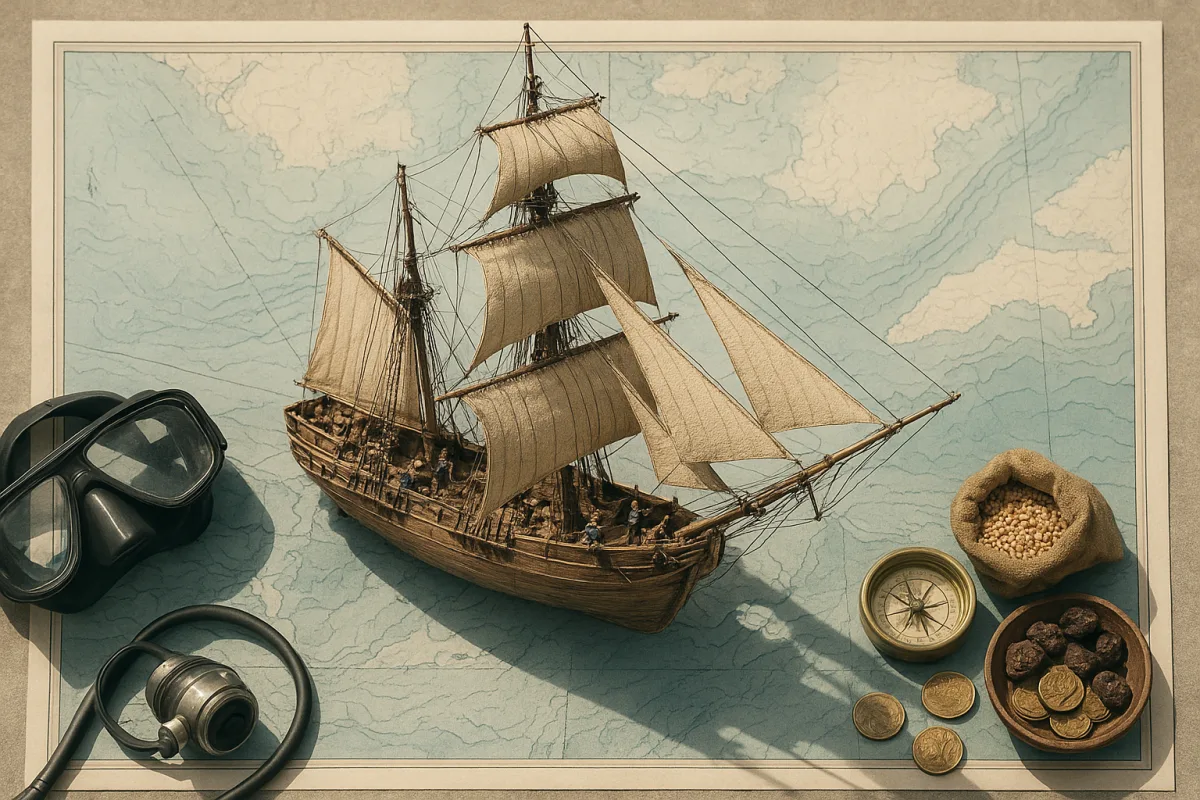
The decision before you sail
Charting the Unknown is Crimson Desert’s first paid expansion, released October 29 after a two-week delay from its original October 15 date. [1] It pushes the game toward the ocean with ships, crews, underwater areas, aquatic mounts, trading, new properties, and romance systems.
The asking price is $24.99 on Steam. That buys the DLC, while the base game remains a separate purchase, and it does not cover the hardware storage, internet bandwidth, or time you may need to install its update. [9]
You can explore the new region after reaching Chapter 3, but the expansion’s main story is gated behind completion of the base game campaign. That is a much taller ask than it sounds, given the campaign reportedly averages about 69 hours. [8]
GAME-scanner found that only 9.7% of Steam players had completed Crimson Desert’s main story as of August 2026. [8] So most players can access the ocean systems, but cannot yet see the DLC’s advertised epilogue missions.
That access split explains much of the early response. IGN’s Travis Northup found the seafaring activities compelling, but called the added story material a largely uninspired continuation built around tougher versions of familiar bosses and repetitive objectives.
If you are returning after the base game, treat Charting the Unknown as a systems expansion. If you are starting fresh, it is a distant target, and buying it early only makes sense if the promise of seafaring gives you a reason to commit to the campaign.
The system to understand: your crew is your economy
The single mechanic that decides whether Charting the Unknown feels like a rich sandbox or a slow series of blocked menus is crew allocation. Your comrades are a shared workforce, not separate pools reserved for ships, workshops, dispatches, and businesses.
A comrade assigned to a land business cannot simultaneously fill a vacancy aboard your vessel. GamingBolt’s early guidance is blunt here: staff the ship first, then use whoever remains for production on land.
That makes crew roles a pre-departure decision with real consequences. You assign ship jobs while docked, and cannot rearrange those assignments once at sea, so leaving port with the wrong personnel can strand an intended activity until you return.
The same logic governs island dispatches. A dispatch may refuse to begin because you are outside the destination’s facility circle, but it can also fail because you have not assigned the required number of deckhands.
This is not busywork for its own sake. A staffed ship gives you access to voyages, trading runs, combat encounters, and exploration, while understaffing it to improve a workshop can save pennies at home and cost you an entire trip.
Land businesses still matter because facilities continue producing while you sail. Start their work before a long expedition, return to collect output, then set them up again before leaving, and the game’s clock becomes a source of supplies instead of downtime.
But a business needs physical access to function. Workers must reach the front of their workstations, and a badly rotated station can create a bottleneck that leaves staff idle and makes a profitable-looking operation produce far less than expected.
That gives you a clean early priority order. First, crew the ship to meet your planned route’s requirements. Second, start any production that can run unattended. Third, inspect workstation placement before assuming a business is underperforming because of missing resources.
It is a surprisingly coherent loop: crew capacity enables voyages, voyages produce loot and trade opportunities, profits fund repairs and upgrades, and your land operations refill materials while you are away. The limiting resource is usually people, not another shiny weapon.
We would resist the impulse to fill every workshop slot immediately. A ship with enough deckhands to launch dispatches and recover from a bad fight gives you more ways to earn, while a perfectly staffed business cannot help if you cannot sail.
How to build a first voyage that pays for itself
Before your first serious trip, decide whether you are exploring, trading, fighting, or diving. Charting the Unknown offers all four, but trying to do everything at once is how you sail off with a badly stocked hold and the wrong crew.
The updated map gives a useful threat readout. Red areas are blockaded, light-red areas are rebuilding, yellow areas hold incidents, and gray areas remain uncharted, so you can pack supplies and choose a route before discovering a hostile fleet by accident.
Trade goods should travel with you whenever cargo space allows. Trading posts remain visible on the map, and routing through them turns a voyage between objectives into an income run instead of a pure expense.
That matters because ships are expensive enough to hurt when lost. GamingBolt recommends speaking to a fleet master before purchasing a replacement, since fleet masters can recover lost vessels and may repair destroyed ones for a gold fee.
Do not assume the cheapest naval victory is cannon fire. Boarding an enemy vessel puts you into Crimson Desert’s ground combat, but can save repair costs and reduce the risk of watching your own ship become a very expensive wreck.
You still need to judge the crew you are boarding. Fighting directly may preserve the hull, yet it exposes Kliff to close-range combat, so a low-health character or poorly prepared build can turn a money-saving plan into a reload screen.
Keep a shovel in your inventory. Map-marked treasure may be buried, and digging can produce resources or Abyss gear, the special weapons and armor that may alter your combat setup, for the cost of one inventory slot.
Also keep exploration relics instead of selling or discarding them. A relic collector eventually trades them for items, making these awkward early inventory objects part of a delayed reward loop rather than vendor trash.
The outcome of each voyage comes down to preparation: enough crew to launch, enough cargo room to trade, enough gold to repair, and enough gear to survive whatever your route marker promised. It is a captain-management system wearing an action RPG’s armor.
Diving is the expansion’s best new detour
The ocean is not only a travel layer. Charting the Unknown adds underwater ruins, caves, materials, aquatic creatures, diving equipment, propulsion tools, and mounts, turning some points on the map into vertical exploration spaces rather than another shoreline. [2]
Your first limit underwater is oxygen. Long swims toward submerged ruins require you to surface at air pockets, so the route is often less about brute distance than spotting places where Kliff can breathe before making the next dive.
The upgrade path changes that restriction. GamingBolt reports that the A-Tag mech, also called the Iron Knight, can receive underwater equipment at research workshops, letting you remain submerged far longer if you bring the materials and money.
That is a meaningful early investment because it changes what counts as reachable. Without specialized equipment, deeper routes ask you to plan around air pockets; with the upgraded mech, you can search more thoroughly and approach underwater danger on your terms.
Aquatic creatures add another route through the sea. Some require food to earn their trust and others require taming, so an unfamiliar animal is a small read-the-situation test, not a single interaction repeated across every mount.
Whirlpools are the other big risk-reward gate. Flying a wyvern or Black Star over one pulls the mount down and removes your control, but deliberately taking the plunge can reveal hidden areas, bosses, unique rewards, and a secret achievement.
GamingBolt recommends waiting until you have a refined diving suit before treating whirlpools as destinations. We agree, because the potential reward does not erase the basic cost of entering a deep area without gear designed to keep you there.
This is evolutionary underwater design, not a genre reinvention. Crimson Desert folds diving into its existing action, collection, crafting, and mount systems, unlike Subnautica 2’s survival-centered ocean structure or Cthulhu: The Cosmic Abyss’s detective scanning focus. [3]
That is still enough to make the DLC’s best moments feel strange in a good way. IGN’s Northup highlighted the novelty of riding a sea turtle underwater and commanding a pirate crew in a game already crowded with unrelated activities.
Content volume, story limits, and early technical trouble
Pearl Abyss has framed Charting the Unknown as a huge expansion, with early promotional claims reaching 200 hours. That number will vary wildly by how much time you spend trading, collecting, building, fighting, and roaming after the main objectives end.
IGN’s early review reaches the more grounded conclusion: there is a lot to do, and much of it is entertaining, but the DLC adds breadth faster than it adds depth. That was also a criticism of the base game.
The optional content sounds stronger than the story so far. Beyond ships and diving, the expansion adds property management, base-building options, a combat arena-style gauntlet, social links, and romance mechanics for NPCs, according to IGN’s early coverage.
The story has the harsher gate and the weaker opening. Northup described its first missions as epilogue material that revisits old bosses and familiar character beats, including activities that feel like callbacks to already repeated base-game scenes.
Technical stability is the other reason to wait before declaring the DLC a clean win. IGN encountered two hard crashes, visual flickering or blurry textures, and an arm-wrestling character animation that broke badly during the early hours.
GamesRadar also reported a game-breaking bug in the first DLC quest roughly 12 hours after launch. [5] That is particularly rough for players who have already spent dozens of hours clearing the main campaign to unlock the story path.
Player reaction is not a disaster, but neither is it a landslide. GamesRadar reported a Mostly Positive Steam rating from 250 reviews, alongside a 16,955-player concurrent peak that was among the game’s lower weekly peaks. [5]
Some players have called $24.99 steep, and the campaign-completion gate leaves much of the expansion’s story inaccessible to the majority of Steam owners. [5] We would buy now only if the ship-and-dive loop is the attraction, not because you need narrative closure.
PC setup and installation expectations
The DLC is available on Steam, Epic Games Store, PlayStation Store, and Xbox Store. [10] On PC, Steam lists the $24.99 DLC, while Pearl Abyss has not published separate PC pricing for platforms beyond the stores carrying it. [9]
For recommended high settings, Pearl Abyss lists Windows 10 or 11 64-bit, an Intel Core i7-11700 or AMD Ryzen 7 5700X, 16 GB to 32 GB of DDR4 or DDR5 memory, and DirectX 12. [9]
The recommended graphics tier is an RTX 3060 12 GB, RTX 4060 8 GB, RX 6600 XT 8 GB, or RX 7600 8 GB. Pearl Abyss also recommends 120 GB of NVMe M.2 SSD storage. [9]
Those are recommended specifications, not performance guarantees. They tell you the target hardware class, but not a locked frame rate at a particular resolution, and they do not substitute for checking available drive space before a large update.
Shroud’s launch stream showed why the SSD recommendation has a day-one angle beyond loading screens. Steam began downloading a 54 GB DLC update at release, then spent roughly 22 minutes patching files after the download had completed.
That post-download stage rewrites or updates existing game files, which can make a fast connection feel irrelevant while drive activity becomes the bottleneck. If you are planning to play at launch, leave the game installed on fast storage and budget time for both stages.
Frequently Asked Questions
What new gameplay features does the Charting the Unknown DLC add to Crimson Desert?
The DLC introduces sailing, ship crews, underwater diving, aquatic mounts, trading routes, new properties, and romance systems. It expands the game’s focus toward ocean exploration and management, adding a substantial set of systems that complement the base game’s land-based gameplay.
How does crew management affect gameplay in Crimson Desert's Charting the Unknown DLC?
Crew members serve as a shared workforce for both ship operations and land businesses. Assigning comrades to the ship is a priority since an understaffed ship can block voyages and dispatches. Crew roles must be set before departure, as they cannot be changed at sea, making crew allocation a critical strategic decision.
What are the best strategies for starting voyages in the Crimson Desert DLC?
Players should focus on a clear goal, exploration, trading, fighting, or diving, rather than trying to do everything at once. It is recommended to staff the ship adequately first, plan routes using the map’s threat indicators, and include trade goods to turn voyages into income runs. Avoid rushing into combat without considering crew and ship condition to prevent costly losses.
Do I need to finish the base game before playing the Charting the Unknown DLC?
You can access the new ocean systems after reaching Chapter 3 of the base game, but the DLC’s main story content is locked behind completion of the entire base game campaign. Since the campaign averages about 69 hours, most players will experience the DLC primarily as a systems expansion rather than a narrative continuation.
How does underwater diving work in the Charting the Unknown expansion?
Underwater exploration integrates with existing gameplay by allowing the use of diving suits, propulsion devices, and aquatic mounts like rideable sharks. Players can gather materials underwater, but the feature builds on established mechanics rather than introducing a fundamentally new underwater gameplay system.
How we researched this
This article was assembled from 2 video sources across 2 channels, 1 published article, 10 cited references.
Nothing here is based on hands-on testing. Where a figure or finding appears, it belongs to the source cited beside it, and the writing says so rather than implying otherwise. Every source is listed below so you can check it.
Sources
Crimson Desert: Charting The Unknown - 15 Beginner Tips That Make a HUGE Difference, GamingBolt
Charting the Unknown Brings Underwater Diving to Crimson Desert
Cthulhu: The Cosmic Abyss review: stunning UE5 visual design and ambitious ideas impress
Crimson Desert Underwater Exploration Guide for Charting the Unknown
Crimson Desert DLC debuts to positive Steam reviews, but it hasn't done much for PC player count
Fans didn’t show up: Crimson Desert expansion fails to generate hype
Crimson Desert Developer Confirms Delay For Charting The Unknown DLC - PlayStation Universe
Crimson Desert's low story completion rates: what does this mean for players? | GAME-scanner
The Journey of Crimson Desert Continues with Charting the Unknown - XBOX Wire
Watch Crimson Desert DLC and Gameplay Insights on Youtube
Also from the sources
Related Articles
World of Warcraft Forever Expansion and Community Reaction
Explore the World of Warcraft Forever expansion, its social systems, name reservations, and community reactions from the beta phase.
Metro 2039 Gameplay and Developer Insights on Survival
Explore Metro 2039 gameplay and developer insights focusing on crafting, stealth, and survival mechanics shaping the player experience.

Wardogs Tactical FPS Gameplay Guide: Maps, Economy & Combat
Explore Wardogs tactical FPS gameplay, including maps, economy, combat, and base building strategies for PC players.
Phantom Blade Zero Gameplay Guide: Combat, Weapons, and Tips
Learn key Phantom Blade Zero gameplay tips, weapon upgrade strategies, and difficulty advice to master combat and quests.