
BioWare Closure and Mass Effect 5 Cancellation Explained
Learn why BioWare shut down and Mass Effect 5 was canceled, including details on the leaked trailer and EA's restructuring impact.
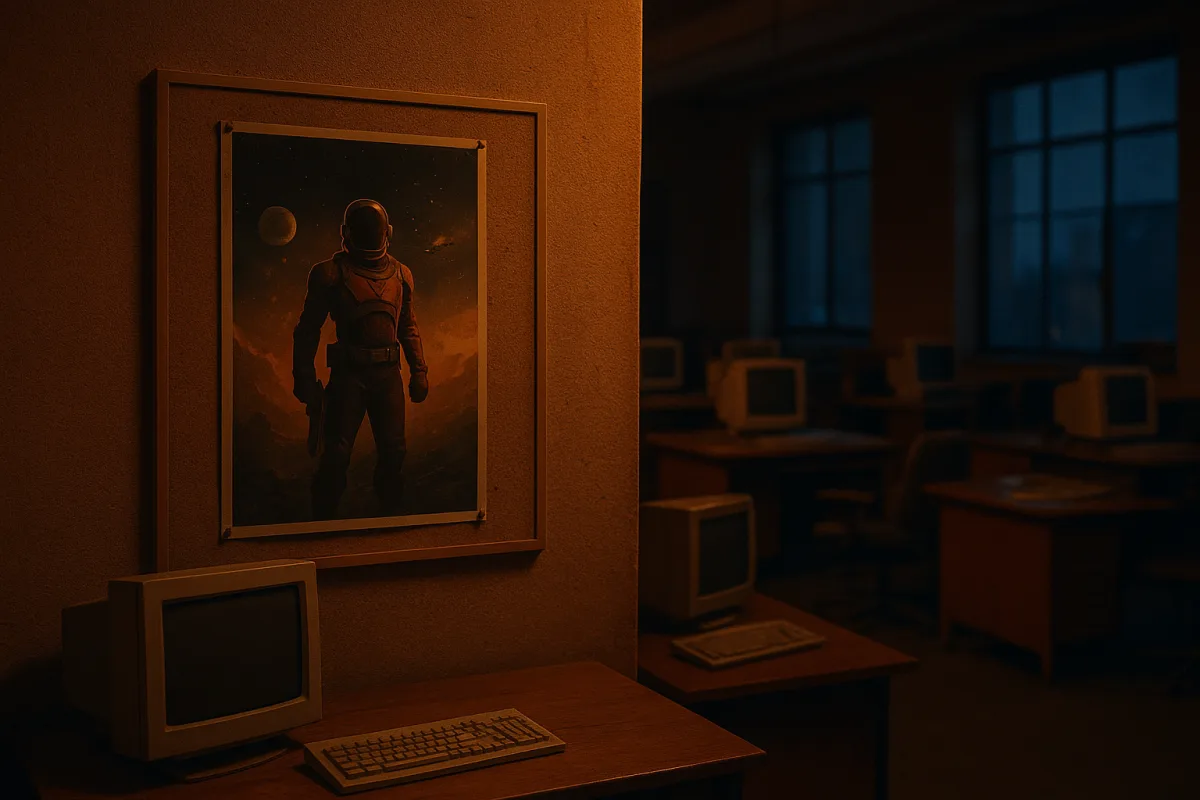
The number that mattered was 50
The grimest detail in EA’s announcement is not that BioWare had once been a giant of western RPGs. It is that around 50 people were reportedly still working on the next Mass Effect when the studio was shut down. [1][5]
Fifty developers is enough to create prototypes, test art direction, write an early narrative outline, and assemble a leadership trailer. It is not the staffing level associated with finishing a modern, big-budget RPG full of dialogue, cinematics, combat encounters, localisation, accessibility work, testing, and PC optimisation.
That distinction explains the strange emotional whiplash around the Mass Effect: Universe leak. Fans got a slick glimpse of a game one day after learning they would never play it, then understandably treated its existence as proof that EA killed a finished product.
It was not that. The opening disclaimer says the footage used pre-production assets from a small team, and reporting by IGN, Vice, ComputerBase, and Bloomberg journalist Jason Schreier established that the trailer is authentic. [8][9] Authentic does not mean representative of a finished game.
The trailer is still meaningful, just in a more specific way. It shows BioWare had a pitch. A former military character has moved into covert, preventive work, essentially trying to stop disasters before they start. There is a nightclub, a bar fight, biotic action, ship travel, a galaxy map, and an older Liara T’Soni.
That is the Mass Effect kit being laid on the workbench, not the final loadout. These are the familiar verbs and icons a team uses to show executives that it understands the franchise: talk, investigate, travel, shoot, use powers, recruit allies, romance people, and make choices.
The working title, Mass Effect: Universe, is equally easy to over-read. It could signal a larger framing for the setting. It could also be a title card built for one internal presentation, which is exactly the kind of thing production teams change long before a public reveal.
What “choice and autonomy” actually costs
Former BioWare cinematics lead Tony de Waal told Eurogamer that the project aimed for “a level of autonomy and choice that no other game has been able to match,” drawing inspiration from recent work by Larian Studios and CD Projekt Red. It is a tantalising statement, but it needs unpacking.
In an RPG, choice is not simply selecting a dialogue wheel response. A real consequential decision needs a state variable, something the game remembers, and later content that checks that state before deciding what to show the player.
The simplest version is binary. Save Character A or save Character B. The game writes a flag, then swaps a line of dialogue or changes who appears in the next mission. It is cheap, readable, and often effective.
The expensive version is systemic. A decision changes a faction’s trust, unlocks or locks off missions, alters a companion relationship, moves a political conflict in a different direction, changes the tools available in combat, and eventually affects scenes hours later.
That is where RPG choice becomes a production problem rather than merely a writing problem. Every branch creates work for writers, designers, cinematic artists, voice actors, QA testers, localisation teams, and anyone maintaining save compatibility between chapters.
A choice with two outcomes does not necessarily double the cost of a quest. Developers can reconverge branches, where two paths lead back to the same mission with altered dialogue or party composition. But players notice when every supposedly seismic decision returns to the same corridor.
Mass Effect has always played this game with varying levels of success. The original trilogy made players feel that decisions accumulated through character survival, romances, squad loyalty, political choices, and the final-war readiness structure. That feeling was powerful enough that Mass Effect 3’s ending provoked a major backlash precisely because many players expected their accumulated choices to transform the ending more radically. [10]
The lost Mass Effect project apparently wanted to push that promise further. De Waal’s comments suggest the team was looking at the contemporary standard set by Baldur’s Gate 3 and CD Projekt Red’s RPGs, games that often let players solve quests through combat, stealth, dialogue, alliances, failure, or outright weirdness.
That does not mean Mass Effect: Universe had solved the branching-content equation. No leaked design document proves it had. It means the team had identified the target: choices that affect the player’s route through a scenario, rather than merely painting a different shade onto the same conclusion.
This is why the project’s cancellation stings more than losing another cover-shooter campaign. BioWare’s historic speciality was making players inspect the save file in their heads. Who survived? Who trusted you? Who did you betray? Which companion became the person they were because of your decisions?
The trailer gives almost no evidence of how the system would function. Its espionage framing does at least fit the ambition. A covert operative can plausibly obtain information through deals, infiltration, combat, blackmail, diplomacy, or calling in favours. That is a better chassis for autonomy than a linear military deployment.
But the same structure is expensive to finish. The more ways players can enter a mission, the more paths need to remain legible, functional, and dramatically satisfying. A choice-heavy RPG is not just more writing. It is a larger test matrix.
Why the project was still years from the finish line
The internal trailer looks polished because trailers are designed to establish a fantasy efficiently. A few well-composed scenes can represent a role-playing game that would require hundreds of hours of development across dozens of disciplines.
EA’s own language described the Mass Effect team as working in early development, despite the project having been announced in December 2020. [5] That sounds absurd until one separates an announcement from full production, which are very different stages.
Early development is where a team answers dangerous questions: what game is this, who is the protagonist, what does exploration mean, what choices persist, what technology supports it, and how much content can the studio actually afford? The trailer suggests some answers, not a completed plan.
Large RPGs routinely take years once a project enters sustained production. One 2026 industry timeline guide places large-scale games on multi-year schedules, while scope and team size drive the real figure. [11] The next Mass Effect was not a two-year cleanup job waiting for a final cutscene.
BioWare’s history also makes “they had six years” a misleading scoreboard. Development can be restarted, redirected, or held in pre-production while another game receives most of the studio’s staff. Calendar time is not the same as uninterrupted full-team production.
That matters because the community response risks repeating an old patch-note mistake: seeing one visible number and assuming it explains the whole system. Six years since a teaser does not equal six years of finished assets, missions, or working code.
There is no credible evidence that BioWare had a completed gameplay vertical slice, a release window, PC specifications, graphical settings, or a patch roadmap. No hardware requirements were ever announced because there was no public build to support.
Closure was a financial decision made in a creative graveyard
It would be false to pretend BioWare entered 2026 in perfect health. Mass Effect: Andromeda received 72 on PC, 71 on PlayStation 4, and 76 on Xbox One through Metacritic, well below Mass Effect 2’s 94 to 96 range. [2][10]
Those scores track with the memory of its launch: strong combat and an appealing premise undermined by technical problems, facial-animation memes, uneven writing, and a game that looked less decisive than its predecessors. That was real criticism, not revisionist hate.
Anthem and Dragon Age: The Veilguard added their own baggage, though reducing the latter to an internet-culture-war punchline is lazy. Polygon notes that The Veilguard’s development shifted from an early version, to live-service ambitions, and back toward a single-player RPG before release.
Its commercial result was weak against EA’s expectations, with roughly 1.5 million players in its first two months, but it also arrived after years of design upheaval and in an exceptionally busy release calendar. [7] A studio can make mistakes and still not deserve liquidation.
The immediate context is EA’s acquisition by a consortium led by Saudi Arabia’s Public Investment Fund, alongside Silver Lake and Affinity Partners. The $55 billion deal brought roughly $18 billion in debt, followed by cuts including $700 million from R&D and 400 layoffs across EA. [1][5]
That is the actual balance-change patch. When a publisher is newly private and carrying acquisition debt, long-horizon projects with uncertain returns become obvious targets. A small pre-production team on a costly, choice-heavy RPG is exactly the kind of investment finance departments mark in red.
That does not absolve BioWare’s previous failures, nor does it prove every rumour about internal dysfunction. The available reporting does not substantiate broad claims about undisclosed creative disputes, morale, or mismanagement on Mass Effect: Universe. Those claims should stay in the speculation bin.
What the RPG community actually lost
The mourning is not merely nostalgia for Commander Shepard, Dragon Age romances, or the line “You must gather your party before venturing forth.” It is concern that a particular kind of expensive RPG is becoming harder to justify inside a publisher built around annual sports games, shooters, and recurring revenue.
BioWare helped popularise party-based storytelling, companion loyalty arcs, branching choices, cinematic conversations, and romance systems at blockbuster scale. Rock Paper Shotgun described the studio as a defining vocabulary for western computer RPGs, while industry figures from CD Projekt Red and Larian publicly credited its influence.
Former BioWare creative leads have correctly stressed that Electronic Arts still owns Mass Effect, Dragon Age, and Jade Empire. The franchises are not legally dead, but ownership is not development. An IP in a vault has no writers, no designers, no actors, and no release date.
That leaves Mass Effect: Universe in an unusually frustrating state. Its leaked trailer is not a promise of a lost masterpiece, and calling it one would be community panic talking. It is something more concrete and sadder: evidence that a small team had begun rebuilding Mass Effect around a modern version of its central promise.
The promise was not “more Liara,” though Liara’s return would have mattered. It was that the player’s actions could shape the kind of person they became, the relationships they built, and the version of the galaxy that survived them. That system was always costly. Now it is unfinished.
Frequently Asked Questions
Why did EA shut down BioWare?
EA shut down BioWare as part of a broader post-acquisition restructuring following a buyout in August 2026. This restructuring added $18 billion in debt to EA and forced the company to cut $700 million in research and development spending, along with laying off 400 employees across the company, including around 50 at BioWare. The shutdown was driven by financial pressures rather than solely by the performance of specific BioWare titles.
What caused the cancellation of Mass Effect 5?
Mass Effect 5 was cancelled due to EA’s financial restructuring and cost-cutting measures after the 2026 buyout. About 50 developers were still in pre-production on the game when BioWare was closed, and the cancellation was part of the company-wide layoffs and budget reductions rather than a failure of the game’s development itself.
What was shown in the leaked Mass Effect Universe trailer?
The leaked trailer, titled Mass Effect: Universe, was an internal production test showing early pre-production assets. It featured a new espionage-focused protagonist, the return of Liara T’Soni, familiar powers, and a Milky Way setting. The footage included scenes like a nightclub, a bar fight, biotic action, ship travel, and a galaxy map, but it was not representative of a finished game.
How far along was Mass Effect 5 before cancellation?
Mass Effect 5 was in early pre-production with roughly 50 developers working on it. The team had created prototypes, tested art direction, written an early narrative outline, and assembled a leadership trailer, but the game was far from completion and had no playable build.
What impact does BioWare's closure have on RPG gaming?
BioWare’s closure interrupts the development of a major western RPG studio known for its emphasis on player choice and narrative depth. The cancellation of Mass Effect 5 means the loss of a project aiming to advance RPG autonomy and consequential decision-making, which could have influenced future RPG design and player experience.
How we researched this
This article was assembled from 5 video sources across 2 channels, 8 published articles, 11 cited references.
Nothing here is based on hands-on testing. Where a figure or finding appears, it belongs to the source cited beside it, and the writing says so rather than implying otherwise. Every source is listed below so you can check it.
Sources
10 Things That KILLED BioWare — gameranx
10 Things That KILLED BioWare — gameranx
BioWare Is Officially Dead - What The HELL Happened? — GamingBolt
BioWare Is Officially Dead - What The HELL Happened? — GamingBolt
BioWare Is Officially Dead - What The HELL Happened? — GamingBolt
An internal Mass Effect 5 trailer has reportedly leaked, offering you a glimpse at the sequel you'll never get to play — Rock Paper Shotgun
Can We Finally Agree That Dragon Age: The Veilguard Was Actually Terrific? — Polygon
A Convincing Trailer For What May Have Been Mass Effect 5 Has Leaked [UPDATE: It’s Real] — Kotaku
Even at their most chaotic and conflicted, BioWare were the heart of the western computer RPG — Rock Paper Shotgun
Video Game Industry Responds to BioWare Shutting Down — Polygon
Games industry mourns sudden BioWare closure - "Anyone who participated in this travesty should be ashamed" — Eurogamer
Video game developer BioWare shuts down, next 'Mass Effect' canceled amid broader layoffs at EA
Electronic Arts to lay off 400 staff, shut down BioWare [Update] - Gematsu
EA Is Shutting Down Legendary RPG Studio BioWare Amid New Round Of Layoffs
'Mass Effect 5' Trailer Reportedly Leaks Just One Day After BioWare Announces Closure
Mass Effect: Universe: Geleakter Trailer zu Teil 5 legt Finger in die Wunde - ComputerBase
Watch BioWare Closure and Mass Effect 5 Fallout on Youtube
Also from the sources
Related Articles
Xbox layoffs and next-gen console pricing update 2026
Explore Xbox layoffs, Project Helix pricing rumors, and upcoming service changes affecting gamers and developers in 2026.
Xbox Halo restructuring: studio changes and industry impact
Explore Xbox Halo restructuring, studio layoffs, and Activision's new role in Halo's future development and industry impact.
GTA 6 Leaks and Rockstar's Response Explained
Explore the latest GTA 6 leaks, what they reveal, and how Rockstar Games is responding to the ongoing leak campaign.
Exodus Sci-Fi RPG Preview
Explore the Exodus sci-fi RPG preview, its unique time dilation feature, gameplay, and release details compared to Mass Effect.