
AI Modding Controversies
Explore AI modding controversies, including authorship disputes, legal risks, and community responses in PC gaming modding scenes.
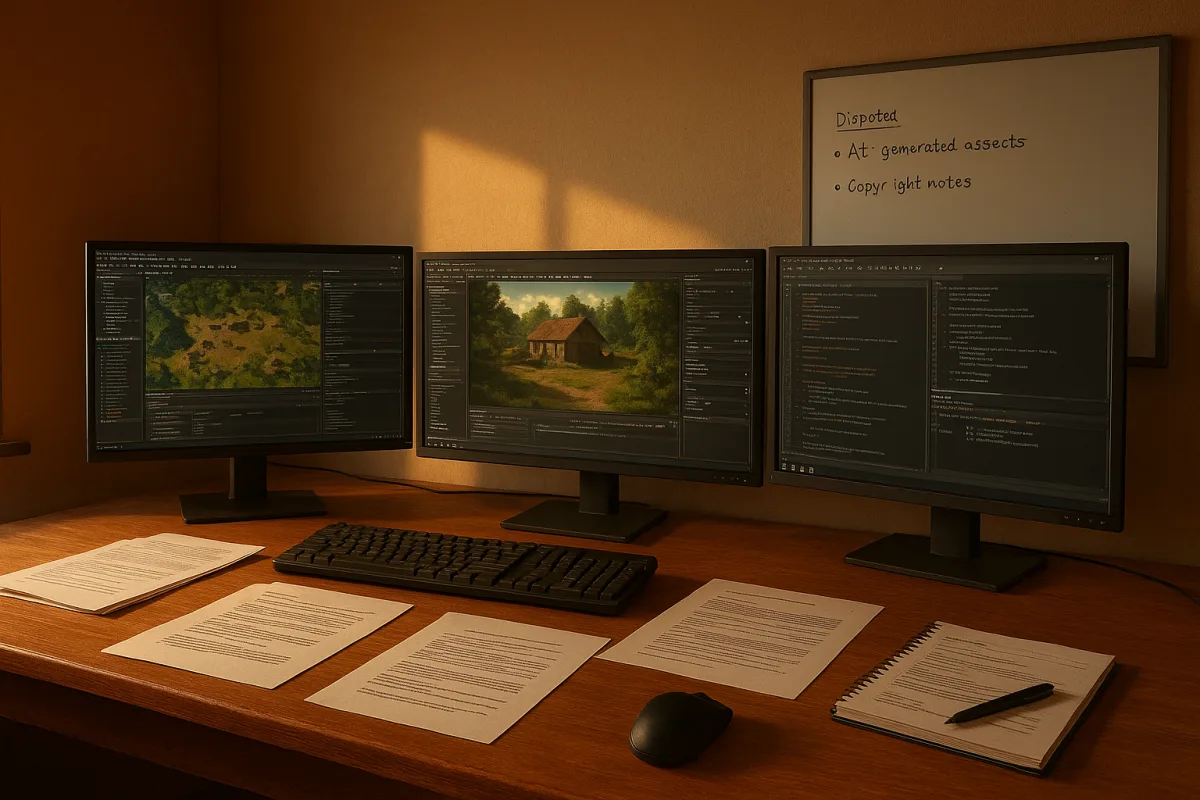
The shift is real: AI is now a modding dispute, not just a production tool
The argument around AI in games has changed shape. A year or two ago, the loudest question was whether generative tools could make concept art, dialogue, or placeholder assets faster. Now the practical fights are over authorship, permission, proof, and enforcement.
That shift is visible across unrelated corners of the creative ecosystem. A Total War: Warhammer III modder has sabotaged compatibility with unauthorised AI-derived uploads. Bethesda has removed an AI-built Fallout fan game. Human artists are being accused of using AI despite extensive process records.
These are not identical disputes, and it would be sloppy to pretend they are. One concerns a mod author protecting years of work, another concerns a publisher defending a commercial franchise, and another concerns artists defending their reputations. But they all point to the same problem.
AI has reduced the time between “I saw a thing” and “I published a version of that thing.” It has not reduced the importance of consent, ownership, or trust. If anything, it has made those constraints more visible.
For PC players, this matters because modding has always run on a fairly delicate social contract. Someone makes a tool, patch, overhaul, translation, model, or script. Other people use it, credit it, ask before redistributing it, and accept that maintenance is unpaid labour.
AI-generated remixes hit that contract like a balance patch that buffs every opportunist build while quietly deleting the support role. The immediate output might look productive, but the people maintaining the actual foundation have less reason to keep showing up.
The SFO dispute is about maintenance, not merely anti-AI rhetoric
The cleanest example comes from the Total War: Warhammer III scene. Venris, creator of the long-running Simply Fun Overhaul, or SFO: Grimhammer III, deliberately corrupted the mod to stop it functioning with unauthorised reuploads and AI-generated sub-mods. [1]
SFO: Grimhammer III is not a cosmetic tweak that can be replaced by changing a few tables. IGN described it as a broad overhaul affecting campaign systems, battles, economy, customisation, and the game’s relationship to Warhammer lore. That is years of interconnected balancing work.
Anyone who has played a serious overhaul knows why that distinction matters. A new Creative Assembly patch can alter recruitment, unit values, abilities, AI behaviour, or campaign scripting. Updating the mod is not simply pressing an “AI compatibility” button.
The visible complaint is that unauthorised uploads were using AI to keep versions alive without permission. The deeper complaint is that this treats ongoing maintenance as if it were a pile of disconnected code and data that anyone can harvest.
Venris’s response was unusually blunt. Rather than issue another warning and hope uploaders behaved, he changed his own files so the unauthorised versions would stop working. He also warned that SFO: Grimhammer III could become private if the situation continued. [1]
That is the nuclear option in a modding scene. It does not merely punish a reuploader. It risks inconveniencing ordinary players, fragmenting multiplayer compatibility, and making installation harder for people who did nothing wrong.
It is also a useful indicator of how serious the trust breakdown has become. Mod authors generally want users. A creator threatening to withdraw a hugely visible project is not a healthy sign of community confidence, even if the measure is understandable.
There is an important evidence limit here. No public data establishes how many AI-generated SFO reuploads exist, how many players used them, or how much time they saved versus conventional sub-mod updates. The controversy is real, but the scale is unquantified.
That distinction matters because community panic often outruns the patch notes. We can say that unauthorised AI-related reuploads were serious enough for Venris to corrupt compatibility. We cannot honestly claim that AI has already replaced the Total War modding scene.
Fallout: New York shows why “free fan demo” is not a defence
The Fallout: New York case demonstrates a separate boundary. A creator using the name CHRIS FIRST published a browser-playable AI-generated Fallout project built with Anthropic’s Claude Opus 5.5, featuring quests, companions, dialogue choices, V.A.T.S. combat, and a Pip-Boy. [3]
The project’s pitch leaned heavily on its technical novelty. Its creator said buildings, weapons, faces, sounds, and other assets were generated by code rather than lifted from conventional texture or sound files. That is interesting as a prototype claim, but it does not make the Fallout branding ownerless.
According to reporting on the takedown, ZeniMax Media, Bethesda’s parent company, issued a cease and desist. The game was removed. The precise legal arguments in the letter have not been made public, so claims that it was solely about copyright, trademark, or the domain name go beyond what is known. [3]
Still, the outcome should not surprise anyone planning a similar project. “It is free” is not a licence. “The assets were generated” is not a licence. “It is a tribute” is not a licence either.
The most obvious problem was the use of Fallout’s recognisable identity. Fallout: New York used the franchise name, its world, signature mechanics, visual language, and the Pip-Boy concept. That is a much more direct collision with a rights holder than making a mechanically similar post-apocalyptic RPG.
The browser format makes the lesson sharper. Traditional mods often require the original game, which at least establishes a relationship with the publisher’s product and its modding ecosystem. A standalone browser game can look less like a mod and more like an unauthorised replacement.
That does not mean every AI-assisted fan tool will receive a cease and desist. Rights holders enforce selectively, and their policies vary. But Bethesda’s action tells project planners to budget for legal exposure before they budget for model tokens or hosting costs. [3]
It also punctures the idea that AI has somehow moved fan games outside established IP rules. The generation method may be new. The commercial value of an established franchise name is not.
Artists now have to prove they made their own work
The artist side of this trend is nastier because the accusation can become the damage. Kotaku reported that illustrator Lois van Baarle, known online as Loish and credited for work connected to Horizon Zero Dawn, was accused on TikTok of using generative AI.
The allegation was especially flimsy because van Baarle had shared process material for the criticised piece, dated it to 2023, and had a public body of work going back to 2003. Her artistic development was visible to anyone prepared to look beyond a comment thread.
Her response gets at the real issue. Artists whose work may have been used to train generative systems now face a second burden: proving that their own images are not generated. That is a miserable extra system to bolt onto ordinary creative work.
For game artists and modders, the equivalent is familiar. A clean hand-painted texture can be called AI because it looks too polished. A procedural tool can be called AI because the accuser does not understand node workflows. A polished animation can trigger suspicion because consistency now feels suspicious.
The useful response is not to demand that every artist livestream every brushstroke. That would be another unreasonable tax. It is to build a provenance trail proportionate to the project: source files, Git commits, work-in-progress images, credits, asset licences, and public changelogs.
That documentation will not convince every bad-faith commenter. Nothing will. It does make it easier for moderators, collaborators, clients, and players to check a claim without relying on visual guesswork or dubious “AI detector” tools.
Why this is happening now
Three forces have landed at once. First, generative systems can now produce plausible prototypes, code, art, voice-like audio, and game-facing UI quickly enough to create viral clips before anyone asks what was actually made or authorised.
Second, social platforms reward the first impressive-looking post, not the maintenance record behind it. A twenty-second video of Minecraft inside Elden Ring can travel farther than a modder’s months of compatibility fixes, testing, bug reports, and documentation.
Third, the old signals of authenticity have degraded. A screenshot is no longer strong proof of a finished build, an original artwork, or even a real event. Kotaku’s report on an alleged AI-generated Airbnb damage image is outside gaming, but it illustrates the same verification problem.
Airbnb responded by banning AI-generated, enhanced, or synthetic evidence in damage claims from its terms in April 2026. That is not a precedent for Nexus Mods, Steam Workshop, or ModDB, but it shows what platform governance looks like when image evidence becomes cheap to fabricate.
Gaming communities will probably follow with their own uneven rules. Some will ban AI-generated assets outright. Some will require disclosure. Some will only care about commercial uploads. Others will do nothing until a moderation disaster forces the issue.
The UK Games Expo has already taken a firm human-creativity line, banning exhibition, display, and sale of games or products primarily created with AI. [2] That is an event policy, not a universal industry standard, but it is a concrete sign of gatekeepers choosing provenance over ambiguity.
The legal picture remains unsettled. The U.S. Copyright Office has said that purely AI-generated material without sufficient human creative input is not copyrightable, while requiring applicants to identify the human contribution and disclaim AI-generated portions.
At the same time, court decisions, training-data lawsuits, publisher enforcement, and rules outside the United States are moving on separate tracks. A project might be technically lawful in one narrow sense while still violating a platform rule, an event policy, a trademark, or a collaborator’s trust.
What to do if you are planning a mod or fan project
Start with scope discipline. If your project depends on another creator’s overhaul, ask permission before building a compatibility patch, fork, update, or AI-assisted derivative. “The original is out of date” is a practical complaint, not an entitlement.
If permission is unavailable, write something original around the same gameplay need. The best answer to an abandoned combat rebalance is not necessarily an unauthorised reupload. It might be a fresh overhaul with clearly documented goals, dependencies, and credits.
Keep your project’s identity separate from protected franchises whenever possible. A game inspired by post-apocalyptic choice-and-consequence RPGs has a viable path. A browser game marketed as Fallout, using Fallout’s terms and iconography, is asking a rights holder to notice it.
If you use AI tools at all, disclose their role with enough detail to mean something. “AI-assisted” is not useful patch-note language. Say whether it generated placeholder code, concept thumbnails, localisation drafts, final textures, voice work, or gameplay content.
Then decide whether your community will accept that use before launch. A Warhammer III mod audience, a visual-novel community, and a game-jam judging panel may each have different expectations. The fastest workflow can still be the wrong build for the queue you intend to join.
Finally, do not accuse other creators based on vibes. Check their history, process posts, credits, and files where available. The pushback against AI misuse is strongest when it is specific, evidenced, and aimed at actual misconduct rather than any artwork that looks unfamiliar.
Frequently Asked Questions
What are the main controversies surrounding AI in game modding?
The controversies focus on authorship, permission, proof, and enforcement rather than just production speed. Issues include unauthorized AI-generated reuploads, the impact on ongoing maintenance, and disputes over the use of AI in fan projects. These disputes highlight tensions between modders, rights holders, and communities about consent, ownership, and trust.
How does AI affect authorship and permissions in modding?
AI has shortened the time between seeing content and publishing versions, but it has not lessened the need for consent or ownership. Unauthorized AI-generated mods can undermine the social contract of modding by bypassing permission and credit, leading to conflicts over who controls and maintains the work.
Why did a Total War modder sabotage their own mod over AI?
Venris, creator of the Simply Fun Overhaul: Grimhammer III mod, corrupted his own files to prevent unauthorized AI-generated reuploads from functioning. This drastic step was taken because unauthorized AI versions treated maintenance as a disconnected task, threatening years of balancing work and the mod’s integrity.
What legal risks do AI-generated fan games face?
AI-generated fan games risk cease and desist actions from rights holders, as seen with Bethesda’s takedown of the AI-built Fallout: New York project. Even if assets are procedurally generated, using franchise names and trademarks can lead to legal challenges, especially since copyright law around AI content remains unsettled.
How are gaming communities responding to AI-generated mods?
Responses vary but include platform and event bans on AI-created games, such as the UK Games Expo’s prohibition of primarily AI-made products. Modders like Venris have taken protective actions against unauthorized AI uploads, reflecting a growing insistence on human creative input and control within communities.
How we researched this
This article was assembled from 4 published articles, 3 cited references.
Nothing here is based on hands-on testing. Where a figure or finding appears, it belongs to the source cited beside it, and the writing says so rather than implying otherwise. Every source is listed below so you can check it.
Sources
Airbnb Host Tries To Scam Guest With An AI-Created Image Of A Disgusting Toilet — Kotaku
Total War Modder Corrupts Own Work to Fight AI-Generated Reuploads — TechNewsReel
Related Articles
Gamescom 2026 Theft Impact on Indie Developers and Security
Explore how Gamescom 2026 thefts affected indie developers and the event's security measures to protect exhibitor equipment.
Physint Development Funding Challenges and Publisher Impact
Explore Physint's development funding challenges and how publisher changes affect Kojima Productions' milestone-based game progress.
Xbox Halo restructuring: studio changes and industry impact
Explore Xbox Halo restructuring, studio layoffs, and Activision's new role in Halo's future development and industry impact.
Wardogs Launch Impact: Sales, Players, and Server Challenges
Explore the Wardogs launch impact with sales, player peaks, and server issues shaping this multiplayer shooter’s early success.