
Nexus Mods AI Policy: Disclosure and Community Impact
Learn about Nexus Mods AI policy, mandatory AI disclosures, labels, and how it affects the modding community and user filtering options.
Nexus Mods’ AI Labels Are a Disclosure System, Not an AI Ban
Nexus Mods put the choice in the download page
On November 3, 2026, Nexus Mods made AI disclosure mandatory for uploads while rejecting calls for a blanket ban on AI-made mods. The rule applies to new submissions and gives existing authors a 60-day window to update their pages. [1][2]
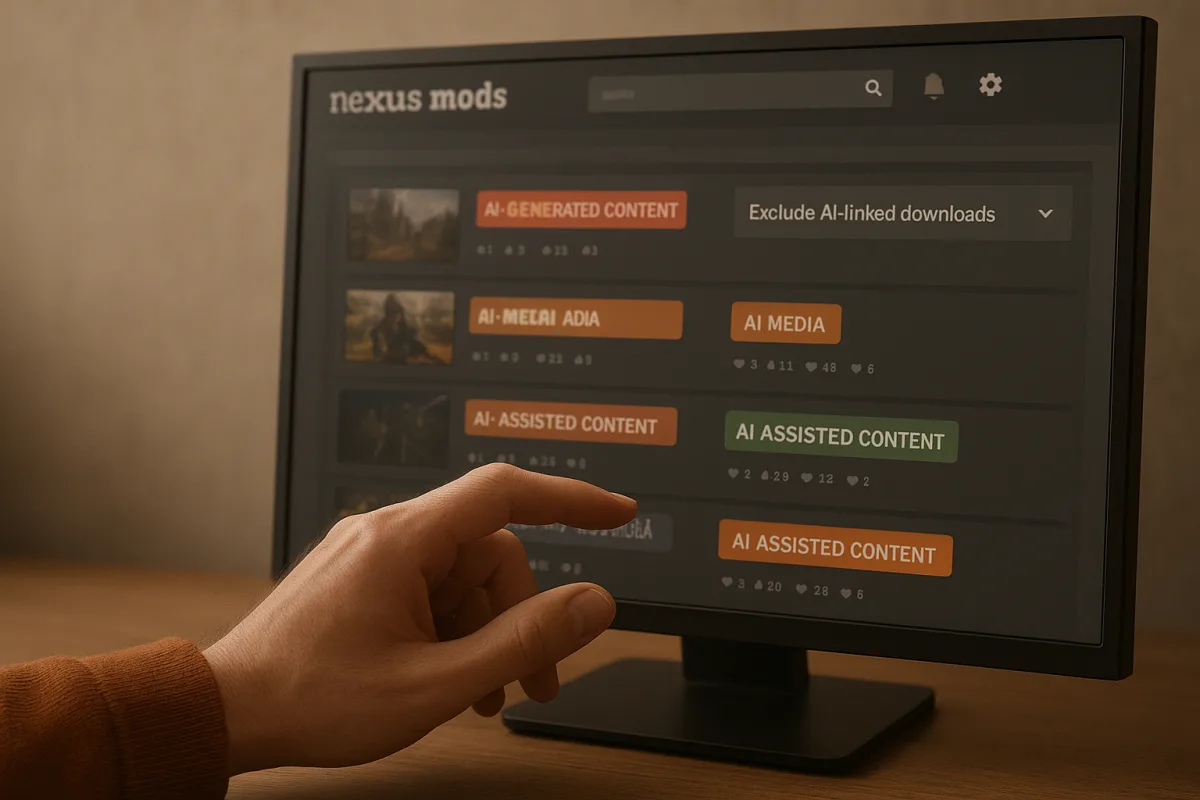
For you, the visible change is a set of AI labels and a filter. You can exclude AI-using mods from search results and suggestions, avoiding the need to inspect every thumbnail or description manually. [1][2]
The less visible change is bigger. Nexus Mods has turned an argument about whether AI belongs in modding into a metadata and moderation system, where authors declare usage, users filter it, and staff arbitrate disputed labels.
That may sound bureaucratic. It is also the only part of this policy that can change what appears in your search results today, without Nexus Mods attempting to detect every generated texture, rewritten line, or code completion tool.
The three labels are the policy’s load-order rules
Nexus Mods asks authors to sort their upload into three categories: AI-Generated Content, AI Media, and AI Assisted Content. Those labels sound similar, but they identify different things you may be choosing to install. [2]
AI-Generated Content is the broadest and most consequential category. It covers a mod whose downloadable content was generated with AI, such as generated assets, dialogue, voices, textures, or other game-facing material. [2]
If an NPC voice pack replaces hundreds of spoken lines with generated performances, that is content you will hear in game. A cosmetic pack filled with generated character faces is also content, even if its plugin file is technically conventional.
AI Media is narrower. It covers AI-generated material used to market or present a mod, such as a thumbnail, gallery image, banner, or promotional video, not necessarily the files that alter your game. [2]
This is where browsing gets messy. A mod can be entirely hand-built yet use an AI-enhanced promo image, while another can use a clean in-game screenshot but ship generated audio or textures underneath.
AI Assisted Content covers use of AI as part of the creation process without necessarily making the AI output itself the central downloadable asset. Nexus Mods specifically treats this category as one needing a public explanation and supporting evidence. [2]
Code assistance sits here. A creator might use an AI tool to draft a Papyrus script for Skyrim, generate boilerplate for a Fallout 4 F4SE plugin, or help troubleshoot a Lua function used by a Baldur’s Gate 3 mod.
That does not automatically tell you whether the resulting mod works. Plenty of human-written scripts leak memory, conflict with frameworks, or break after a game update. Plenty of assisted code may be reviewed, tested, and documented carefully.
Still, AI assistance changes the information you need from the page. If a mod adds gameplay systems through scripts, you want its dependencies, changelog, known incompatibilities, crash reports, and update cadence before you want a philosophical answer about its author’s tools.
Why “AI-assisted” needs evidence
The AI Assisted label has a higher documentation bar because it is the category most open to vague claims. Nexus Mods’ help documentation says authors may need detailed evidence, including project-file history or version-control commits, supporting the classification. [2]
Think of that evidence as a modding equivalent of showing your work. A Git history can reveal when a script changed, project files can show asset development, and revision records can establish what the author actually made and edited.
Nexus Mods moderators can reclassify a mod if an author cannot substantiate an AI Assisted classification. That gives staff a way to correct misleading labels without claiming they can read the origin story of every texture or line of code. [2]
This is an important limit on the policy. A creator cannot reliably hide behind the softer-sounding “assisted” label if the upload is actually dominated by generated assets, at least when moderators have enough information to challenge it.
It is not an automatic forensic tool. Nexus Mods may ask for source code or supporting material when it investigates, but authors are not compelled to provide source code, leaving moderation dependent on available evidence and site rules. [2]
That gap will frustrate players who want certainty. It also reflects modding’s reality: many authors work alone, use private repositories, modify old files in place, and do not build the exhaustive paper trail expected from a commercial studio.
Disclosure is an honesty rule with enforcement limits
Nexus Mods co-owner Victor “Foledinho” Folmann argued that a complete AI ban would encourage people to conceal their use of AI tools. GamesRadar reported that Nexus Mods instead chose mandatory disclosure and user filtering. [1]
The platform’s position is straightforward: it cannot make AI disappear from the workflow, particularly when tools range from script completion to generated voices and full assets. It can demand labels for uploads hosted on its service. [1][2]
That makes this a compliance system. Its outcome depends on three groups doing their jobs: authors accurately tagging uploads, users reporting suspect pages, and Nexus Mods’ Trust and Safety staff reviewing reports and applying consequences.
Community flagging is central because the platform cannot inspect every upload with the depth a disputed claim demands. A player recognizes a reused generated voice pack, notices an uncredited asset, or spots a misleading description, then reports it. [2]
Moderators can investigate and apply removal or account restrictions when authors fail to meet the policy. Existing uploads left uncorrected after the grace period can face those consequences, not an invisible downgrade in search ranking. [1][2]
That means bad actors still have an opening. An undisclosed AI mod can remain visible until someone flags it and Nexus Mods completes a review, and no published figure shows how many labels are challenged or corrected.
Nexus Mods has not published a percentage of mods using AI-generated content, an estimate of undisclosed usage, or filter-effectiveness data. Claims that AI has numerically taken over the site go beyond what the platform has publicly quantified. [1][2]
The filter changes discovery, not compatibility
The user-side AI filter is the part of this rollout you can act on immediately. If you do not want generated voices, AI-built asset packs, or AI-assisted releases in your discovery feed, switch it on. [1][2]
But do not mistake it for a safety filter. It removes content according to its declared or moderated category, not according to whether a mod is stable, lore-friendly, performance-conscious, correctly packaged, or compatible with your setup.
A heavily scripted overhaul can be a fragile install whether every line was typed by its author or drafted with assistance. A simple texture replacement can be low-risk whether its artwork was painted, generated, upscaled, or photographed.
For a large modlist, keep using the checks you already should. Read the requirements, look for current game-version support, inspect the Bugs tab, scan posts for reproducible conflicts, and make sure uninstall instructions exist.
The AI explanation becomes one more compatibility clue. If an author says AI drafted a script, ask whether the script has source available, whether it has been updated after recent patches, and whether users report save corruption or conflicts.
If the page says AI generated translated dialogue or voice files, check what it replaces and whether subtitles, lip sync, quest triggers, and companion frameworks are affected. A generated asset can still have ordinary implementation problems.
We would not exclude every AI Assisted mod by default if it came from an established author with clear changelogs, dependencies, and active support. We would skip vague pages that offer a label but no meaningful explanation.
Permissions are the next unresolved fight
The disclosure labels address what went into a mod. Permissions address what happens after it is uploaded, especially when another author wants to fork it, build on it, or feed it into an AI training workflow. [2]
Nexus Mods is working on permission options covering AI usage and training, forks, and derivative mods. The site has also said it will not train AI on hosted mods or sell or license mods to parties doing so. [1][2]
This matters because PC modding is cumulative work. A texture pack may depend on a framework, a quest mod may bundle contributions from several authors, and a compatibility patch may touch work originally released years earlier.
Kotaku reported that the planned permissions can default to “ask me,” allowing authors to require consent before AI use, training, or derivative work. Authors can also allow the activity or prohibit it outright. [2]
That is potentially the policy change with the longest tail. A label tells you what an upload claims to contain today, while permissions decide whether someone can turn an author’s work into tomorrow’s derivative pack or training input.
The hard cases have not disappeared. Nexus Mods has acknowledged that existing licenses, forks, and permissions across different versions need further work, and has not announced a final answer for every legacy mod arrangement. [1][2]
No reported legal or copyright dispute on Nexus Mods has yet established how these new AI labels and permissions will hold up under a formal challenge. For now, this is platform governance, enforced through account and hosting rules.
What to do before you click download
Start with the filter setting that matches your preference. If you want no listed AI involvement, exclude it. If you mainly want to avoid generated game assets, leave results visible but inspect the category and explanation. [1][2]
Then treat the page as you would any other mod page. A creator who lists exact AI use, credits dependencies, maintains a versioned changelog, and answers bug reports gives you information you can use when something breaks.
A creator who says only “AI assisted” tells you almost nothing. That phrase could refer to code completion, a rewritten description, a concept image, an asset-generation pipeline, or a project with substantial generated material.
Nexus Mods’ new rule makes the missing explanation reportable. It does not replace the basic player habit that keeps modded games stable: install carefully, test one change at a time, and keep a rollback path.
The platform chose transparency over prohibition, and its success will be decided in moderation queues and mod-page details, not in the announcement language. For now, the label is a starting point for your judgment, not the judgment itself.
Frequently Asked Questions
What is the Nexus Mods AI policy?
Nexus Mods requires all mod authors to disclose AI usage in their uploads through three categories: AI-Generated Content, AI Media, and AI Assisted Content. This policy aims to provide transparency without banning AI-made mods, allowing users to make informed choices when downloading. Authors must update existing mods within 60 days of the policy’s introduction.
How does Nexus Mods handle AI-generated content?
Authors must label their mods according to the type of AI involvement, and Nexus Mods staff can remove uploads or restrict accounts for noncompliance. Moderators may reclassify mods if authors fail to provide required evidence, especially for AI Assisted Content. However, Nexus Mods cannot force authors to share source code to resolve every dispute.
What are the AI labels on Nexus Mods?
There are three AI labels: AI-Generated Content covers mods with downloadable AI-created assets or game-facing material; AI Media applies to AI-generated promotional images or videos; and AI Assisted Content refers to AI tools used during creation, such as code assistance, which requires public explanation and supporting evidence.
Can users filter AI-generated mods on Nexus Mods?
Yes, users can enable an AI filter to exclude AI-linked mods from search results and suggestions. However, Nexus Mods has not published data on how often this filter is used or how effectively it identifies undisclosed AI content.
What evidence is required for AI-assisted content on Nexus Mods?
For AI Assisted Content, authors may need to provide detailed evidence like project-file history or version-control commits to substantiate their claims. This documentation helps moderators verify the classification and prevent vague or misleading labels.
How we researched this
This article was assembled from 4 published articles, 2 cited references.
Nothing here is based on hands-on testing. Where a figure or finding appears, it belongs to the source cited beside it, and the writing says so rather than implying otherwise. Every source is listed below so you can check it.
Sources
"An outright ban will not eliminate AI from the modding process," Nexus Mods say as they rule out barring generated creations from their site, Rock Paper Shotgun
Nexus Mods introduces new AI disclosure rules, but won't ban AI mods outright, Eurogamer
Nexus Mods Forces Mandatory AI Disclosures and Filters, Explains Why It Won't Ban AI Mods, IGN
The World’s Biggest Mod Site Makes AI Disclosure Mandatory, But Stops Short Of Banning Its Use, Kotaku
Nexus Mods introduces "mandatory" AI disclosures and lets users filter out machine-generated mods
Related Articles
AI Modding Controversies
Explore AI modding controversies, including authorship disputes, legal risks, and community responses in PC gaming modding scenes.

AI Impact on Game Development and Storefront Approval Delays
Explore AI's impact on game development, storefront delays, and how Steam and itch.io handle AI-generated game content and disclosures.
World of Warcraft Forever Expansion and Community Reaction
Explore the World of Warcraft Forever expansion, its social systems, name reservations, and community reactions from the beta phase.
Steam Next Fest 2026 AI Controversies in Indie Games
Explore Steam Next Fest 2026 AI controversies, demo risks, and Steam's AI disclosure rules affecting indie game developers.