
Nvidia DLSS 5 Leak and Modder Reactions Explained
Explore the Nvidia DLSS 5 leak, modder experiments, and early performance and visual impacts on games like Control and Skyrim.
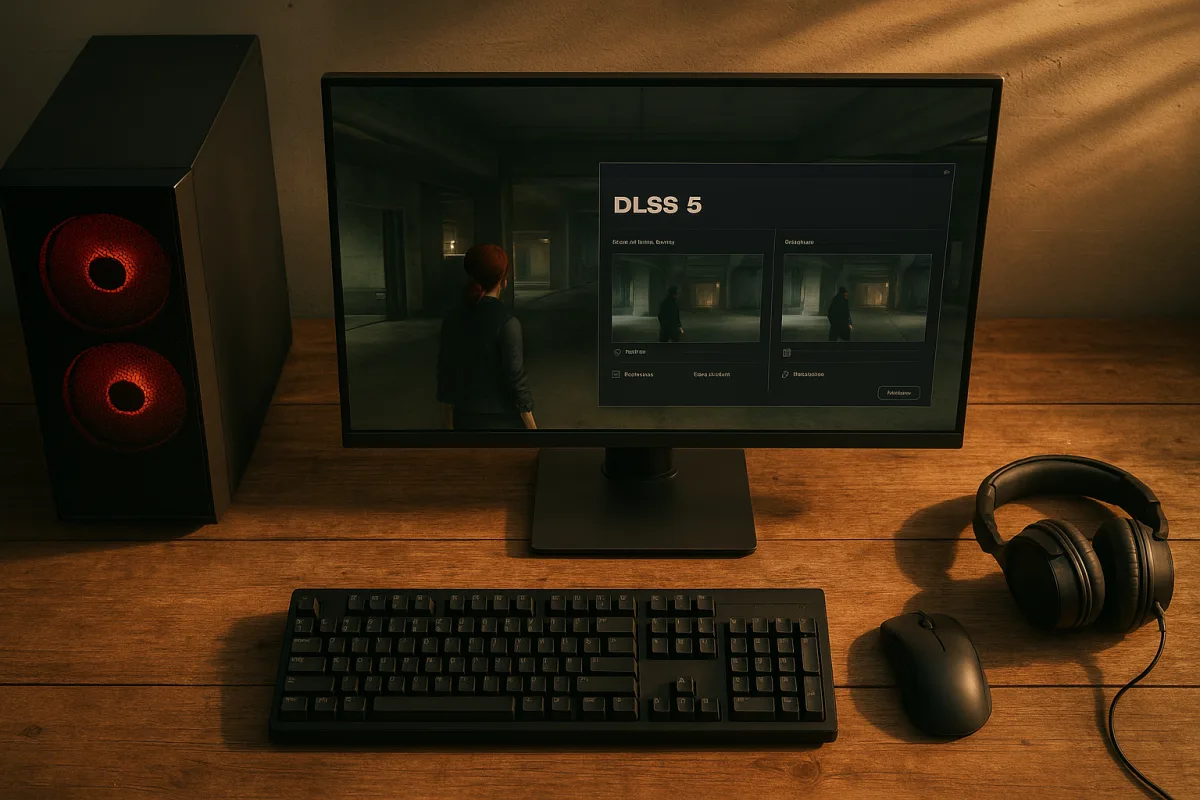
The shift is from demo footage to uncontrolled compatibility testing
Nvidia DLSS 5 has moved from a carefully staged feature announcement to something modders can force into games that were never designed to use it. That changes the conversation, even if it does not validate the technology.
The leaked file is nvngx_dlssnr.dll, where the “nr” appears to mean Neural Rendering. Reports tracing it to the August 26 NBA 2K27 early-access build identified it as an unreleased DLSS neural-rendering runtime, rather than another routine DLSS Super Resolution update. [7]
That distinction matters. DLSS 4 and DLSS 4.5 generally sit in familiar PC graphics territory, reconstructing an image, improving ray-traced output, or generating frames. DLSS 5’s proposed neural rendering is intended to alter the rendered appearance itself. [3][8]
The first public reactions have predictably called it an “AI slop filter,” but that label is less useful than identifying what viewers are seeing. This is an image-transforming layer, not a magic settings toggle that hands out free visual quality.
Several groups are testing the same basic idea
Rock Paper Shotgun reported that RenoDX community contributors got the leaked runtime functioning in Remedy Entertainment’s Control, a 2019 action game with a well-established PC modding scene. Their build apparently affected character models while leaving HDR in a broken state.
IGN separately reported Control experiments with sliders for skin masking, intensity and style. Those controls broadly match Nvidia’s earlier promise that developers would be able to tune the neural-rendering effect rather than accept one hard-coded visual treatment. [6]
Kotaku reported follow-up attempts in Bethesda Game Studios’ The Elder Scrolls V: Skyrim and Square Enix’s Final Fantasy VII Rebirth. The screenshots are important less because any one looks convincing, and more because multiple modders quickly attempted the same runtime injection across very different games.
That is the real trend. A leaked library became a portable curiosity almost immediately, and the community began testing compatibility, parameter controls and failure cases. This is the usual modding response to a new graphics hook, only with much stranger visual consequences.
It is worth resisting the temptation to call these independent benchmarks, though. The reporting is independently published, but much of the evidence traces back to the same leaked DLL, RenoDX discussion, shared screenshots, and social posts.
Still, the replication across Control, Skyrim and Final Fantasy VII Rebirth supports one narrow conclusion: this is not merely a fabricated Nvidia demo clip. An unfinished neural-rendering component can be invoked outside NBA 2K27, at least on some RTX 50-series configurations.
Why the faces look wrong
Nvidia clarified that DLSS 5 neural rendering works from 2D frame information and motion vectors. It does not directly use a game’s geometry, textures, or lighting data, which is exactly why the early images can look detailed and fundamentally misplaced simultaneously. [5]
A traditional character renderer knows where skin ends, where a beard begins, which wrinkles belong to a normal map, and how a face sits under scene lighting. An image model is inferring those things from the finished frame.
That can add the kind of local contrast that reads as “detail” in a still screenshot. It can also replace authored texture work with smooth pores, sharpened shadows, artificial makeup, or a face that seems to belong to another game entirely.
Rock Paper Shotgun’s description of Control character models getting selectively processed is especially revealing. If neural rendering is only catching faces and bodies, the visual mismatch becomes more obvious, because the world around them remains authored while people receive an AI beauty pass.
Kotaku’s reports of Skyrim characters becoming lifeless and Final Fantasy VII Rebirth protagonist Cloud Strife acquiring an unfamiliar resemblance are extreme examples. They show the risk in applying one learned visual preference across games with radically different art direction.
This is why the current community argument, “more detail” versus “uncanny slop,” is mostly talking past itself. Both reactions can be true in the same frame. The filter may increase apparent micro-detail while reducing material accuracy and artistic consistency.
Nvidia has responded to criticism by giving developers Structure Intensity and Tone Intensity controls. That is a sensible concession, but it remains developer-side control, not evidence that players will get granular options for skin, eyes, hair, surfaces, or individual effects. [6]
For a PC player, the question is not whether DLSS 5 can make a screenshot look more photographic. The question is whether a game’s developer can tune it until the new pixels still look like that specific game.
The performance bill is not a rounding error
The ugliest number so far comes from a Tech Times consumer test of the modded Control implementation. At 4K on an RTX 5070 Ti, enabling the leaked neural-rendering build reportedly reduced performance from 71 fps to 35 fps. [2]
That is a 51 percent loss, which changes the match more than any facial slider. A game hovering around 70 fps can still feel comfortable with adaptive sync. At 35 fps, input response and frame pacing become the first things players notice.
Other reports have quoted smaller but still severe losses, including roughly 40 percent in one RTX 5060 result and near-50-percent reports from RenoDX experimenters. The precise number is less reliable than the pattern: this build is currently expensive to run.
Nobody should compare those results directly with an official DLSS 5 release, because Nvidia has not released DLSS 5 or published official performance numbers for it. The mods are using an extracted runtime in games without native integration or final optimization. [2][8]
HDR is another major unknown. Rock Paper Shotgun noted that HDR was not working in the unofficial Control setup, while Nvidia has not supplied detailed public compatibility information for DLSS 5’s neural-rendering path. A broken HDR pipeline can poison every visual judgment.
For perspective, Nvidia’s current released DLSS 4.5 features are nowhere near this punitive in available testing. VideoCardz reported around a 4 to 5 percent RTX 5070 Ti hit and roughly 12 percent on RTX 3090 Ti and RTX 2080 Ti hardware. [1]
That is the difference between a setting people may leave on and a setting they benchmark for curiosity before turning off. DLSS 5 is not yet in the first category, and pretending otherwise because the leaked code has “DLSS” in its name would be silly.
Why this is happening now
The timing is not mysterious. Nvidia has announced a Fall 2026 target for DLSS 5, and NBA 2K27 is due to launch on September 4. A pre-release game build carrying a new runtime is plausible, even if shipping it was a mistake. [7][8]
Nvidia is also still actively iterating on the mature DLSS stack. At Gamescom in August, the company highlighted DLSS 4.5 updates including Ray Reconstruction and Dynamic Multi Frame Generation, so the company is not treating neural rendering as a clean replacement. [3][9]
The bigger business context explains Nvidia’s willingness to pitch a more aggressive AI graphics feature. PC Gamer noted that gaming is now folded into Nvidia’s Edge Computing reporting, while data centers account for 93 percent of company earnings. [4]
That does not prove DLSS 5 exists to chase an AI narrative. It does mean Nvidia has every reason to frame gaming graphics as another application for neural models, even when the first public reaction is that the model has edited the art instead of enhancing it.
Nvidia has named Bethesda, Capcom, Hotta Studio, NetEase, NCSOFT, S-GAME, Tencent, Ubisoft and Warner Bros. Games as DLSS 5 supporters. That is a meaningful list of prospective partners, but it is not adoption data, because the feature remains unreleased. [8]
The meta will not move because a leaked DLL produced a few cursed screenshots. It moves when one or two high-profile shipped games provide a clean toggle, stable HDR, tolerable performance, and visuals that survive motion rather than only passing screenshot inspection.
What modders and project builders should do next
For modders, the useful lesson is that neural rendering may reuse inputs already common in DLSS-capable games. Rock Paper Shotgun’s RenoDX reporting suggested Unreal Engine 5 games could be comparatively straightforward targets, assuming their render paths expose suitable motion-vector data.
That makes UE5 projects the likely first wave of experimentation, not because they are guaranteed to look good, but because graphics integrations are easier to prototype where the plumbing is familiar. Control proves that engine choice is not the only route, however.
Do not mistake ease of injection for support. A mod that changes a character face in a paused shot may fail under animation, disocclusion, depth of field, particles, UI overlays, cutscenes, changing weather, or HDR. Those are the actual boss fights.
There is also a legal line here. Extracting and redistributing an unreleased proprietary Nvidia library from NBA 2K27 may breach terms of service and potentially implicate Nvidia’s and 2K’s intellectual property rights. Experimentation is not the same thing as a clean redistribution path.
For a public mod project, the safest useful work is documenting behavior around a user-supplied local file, if that is lawful in the relevant jurisdiction, and clearly labelling every result as experimental. Do not bundle leaked runtime files into a mod download.
Performance testing should be equally disciplined. Record GPU model, driver version, resolution, preset, DLSS mode, scene, average fps, frame time, HDR state, and whether the effect touches characters only. “Looks smoother” is not a benchmark.
Hardware buyers should be particularly cautious. The RTX 5070 Ti launched at $749, but the reported August 2026 median price is about $1,099.99, with some MSI Gaming Trio OC listings ranging from $1,049.99 to $1,420. [2]
Those are graphics-card prices only, not the cost of a complete gaming PC, monitor, power supply upgrade, or the electricity and cooling demands of a higher-end build. The RTX 5070 Ti suits high-resolution gaming and experimentation, but not blind spending on unreleased features.
The sensible near-term project is not a DLSS 5 showcase mod. It is a controlled comparison tool: vanilla versus neural rendering, moving footage rather than stills, HDR noted explicitly, and raw captures saved before social-media compression disguises artifacts.
Community panic is premature because this is unfinished code operating outside its intended games. Publisher reassurance would also be premature, because the leak exposes the central risk plainly: a neural renderer can be technically impressive while still making a game look less like itself.
Frequently Asked Questions
What is the Nvidia DLSS 5 leak about?
The leak involves an unreleased DLSS 5 neural-rendering runtime DLL (nvngx_dlssnr.dll) found in an early-access NBA 2K27 build. This leaked file shows that Nvidia’s neural-rendering technology exists outside official releases, allowing modders to experiment with it in unsupported games. However, it is not proof that the final DLSS 5 release will perform or look like these early mods.
How are modders using the leaked Nvidia DLSS 5?
Modders have injected the leaked DLSS 5 runtime into various games like Control, Skyrim, and Final Fantasy VII Rebirth to test compatibility and visual effects. They are experimenting with it as a new post-processing layer that can overwrite faces, materials, and tone, despite lacking access to the game’s actual geometry or lighting data. These experiments focus on exploring the technology rather than improving game visuals in a polished way.
What performance impact does DLSS 5 have on RTX 5070 Ti?
Unofficial modded tests report a significant performance drop, such as a reduction from 71 fps to 35 fps (a 51% decrease) at 4K resolution in Control. However, these results come from unsupported mods with incomplete HDR handling and do not reflect Nvidia’s official performance data. Nvidia has not released official benchmarks for DLSS 5, and earlier versions like DLSS 4.5 showed only minor performance impacts.
Why do faces look different with DLSS 5 neural rendering?
DLSS 5’s neural rendering infers detail from 2D frame data and motion vectors rather than using the game’s original geometry, textures, or lighting. This approach can add local contrast and detail but may also replace original textures with artificial effects like smooth pores or exaggerated shadows, causing faces to look misplaced or different from the intended design. This results in visual artifacts that do not align with the game’s authored appearance.
Can DLSS 5 improve visual fidelity in games?
DLSS 5 is designed to alter the rendered appearance through AI-powered neural rendering, potentially enhancing visual fidelity by adding detail and contrast. However, early modding experiments show mixed results, with visual changes sometimes described as “AI slop filters” that overwrite original graphics in unintended ways. Nvidia plans to give developers control over the effect’s intensity and tone, but user control remains limited and the technology is still unrefined.
How we researched this
This article was assembled from 3 published articles, 9 cited references.
Nothing here is based on hands-on testing. Where a figure or finding appears, it belongs to the source cited beside it, and the writing says so rather than implying otherwise. Every source is listed below so you can check it.
Sources
Nvidia DLSS 5's AI yassification filter reportedly escapes containment ahead of release, thanks to modders digging files out of NBA 2K27 — Rock Paper Shotgun
Nvidia's DLSS 5 Leaks Online, and Modders Have Already Turned It Into a Slop Filter — IGN
DLSS 5 Bleeds Frames in First Consumer Test: 71 to 35 FPS on RTX 5070 Ti
Nvidia Ships DLSS 4.5 Ray Reconstruction and Nanite at Gamescom 2026 – Gaming.net
I barely remember the last time Nvidia mentioned gaming at all in an earnings call
NBA 2K27 Files Reveal Early NVIDIA DLSS 5 Clues | Publish Nexus
NVIDIA DLSS 5 Delivers AI-Powered Breakthrough in Visual Fidelity for Games | NVIDIA Newsroom
Related Articles
GTA 6 Leaks and Rockstar's Response Explained
Explore the latest GTA 6 leaks, what they reveal, and how Rockstar Games is responding to the ongoing leak campaign.
Control Resonant Gameplay and Graphics Review Deep Dive
Explore Control Resonant gameplay, Gravity Shift mechanics, graphics settings, and edition comparisons for an optimized PC gaming experience.
Wardogs Launch Impact: Sales, Players, and Server Challenges
Explore the Wardogs launch impact with sales, player peaks, and server issues shaping this multiplayer shooter’s early success.

Star Wars Galactic Racer review
Read our Star Wars Galactic Racer review covering campaign, editions, PC performance, and top sci-fi racing alternatives for 2026.