
Upcoming Strategy Games and RTS Highlights for 2026-2027
Discover upcoming strategy games and RTS highlights for 2026-2027, including grand strategy, tactical, and large-scale real-time battles.
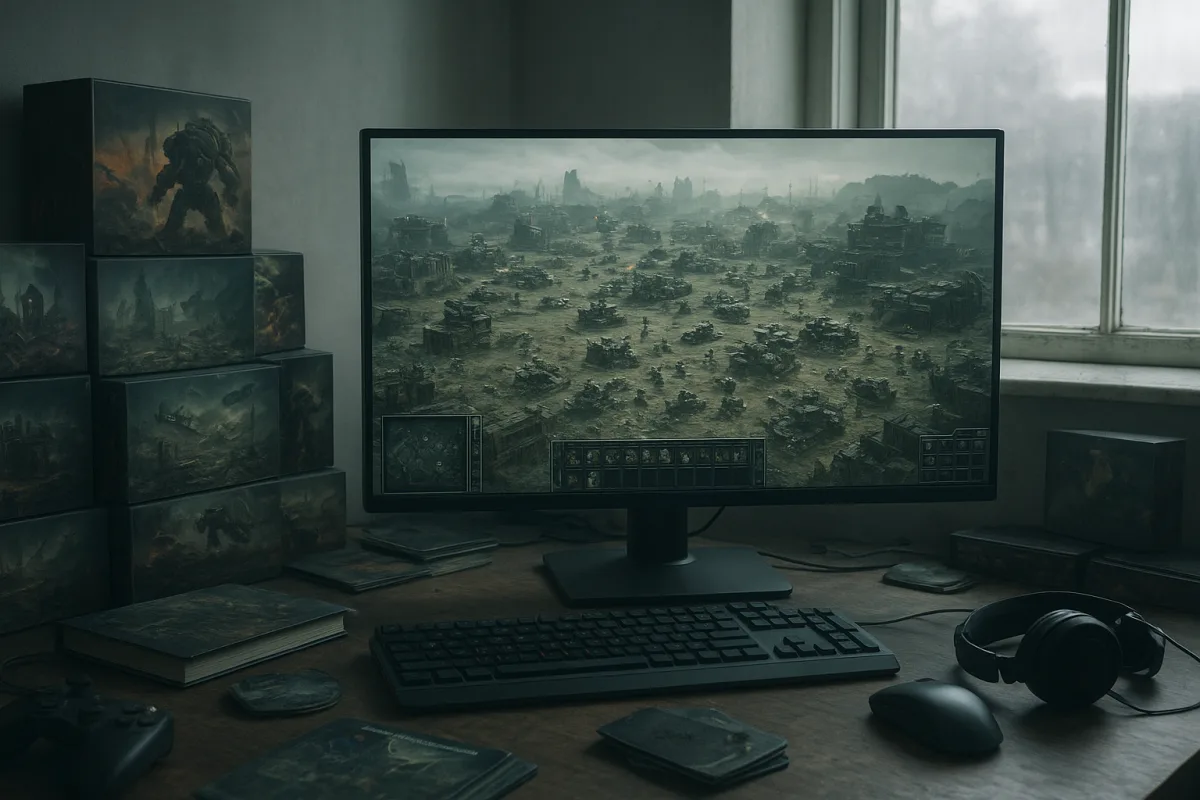
The quick list
Best overall: Original War, for RTS players who want a tight campaign where individual soldiers keep experience and mistakes persist across missions.
Best value: Battle Realms, for players bored with barracks spam and looking for a strange, still-distinct feudal-fantasy RTS.
Best for huge battles: American Conquest, for anyone who wants sprawling formations and armies advertised at up to 16,000 soldiers.
Best tactics-first RTS: Blitzkrieg, for World War II players who want armor angles, recon, artillery, and mission objectives over base construction.
Best weird RTS: Submarine Titans, for players who want three-dimensional underwater combat, depth management, and a setting almost nobody else has copied.
Best upcoming macro RTS: Sanctuary: Shattered Sun, for Supreme Commander and Total Annihilation veterans waiting for another large-scale economy-and-firepower game.
Best upcoming grand strategy gamble: Afterworld, for Paradox players who want post-apocalyptic state building, scavenging, and planned competitive or cooperative multiplayer. [1]
Best upcoming tactics game: Rainbow Six Tactics, for XCOM-style squad-strategy fans who prefer breaches, destructible cover, and a fixed team of operators to an economy game.
The old RTS games to reinstall before 2027 arrives
A veteran engineer dies in Original War, and the next mission starts without the skills you spent several maps building. That is the hook: Czech developer Ultra Interactive made a time-travel RTS where the units are characters first and disposable production icons second.
The 2001 game sends American and Russian forces four million years into prehistoric Siberia over Cyber, a mineral that can power cold fusion. Its campaign combines gathering, base work, vehicles, and squad management, but its real trade-off is pace.
You field a smaller, more valuable force than in Command and Conquer. An experienced scientist or engineer carries abilities forward, so reckless scouting and automatic attack-move behavior can poison several future missions, not only cost you a few replacement units.
Original War is still the easiest old oddity to recommend because it remains commercially available. PCGamingWiki lists the Steam version as Windows-only, with online and LAN multiplayer for up to 12 players, plus extremely light requirements: a Pentium III 900 MHz processor, 256 MB of RAM, and an OpenGL 2.1-compatible GPU. [2]
Battle Realms attacks a different RTS problem: the old rhythm of mining resources, placing barracks, and queueing the same optimal infantry. Liquid Entertainment instead starts you with peasants, then has you train them through branching warrior roles within one of four rival clans.
That gives Battle Realms a stronger match-level identity than many games from 2001. You are shaping a roster through village decisions, not selecting fully formed counter-units from a familiar tech tree. The cost is readability, because the game expects you to learn those transformation routes.
Its feudal Japanese mythology and martial-arts fantasy also hold up better than generic orcs-versus-humans art direction. We would play Battle Realms after Original War, especially if you want a campaign and skirmish game whose central system still feels like an experiment nobody successfully standardized.
American Conquest goes in the opposite direction. GSC Game World built it around formations, national armies, and battles involving up to 16,000 soldiers, covering conflicts across the Americas from 1492 to 1813.
The 12 playable nations and tribes include Spain, England, France, and the Aztecs. Diplomacy with neutral tribes adds a political layer, but the reason to play is visual and operational scale: lines of infantry, cavalry, and artillery spreading across a map instead of tiny squads trading ability cooldowns.
That scale makes American Conquest a poor choice for a quick lunch-break match. It is the one to load when you miss Cossacks-style logistics and want formations to matter, even if its age shows in interface friction and the amount of attention large armies demand.
Blitzkrieg and Sudden Strike are the cleaner recommendations for players who want World War II tactics without the economy game. Both minimize or remove conventional base building, which means every tank, artillery piece, and infantry unit is part of a finite operational puzzle.
Blitzkrieg, released in 2003, leans into vehicle armor and attack angles. A frontal shot can be wasted against a well-armored tank, while reconnaissance and artillery spotters make slow setup far stronger than a straight rush.
Sudden Strike is harsher about force preservation. Its missions hand you a limited force across German, Soviet, and Allied campaigns, then punish players who drive armor unsupported or treat artillery as an afterthought. Pick it if you want tactical restraint, not production queues.
Metal Fatigue remains the deep-cut pick for players who still think mech customization is underused in RTS games. Zono’s 2000 game lets you assemble giant Combots from parts, then fight across three layers: surface, underground tunnels, and orbital space.
The layer system is its best and messiest idea. You can establish bases and launch attacks across all three spaces, making raids and defense more interesting than a flat map, while the older interface makes managing that ambition harder than it ought to be.
Submarine Titans makes an equally unusual demand. Australian developer Ellipse put its RTS under the ocean, where submarines fight at different depths and positioning includes vertical space, not only a horizontal line between your fleet and the enemy base.
Its White Sharks, Black Oxy, and later Silicon campaign give it conventional faction variety, but the depth system is why it survives in memory. We would pick it over a familiar naval RTS when you want to relearn how line of sight, approach routes, and unit placement work.
Dark Colony is smaller in feel. Its Mars conflict between human colonists and the alien Taar uses tanks, aircraft, biological creatures, and a day-night cycle in a horror-leaning RTS campaign. It is punishing, atmospheric, and far less interested in clean esports-style balance.
How the upcoming games split the strategy audience
The 2026-27 slate is trying to cover every layer of strategy at once. Gamewise’s roundup ranges from squad tactics and city building to grand strategy and enormous real-time battles, so the useful split is not genre labels. It is how much you want to command.
Afterworld gives you the broadest mandate. Paradox Interactive describes it as a post-apocalyptic grand strategy game where a small survivor group develops into a nation across a procedurally generated North America. [1]
You scavenge essentials, establish settlements, explore ruins, and define laws and ethics for the society that follows. Rival tribes, raider warlords, and the immortal Ancients are part of the stated setup, while planned multiplayer includes both cooperative and competitive play. [1]
There is still a major missing block of information. Paradox has not announced a release date, price, multiplayer session limits, pause rules, co-op control structure, or hardware requirements beyond TBC, so do not build a 2027 shopping list around it yet. [1]
Sanctuary: Shattered Sun is the direct answer for players who wish modern RTS games would stop shrinking armies. It promises hundreds of units, flowing resources, land and sea combat, later air warfare, simulated projectiles, experimental super-units, and a destructible Dyson-sphere battlefield.
Gamewise reports an August 2027 full-release target following a 2026 pre-alpha demo. Its proposed superweapons can destroy sections of the structure beneath enemy bases, while climate control can freeze oceans and open invasion paths, which sounds tailor-made for players who miss macro games with absurd map-level consequences.
The danger is obvious: a game promising simulation, terrain alteration, huge armies, campaign systems, and multiplayer has a lot of moving parts. We would watch whether its “less micromanagement” goal produces meaningful strategic tools, or merely less control over units when pathfinding gets crowded.
Rainbow Six Tactics takes the smallest battlefield here. Ubisoft Paris’ planned 2027 turn-based spin-off uses squads of four operators selected from a roster of 15, with hostage rescue, bomb disposal, eliminations, destructible environments, drones, and synchronized Breach attacks.
The operator-loss system is the notable detail. A fallen character can enter a coma or become unavailable later, creating some of Original War’s persistence without asking you to manage bases or resource lines. It will live or die on whether its destructible maps create plans, not scripted breach puzzles.
Espiocracy is the most specialized grand strategy prospect. Xvivo Studios’ Cold War intelligence game begins in 1946 and puts you in charge of one of 74 intelligence organizations, including the CIA, KGB, MI6, and Mossad.
Instead of fielding armies directly, you recruit agents, run propaganda, infiltrate governments, fund proxy wars, handle counterintelligence, and work around double agents and misinformation. Gamewise lists a Q3 2027 window, after delays tied to its complexity, which is believable for a game trying to model this many hidden systems.
Game of Thrones: War for Westeros aims at the audience that wants a traditional RTS with a licensed campaign wrapper. PlaySide Studios plans four factions, House Stark, Lannister, Targaryen, and the White Walkers, plus dragons, giants, recognizable characters, and a territory-grabbing sandbox campaign.
Total War: Warhammer 40K has the bigger strategic burden. Creative Assembly’s reported launch lineup includes Space Marines, Orks, Astra Militarum, and Eldar within a galaxy-spanning campaign, while Total Medieval III remains earlier in pre-production. Neither has a published release date or price in the information available here.
Comparison table
| Game | Status | Scale and layout | Core trade-off | Price information |
|---|---|---|---|---|
| Original War | Available now | Small persistent squads, campaign missions, up to 12-player online or LAN | Great unit attachment, less disposable-army freedom | Steam price not stated |
| Battle Realms | Available now | Village economy and branching peasant-to-warrior training | Distinct unit building, steeper learning curve | Price not stated |
| American Conquest | Available now | Formation warfare, 12 nations and tribes, up to 16,000 soldiers | Huge spectacle, demanding army control | Price not stated |
| Blitzkrieg | Available now | Objective maps with tanks, infantry, aircraft, artillery, and recon | Tactical armor play, little conventional RTS base building | Price not stated |
| Submarine Titans | Available now | Underwater bases and three-dimensional depth combat | Fresh positional game, older interface | Price not stated |
| Afterworld | Upcoming | Procedural North America, settlement building, national politics, planned co-op and competitive multiplayer | Huge strategic promise, major details still unannounced | No price announced [1] |
| Sanctuary: Shattered Sun | Targeting August 2027 | Hundreds of units, sprawling bases, Dyson-sphere terrain manipulation | Macro spectacle, high execution risk | No price stated |
| Rainbow Six Tactics | Targeting 2027 | Four-operator squads from 15 operators, destructible tactical maps | Focused tactics, no RTS economy | No price stated |
| Espiocracy | Targeting Q3 2027 | 74 intelligence agencies, covert operations, dynamic political borders | Rare subject matter, complex systems may delay it | No price stated |
The current RTS safety net
Relic’s position explains why Company of Heroes remains one of the few major RTS lines with an active long-term support path. CEO Justin Dowdeswell told Rock Paper Shotgun that keeping Company of Heroes in Relic’s 2024 separation from Sega was essential, because its catalog sales and future potential were central to the studio’s survival.
The studio has since focused on Company of Heroes 3 updates, DLC factions, and restoration work on its older catalog. Its 3.0 anniversary patch overhauled effects, audio, NPC AI, Italy-campaign systems, and added autumn and winter assets for community map makers.
That does not guarantee a new Relic RTS tomorrow. Dowdeswell said the studio wants a modern Relic game and expects to remain in strategic gameplay, even if it explores adjacent genres. For now, Company of Heroes 3 is the live-service-like testing ground where Relic can make faster iterations and remain connected to players.
Skyrim players also have a large strategy-adjacent time sink this month, though it comes with mod-management costs. Beyond Skyrim: Bruma 2.0 adds a fully voiced quest, new dungeons and interiors, weapons including its first spear, enemies, spells, enchantments, encounters, books, maps, and boss-fight changes. [3]
Rock Paper Shotgun reports that the update arrived on November 11, 2026, Skyrim’s 15th anniversary. The Beyond Skyrim team rebuilt Bruma around a newer Cyrodiil development structure, ending the old need to maintain separate public Bruma and work-in-progress Cyrodiil builds.
Install it only after clearing the decks. Version 2.0 breaks prior Bruma saves, needs Skyrim Special Edition version 1.6 or higher plus the project’s shared asset repository, and may require submod updates or patches for conflicts with Identity Crisis and Beyond Reach. [3]
Who each option suits
Original War suits campaign players who want a squad-level memory of their mistakes. Battle Realms suits players who want an RTS where unit production is a strategic system in itself, and American Conquest suits anyone who wants formations and absurdly large historical battles.
Blitzkrieg and Sudden Strike suit players who prefer battlefield planning to building a base. Pick Blitzkrieg for armor facing and recon, pick Sudden Strike when you want strict force preservation, and pick Metal Fatigue if customizable robots and layered maps outweigh interface polish.
Submarine Titans suits players who have exhausted every tank-and-infantry variation and want depth to be an actual combat variable. Dark Colony suits players who value a hostile mood and difficult campaign missions over smooth modern conventions.
For the future, we would keep Sanctuary: Shattered Sun at the top of the RTS watchlist because it is chasing a scale few current games attempt. Afterworld is the more intriguing long-term prospect for Paradox players, but its missing date, price, requirements, and multiplayer details mean it remains a watchlist entry, not a preorder.
Rainbow Six Tactics suits turn-based breach planners, while Espiocracy suits players who would rather destabilize a government than win a frontline battle. War for Westeros and Total War: Warhammer 40K are the license-heavy bets, potentially huge, but still needing proof that their spectacle can support a durable strategy game.
Frequently Asked Questions
What are the most anticipated upcoming strategy games in 2026 and 2027?
Sanctuary: Shattered Sun is an upcoming macro RTS targeting August 2027, promising large-scale economy and firepower battles. Afterworld is a grand strategy game announced by Paradox Interactive with no confirmed release date but planned multiplayer modes. Rainbow Six Tactics is another upcoming title focused on tactical squad strategy.
Which upcoming RTS games feature large-scale battles and unique mechanics?
Sanctuary: Shattered Sun aims to deliver Supreme Commander-style macro RTS gameplay with large-scale battles and destructible Dyson-sphere environments. American Conquest, though older, is noted for its sprawling formations and armies of up to 16,000 soldiers, emphasizing scale and logistics.
What new grand strategy games are releasing soon?
Afterworld is the notable upcoming grand strategy game, set in a post-apocalyptic world with state building, scavenging, and both cooperative and competitive multiplayer planned. However, its release date, pricing, and detailed system requirements remain unannounced.
How do upcoming strategy games differ in gameplay style and scale?
Upcoming games vary from large-scale macro RTS like Sanctuary: Shattered Sun, focusing on economy and massive battles, to tactical squad-based games like Rainbow Six Tactics that emphasize cover, breaches, and fixed operator teams. Grand strategy titles like Afterworld add a layer of state management and multiplayer cooperation or competition.
What are the key features of upcoming tactical and macro RTS games?
Rainbow Six Tactics offers XCOM-style squad strategy with destructible cover and fixed teams rather than base building or economy management. Sanctuary: Shattered Sun targets macro RTS fans with large-scale battles, economy management, and destructible environments, reminiscent of classic Supreme Commander gameplay.
How we researched this
This article was assembled from 2 video sources, 2 published articles, 4 cited references.
Nothing here is based on hands-on testing. Where a figure or finding appears, it belongs to the source cited beside it, and the writing says so rather than implying otherwise. Every source is listed below so you can check it.
Sources
As The Elder Scrolls 5 turns 15, massive mod Beyond Skyrim: Bruma gets a 2.0 update delivering a new quest, extra dungeons and an "expanded worldspace", Rock Paper Shotgun
Keeping hold of Company of Heroes was essential for Relic to leave Sega, Relic CEO says"Without it we would have been a dead studio", Rock Paper Shotgun
Beyond Skyrim: Bruma's 2.0 Update Adds Dungeons, Weapons, and a Quest
Watch Upcoming Strategy Games and RTS Highlights on Youtube
Also from the sources
Related Articles
Indie Games Highlights and Industry Events in 2026
Explore key indie games, demos, and industry events in 2026 with detailed highlights and release info for PC gamers.
October 2026 PC Game Releases and Sales Guide
Discover October 2026 PC game releases, early access, and Steam Autumn Sale dates to plan your gaming and save on top titles.
New Tactical and Sci-Fi Shooters to Watch in 2026
Explore new tactical and sci-fi shooters in 2026, including Fragmentary Order, VOID/BREAKER, and Silica with gameplay, features, and buying advice.
Nintendo Switch 2 November Game Releases and Updates 2026
Discover Nintendo Switch 2 November 2026 game releases, updates, and upgrades including Ocarina of Time remake and Pikmin 4 Switch 2 Edition.