
Tekken 8 Xbox Series S Criticism
Explore Tekken 8 Xbox Series S criticism, hardware limits, and feature parity issues impacting gameplay and development.
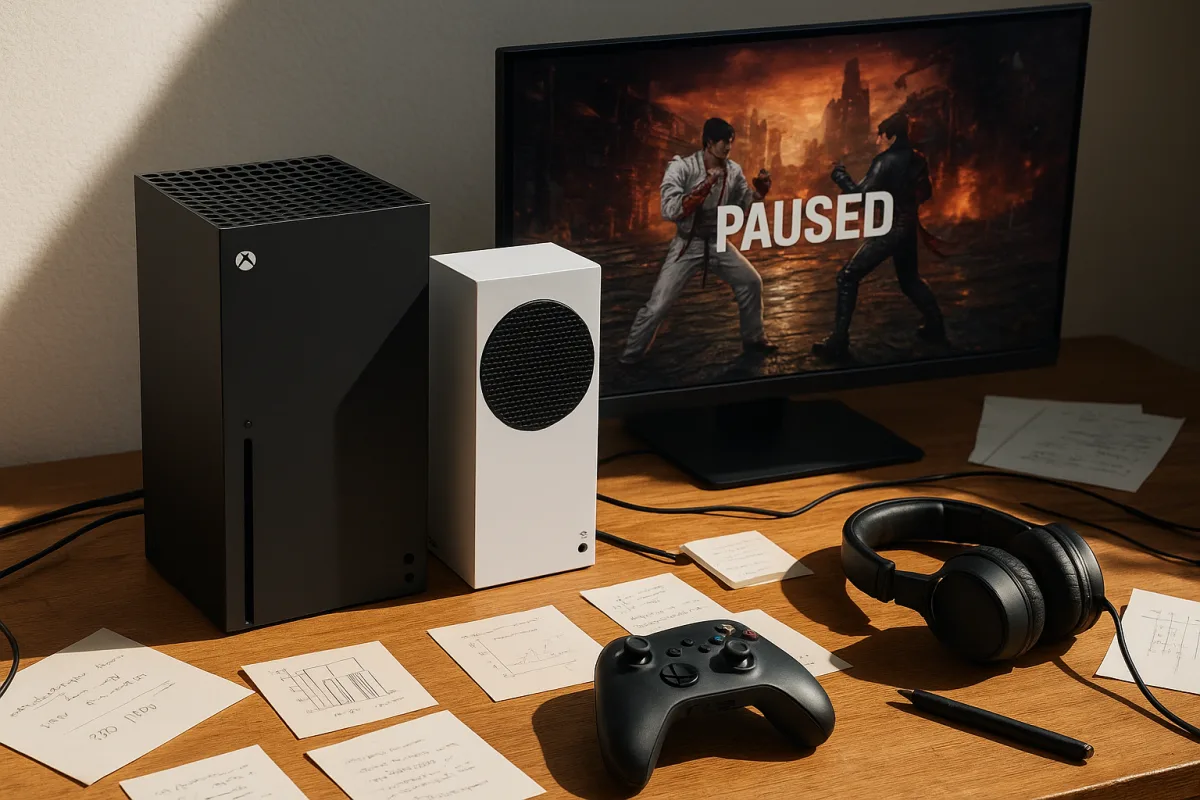
Harada’s complaint came with a clear target
On November 9, Tekken creator Katsuhiro Harada used a Console Game Developers Conference panel in South Korea to say he wished hardware like Xbox Series S “wouldn’t be released.” A senior Xbox representative was reportedly in the room. [10]
Harada was not announcing a Tekken 8 patch or claiming that Series S cannot run the game. His complaint was about feature parity, Microsoft’s requirement that a game released on current Xbox consoles support the same major modes across Series S and Series X. [11]
That is the whole fight. Series S is not an optional low-settings PC preset that a developer can leave behind when a feature proves too expensive. If the Xbox version launches, the lower-spec machine generally comes with it.
Paweł Sasko, CD Projekt Red’s associate game director and a Cyberpunk 2077 developer, gave the diplomatic counterargument. Series S forces teams to optimize code cleanly, and that work can improve performance on stronger systems too. [9]
Harada heard that answer as a very polite agreement. He described Series S as similar enough to Series X that developers must make extra work for a “slightly weaker child,” while still serving a substantial share of Xbox players. [10]
That framing is harsh, but the technical issue is real. You are looking at two consoles sharing the Xbox platform, controller ecosystem, online services, and game library, while carrying dramatically different graphics and memory budgets.
Feature parity means the same match, not identical pixels
Microsoft’s Xbox requirements call for consistency in major game modes, save-game roaming, and online play between Xbox Series S and Series X. [11] The policy does not mean both machines must render every pixel or texture at identical quality.
A Series S edition can use lower resolution, reduced texture quality, shorter shadow distance, less dense effects, or less stable image reconstruction. Those are visual settings, and Microsoft built the system around the idea that developers could scale them down.
The difficult part arrives when a feature needs memory, simulation time, or a particular performance budget. A local split-screen mode, a large multiplayer map, advanced physics, or a demanding replay system can stop being a cosmetic setting.
Baldur’s Gate 3 is the generation’s clearest public example. Its Xbox release arrived later after Larian struggled to get split-screen co-op running on Series S, and Microsoft engineers helped the studio find a path forward. [4]
The final outcome did not mean the original problem was imaginary. It showed what feature parity does in practice: developers either make the feature work within Series S limits, alter it, delay it, or risk leaving the entire Xbox release behind.
For a fighting game, the equivalent danger is not usually a 100-player battlefield. It is a feature that affects the match environment, spectator tools, replay systems, training options, online consistency, or the frame budget behind all of them.
Why the hardware gap keeps showing up
Xbox Series S has a 4 TFLOPS GPU with 20 compute units running at 1.565 GHz. Its 10 GB of GDDR6 memory is split between 8 GB at 224 GB/s and 2 GB at 56 GB/s. [1]
Xbox Series X lists 12 TFLOPS from 52 compute units at 1.825 GHz, backed by 16 GB of GDDR6 memory. [1] On the headline GPU number alone, Series X has three times Series S’s listed compute throughput.
TFLOPS are not a frame-rate guarantee. They describe a type of theoretical graphics calculation, not the full cost of rendering a real game, loading textures, streaming data, simulating effects, processing input, and handling online play.
Still, the figures explain why Series S cannot be treated as Series X with a small resolution reduction. Its GPU is substantially smaller, and its memory pool gives developers less room to keep high-quality assets ready for use.
The split memory arrangement adds another complication. Series S has 2 GB operating at 56 GB/s, one-quarter the bandwidth of its faster 8 GB section. [1] Bandwidth is the rate at which hardware can move data, including textures and render targets.
When memory pressure climbs, a developer cannot wave it away with a lower output resolution. Texture quality, streaming behavior, visual effects, and scene detail may need separate cuts, because the machine must fit assets and rendering data into its available memory.
Harada specifically identified low memory as an issue, but he focused even more on the workflow. A Switch 2 port can be planned as a version for a distinct Nintendo audience, he argued, while Series S sits beside Series X under one Xbox release. [10]
That makes the Series S version highly visible. Players see the Xbox logo, see a game advertised for the Series family, then ask why their version has blurrier textures or reduced visual options. Harada said those complaints land on developers. [10]
What this means in Tekken 8
Tekken 8 is a 3D fighting game where both players need a stable simulation for every exchange. A blocked jab, a sidestep, a Heat activation, and a wall break all need to resolve predictably for both machines in an online match.
This is why fighting games often prioritize frame consistency over visual excess. A brief hitch during a scramble can be worse than a softer background texture, because the player has only a narrow response window to recognize and counter an attack.
New Tekken 8 character Roger Jr. makes that timing pressure easy to see. IGN’s starter guide describes Rocket 2 as a 15-frame high, Rocket 3+4 as a 14-frame mid, and Rocket 1 as a slower 28-frame launcher.
Those numbers describe how quickly attacks become active. At 60 frames per second, one frame lasts about 16.7 milliseconds, so a 14-frame move reaches its hit point roughly 233 milliseconds after its animation begins.
Roger Jr.’s stance pressure turns those small windows into match-defining decisions. IGN notes that entering Rocket stance from 2,1 on hit grants plus 9 frames, enough advantage to make many follow-up attacks uninterruptible.
That is why clean performance matters in a Tekken match. If you know Roger Jr. has entered Rocket at plus 9, you are not guessing whether you are technically allowed to jab. You are identifying whether he will use a mid, low, heat option, or throw.
The character’s Astronaut stance creates a similar layered threat. Astronaut 3 is a plus-on-block mid, Astronaut 4 is a homing high, and Astronaut 3+4 is an unbreakable throw dealing 45 damage, according to IGN’s guide.
None of that proves Series S runs Tekken 8 poorly. No recent public benchmark in the available reporting gives exact Tekken 8 frame rates, resolutions, or frame-time comparisons across Series S, Series X, and PlayStation 5.
It does explain why Harada’s complaint has more weight than a graphics-purist rant. A fighting-game team has to preserve the parts that decide a match first, then find savings in the areas players still notice immediately, such as textures and effects.
The cost is larger than a lower resolution setting
Series S was built as the cheaper entry to the current Xbox generation, but its U.S. price has risen sharply. Microsoft’s 512 GB Series S is now listed at $499.99, while the 1 TB model is $599.99. [7]
Those prices include the console and its internal storage. They do not include extra storage, a tournament-ready monitor, an arcade stick or leverless controller, a second controller, a wired network setup, or the games themselves.
The 512 GB machine has roughly 364 GB of usable SSD space after system allocation. [1] For one household rotating through a few games, that is an inconvenience. For an event setup with multiple fighting games, it becomes an operations problem.
Tournament organizers need installed game builds, patches, DLC, profiles, and sometimes several titles ready for pools or side brackets. Deleting and redownloading games between events is slow, error-prone, and dependent on network access organizers may not control.
The storage issue does not make Series S incapable of hosting a bracket. It does make the lower-priced machine less attractive once you treat a fighting-game station as equipment that must be maintained, updated, and duplicated across an event floor.
Reports have also pointed to tournament organizers moving toward Xbox Series X hardware because of PlayStation 5 reliability concerns. Texas Showdown is among events reported to have selected Series X hardware for future competition. [6]
That shift does not validate every claim about console performance. It shows that organizers value predictable hardware, storage capacity, and a manageable event setup over brand loyalty, especially when hundreds of matches depend on the stations staying online.
The Series S benefit is real, but so is the bill
Sasko’s defense deserves more than a sarcastic footnote. Optimization work can expose wasteful rendering, memory use, or streaming behavior that a stronger machine hides, and CD Projekt Red said work for weaker targets benefited Cyberpunk 2077 on other platforms. [9]
The cheaper box can also expand the audience. If someone can afford a Series S but not a Series X, parity means they still get access to the same broad game catalog and can play online with friends on stronger hardware.
But Microsoft has made the trade explicit. Developers gain a larger installed base, while accepting that every core Xbox feature must survive on a console with 4 TFLOPS of GPU compute and 10 GB of split memory. [1]
Harada’s frustration is aimed at that obligation, not at Series S owners for buying the console Microsoft offered. Players are entitled to ask why their version has lower texture quality, but the answer starts with the platform holder’s product strategy.
We would not read Harada’s comments as proof that a “Helix S” successor is doomed. He joked that Microsoft might hear Sasko’s praise and build one anyway, while Shift Up CTO DongKi Lee expressed interest in receiving an early Helix development kit. [10]
A lower-cost next-generation Xbox could work if Microsoft gives developers a clearer split in features, more generous memory, or rules that distinguish competitive consistency from every optional graphical and technical feature. Microsoft has not announced such a policy.
For Tekken 8 players, the immediate answer is narrower. Series S can still put you in the same match, but Series X is the safer long-term machine if you care about local events, storage headroom, cleaner visual settings, and fewer compromises dictated by parity.
Frequently Asked Questions
Why did Tekken 8 director criticize Xbox Series S hardware?
Tekken 8 director Katsuhiro Harada criticized the Xbox Series S because Microsoft’s requirement for feature parity between Series S and Series X forces developers to accommodate the weaker hardware. He described this as extra work for a "slightly weaker child" that still serves a substantial share of players, complicating development and limiting performance and texture quality.
What are the hardware limitations of Xbox Series S for Tekken 8?
The Xbox Series S has a 4 TFLOPS GPU with 20 compute units at 1.565 GHz and 10 GB of GDDR6 memory split into 8 GB at 224 GB/s and 2 GB at 56 GB/s. This is significantly less powerful than the Series X’s 12 TFLOPS GPU and 16 GB of memory, leading to lower texture quality, reduced effects, and limited memory bandwidth that constrain game performance and features.
How does Xbox Series S affect Tekken 8 gameplay and features?
While the core competitive match experience remains stable, the Series S’s hardware limits require compromises such as lower texture quality and reduced visual effects. These constraints impact players, developers, and tournament organizers by limiting cosmetics and potentially affecting replay systems, training options, and online consistency.
What is Microsoft’s feature parity policy for Xbox Series consoles?
Microsoft mandates that games released on Xbox Series S and Series X must support the same major game modes, save-game roaming, and online play consistency. However, this does not require identical visual quality; developers can scale down resolution, texture quality, and effects on Series S but cannot omit core features or modes.
Should I use Xbox Series X or Series S for playing Tekken 8?
For a dedicated fighting game setup, the Xbox Series X is recommended due to its higher GPU power and memory capacity, which support better texture quality and more stable performance. The Series S can run the same game modes but with visual compromises and potential limitations that affect competitive and tournament play.
How we researched this
This article was assembled from 1 video source, 4 published articles, 11 cited references.
Nothing here is based on hands-on testing. Where a figure or finding appears, it belongs to the source cited beside it, and the writing says so rather than implying otherwise. Every source is listed below so you can check it.
Sources
Tekken creator says he wishes hardware like the Xbox Series S 'wouldn’t be released', Game Developer
Tekken Legend Katsuhiro Harada Says He Wishes 'Hardware Like the Xbox Series S Wouldn't Be Released', IGN
Xbox Series X vs. Series S: Which current-gen console should you buy? | Windows Central
PS5 vs Xbox Series X: which current-gen console should you buy?
Which is better, the Xbox One X or the Xbox Series S? - Game Voyage
Esports Organizers Abandon PS5 for Xbox Series X Due to Hardware Flaws - Newsy Today
Buy New XBOX Series X|S Consoles - See Deals & Pricing | Microsoft Store
Two Major Developers Explain Why They Like And Dislike Making Games For Xbox Series S | Pure Xbox
Ex-Tekken director Katsuhiro Harada wishes hardware like the Xbox Series S 'wouldn't be released'
Technical capabilities - Game Publishing Guide | Microsoft Learn
Watch Tekken 8 and Xbox Series S Hardware Criticism on Youtube
Related Articles
Next-Gen Console Hardware and Exclusives in 2026 Overview
Explore next-gen console hardware updates and exclusive games in 2026, including PS6 progress, Xbox exclusives, and Nintendo Switch 2 lineup.
GTA 6 Launch Performance: Frame Rate, Enhancements & More
Get detailed GTA 6 launch performance info: 30 FPS target, PS5 Pro enhancements, Xbox Cloud Gaming, and download size tips.
Elder Scrolls VI Xbox Exclusivity Impact on Platforms
Explore the impact of Elder Scrolls VI Xbox exclusivity rumors on PC, PlayStation, and hardware choices for gamers.
Phantom Blade Zero PC Gameplay and Performance Guide
Explore Phantom Blade Zero PC gameplay, system requirements, and optimization tips to ensure smooth performance and master combat mechanics.