
Marathon Shooter Update: Bungie's Revamp and Future Plans
Explore the Marathon shooter update, Bungie's revamp plans, new PvE and PvP modes, and strategies to boost player retention.
Marathon is pivoting beyond extraction, plainly
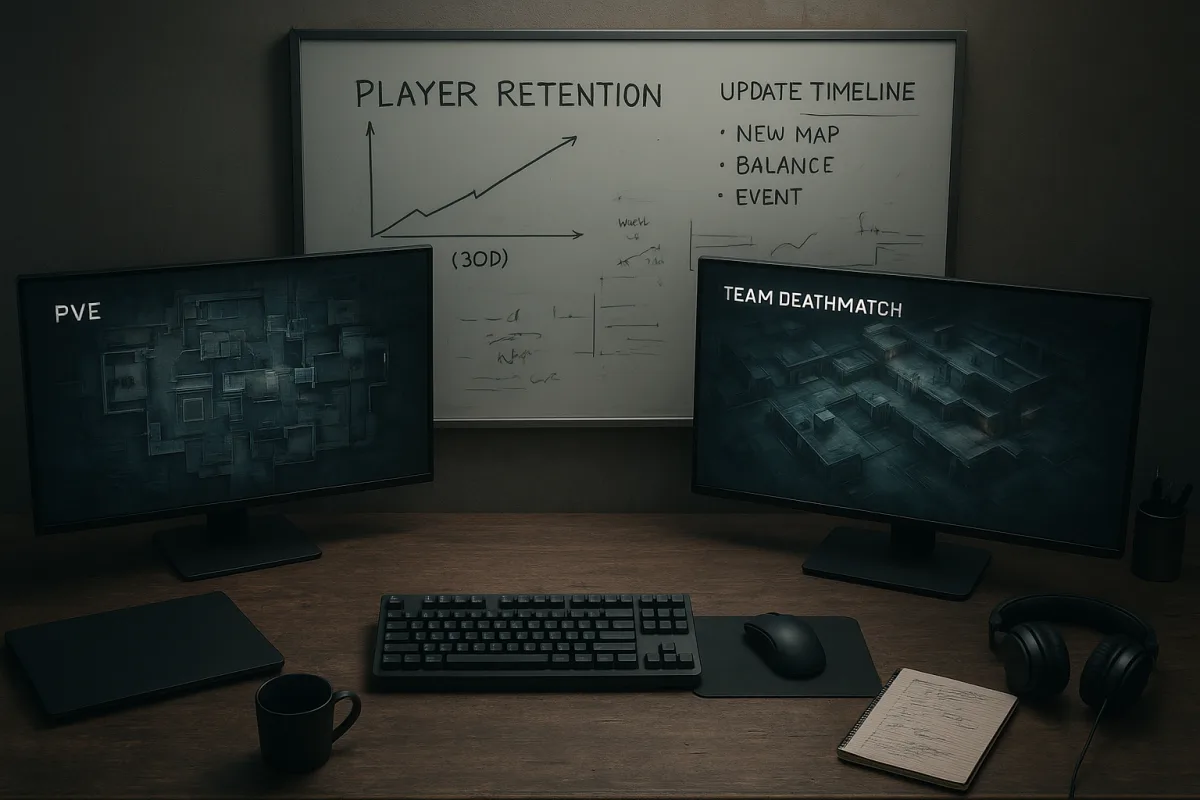
Bungie is broadening Marathon from a hard-edged extraction shooter into a multi-mode shooter with distinct PvE, PvP, and PvEvP lanes. Extraction remains, but it is being demoted from the entire game’s identity to one part of a larger service.
That is not community doomposting reading too much into a minor playlist update. Bungie’s own language is unusually direct: the studio says Marathon “did not reach as many players as we had hoped,” a public admission reported by GamesRadar [4].
The evidence is also visible in what Bungie is actually shipping. The October Nightfall refresh adds a rewards reset, a permanent free NuCaloric Rewards Pass, Sponsored Kit queues, and broader Cryo Archive access, before the larger Symbiosis update arrives December 8 [5][11].
Sponsored Kit queues matter more than their dry name suggests. They let players queue with supplied equipment rather than risking their carefully assembled personal loadout, removing one of extraction games’ most effective fear buttons: losing a kit before understanding why it died.
Then Symbiosis adds Marathon’s first permanent PvE mode and an experimental Team Deathmatch playlist. IGN characterises the intent correctly: give players familiar ways to learn Marathon’s shooting and movement before asking them to accept a full extraction run’s stakes [5].
Bungie is also remaking Perimeter with a fungal infestation, additional routes, and a PvE pinnacle encounter centred on the Tick Queen. The Click reports that the update includes a social space and firing range, giving runners somewhere to meet and test equipment without getting deleted mid-loadout screen [11].
The timeline needs a little caution. Rock Paper Shotgun described the social hub as a March feature, while the research brief and The Click place it with Symbiosis on December 8 [11]. December is the better-supported current plan, but roadmaps are not patch notes until the patch lands.
Several outlets are seeing the same direction
Eurogamer, IGN, Rock Paper Shotgun, and Kotaku all identify the same strategic movement: less dependence on a single high-pressure extraction loop, more ways to play at different commitment levels. That consistency makes the pivot real, but it does not make each outlet an independent verification.
They are chiefly reporting Bungie’s roadmap and accompanying developer messaging, not uncovering separate internal plans. The independent evidence is the population data, the delayed update schedule, and Bungie’s own admission that the original audience target was missed [1][4][5].
That distinction matters because publisher roadmaps naturally frame a retrenchment as an expansion. “More player choice” can mean a healthy game gaining useful variety. It can also mean a studio discovering that its original funnel was too narrow to sustain the investment.
Marathon’s Steam trajectory supports the second reading. MarathonStatus records a peak of 88,337 concurrent players on March 6, 2026, while ixbt.games reported roughly 765 concurrent players by mid-September, a drop of more than 99 percent from that peak [1][2].
Raijin’s Steam tracking puts average daily players at 35,040 in March and around 2,188 in September [3]. Those are not all-platform figures, and neither dataset can tell us exactly how many console players remained, so claims about total retention should stay speculative.
Still, a game does not need a precise global census for the pressure to be obvious. When public PC activity falls that sharply, matchmaking quality, newcomer experience, social momentum, creator interest, and the perceived value of learning a punishing game all deteriorate together.
Why the original loop ran out of runway
Extraction shooters ask for a specific kind of commitment. A player must learn maps, loot value, audio cues, enemy behaviour, ambush routes, extraction timing, and when to disengage, while accepting that a single mistake may erase a meaningful run.
That tension is the genre’s main course, not a side dish. But it makes for a brutal first week if the game offers too few low-risk ways to practice, especially when strong opponents have already built gear reserves and map knowledge.
Bungie’s developers put it more bluntly in the Future of Marathon material published through IGN. The studio says it made the game overly difficult for many players, and that for too many people death was not a learning step, but the only step.
The balance implication is straightforward. If the only efficient way to acquire power requires winning against entrenched players, the rich get cleaner kits and more confidence, while new players become loot deliveries with a loading screen between matches.
Sponsored Kits and Team Deathmatch are attempts to interrupt that loop. One reduces economic punishment, the other creates a place to learn recoil, cooldowns, shell matchups, and movement without needing an extraction win before the match feels worthwhile.
A permanent PvE mode attacks a different problem: not every player wants another human being to be the final exam. Players can enjoy Marathon’s guns, art direction, and co-op problem-solving without treating every corridor as a possible insurance claim.
This is not Bungie abandoning the idea that made Marathon distinctive. The stated future is an interconnected mix of PvE, PvP, and PvEvP, with different intensity levels for solo players and groups, plus revised onboarding and more focused narrative work [5].
The important word is interconnected. If these modes become separate lobbies with separate rewards, extraction regulars may see them as distractions while PvE players see extraction as an unpleasant mandatory detour. Shared progression can fix that, or make it worse.
The market supports the idea, not the outcome
There is a real market case for hybrid shooters. Switchblade Gaming reports that Escape from Tarkov ranked 11th in PC playtime and that ARC Raiders reached 481,966 concurrent Steam players in November 2025, later selling 14 million copies by February 2026 [8].
Those examples do not prove that “add PvE and win” is a formula. They do show that the audience has not rejected extraction tension itself. The more likely lesson is that players want a broader set of reasons to inhabit an online shooter.
Newzoo’s 2026 PC and console report, collected by Game Industry Library, finds that more than half of revenue comes from games ranked 21st and below rather than just the top twenty [6]. The market is less forgiving of a single winner-takes-all service bet.
Meanwhile, Notebookcheck’s analysis points to cooling battle royale interest [7]. That does not mean every competitive game must become a co-op shooter. It does mean the old pitch of one endlessly repeatable, high-pressure PvP loop is no longer automatic mass-market bait.
Marathon is trying to become the game where a squad can choose its mood. One night, players might use Team Deathmatch to practice a Bishop shell build. Another, they might fight the Tick Queen in PvE, then take that familiarity into a riskier extraction run.
That is the sensible version of the plan. The dangerous version is an “everything shooter” with four queues, fragmented populations, incompatible balance demands, and a weekly checklist that turns each mode into homework instead of a preferred activity.
Balance will move slowly, even if the population returns quickly
Team Deathmatch may look like the smallest addition, but it can expose balance issues that extraction mode conceals. A weapon that is merely annoying when ammunition, healing, and gear are scarce can become oppressive when players respawn repeatedly and fight on predictable lanes.
Likewise, Bishop’s stated identity as a fast, melee-burst hunter-killer is more volatile in a respawn mode than in extraction. In an extraction match, an aggressive shell must preserve resources and avoid third parties. In deathmatch, it can trade lives for tempo.
PvE creates the reverse problem. Abilities that feel fair against alert human players can be miserable against enemies with predictable targeting or large health pools. Bungie’s Tick Queen and other alien encounters will need readable telegraphs, cooperative roles, and rewards that do not trivialise player conflict.
The first month after Symbiosis should therefore be treated as an experiment, not a settled meta. Expect obvious outliers to appear within days, particularly burst mobility, melee reliability, ammo economy, and anything that gains unusual value when players can practice with no meaningful gear loss.
The deeper shift will take longer. A new PvE playlist may attract curious returners during December, but a March-scale update linking modes, progression, onboarding, a new zone, and new combatants is the point where Bungie can prove whether the systems reinforce each other.
That March update is also where the studio has promised a more substantial evolution, following the end of Marathon’s strict seasonal schedule [5]. Ending a rigid cadence can be healthy if it buys quality and responsiveness, but it also admits the previous production rhythm was not working.
What developers should take from this
For anyone planning a multiplayer shooter, Marathon’s clearest lesson is not “copy Destiny” or “add a social hub.” It is to identify the first ten hours your game offers to people who are curious, capable, and still unwilling to lose repeatedly.
High stakes need low-stakes scaffolding. That can mean protected starter queues, rentable loadouts, training scenarios that teach real decisions, short competitive modes, co-op objectives, or progression that recognises useful play besides extracting with the biggest backpack.
The social hub is not just set dressing, either. A firing range gives players a practical answer to basic build questions: does this weapon’s recoil suit me, does this shell ability work at close range, and what exactly killed me last match?
However, developers should not read “social space” as an inexpensive engagement lever. Bungie has provided no public technical detail about its implementation, and there is no disclosed cost breakdown for maintaining hubs, multiple modes, networks, matchmaking, or ongoing content pipelines.
The financial context makes that omission relevant. GameRiv reports estimates that Marathon’s development budget exceeded $200 million and may have passed $250 million, while TechRadar reports $22 million in post-Steam-cut revenue before the game fell out of Steam’s top 50 [9][10].
Those estimates are not audited Bungie disclosures, so they should not be treated as a final profit-and-loss statement. They do explain why a broadening strategy is more than a creative adjustment: a costly live-service shooter needs enough kinds of players to justify continued support.
The sensible project plan is therefore narrower than Marathon’s current rescue package. Build one excellent repeatable loop, then ensure multiple skill levels and motivations can access it. Do not mistake harshness for depth, and do not promise a mode ecosystem before proving the core can retain players.
Bungie has enough evidence to justify trying this pivot. It has not yet supplied evidence that the pivot will work. December will show whether Marathon can make its excellent shooting worth returning to, while March will show whether “beyond extraction” is a coherent game or a recovery plan with too many moving parts.
Frequently Asked Questions
What are Bungie's plans for the Marathon shooter update?
Bungie is shifting Marathon from a pure extraction shooter to a multi-mode game featuring permanent PvE, experimental Team Deathmatch, a social space, and a broader PvE, PvP, and PvEvP framework. The December 8 Symbiosis update will introduce these features, marking a significant pivot aimed at expanding player choice and engagement.
How is Marathon changing its gameplay modes?
Marathon is adding permanent PvE modes and an experimental Team Deathmatch playlist alongside the existing extraction mode. The Perimeter map is being overhauled with a fungal infestation theme, new routes, and a PvE pinnacle encounter. Additionally, a social space and firing range will be introduced to provide players with non-combat interaction areas.
Why did Marathon's player count drop sharply?
Marathon's player base fell dramatically from a peak of 88,337 concurrent players in March 2026 to roughly 765 by mid-September 2026 on PC. Bungie publicly acknowledged that the game "did not reach as many players as we had hoped," indicating that the original extraction-only focus limited its audience appeal.
What new features will the Symbiosis update add to Marathon?
The Symbiosis update will add Marathon’s first permanent PvE mode, an experimental Team Deathmatch playlist, a social space, and a firing range. It also includes a fungal-themed visual overhaul of the Perimeter map with additional routes and a new PvE pinnacle encounter centered on the Tick Queen.
How is Bungie addressing player retention in Marathon?
Bungie is introducing new modes to lower the barrier for players to try Marathon, such as Sponsored Kit queues that allow players to queue with supplied equipment instead of risking their own loadouts. They are also adding rewards resets and a free NuCaloric Rewards Pass to encourage ongoing play, though they acknowledge that new rewards and progression systems are needed to keep players engaged long-term.
How we researched this
This article was assembled from 1 video source, 6 published articles, 11 cited references.
Nothing here is based on hands-on testing. Where a figure or finding appears, it belongs to the source cited beside it, and the writing says so rather than implying otherwise. Every source is listed below so you can check it.
Sources
Marathon - Official 'Future of Marathon' Part 1 Overview — IGN
As Marathon's player slump continues, Bungie announces plans to grow it "beyond extraction" — Eurogamer
The future of Marathon includes a fungus-filled Perimeter, a social hub, and a shift "beyond extraction" — Rock Paper Shotgun
Candy Crush Developers Win Contract With Management After Calling For A Multi-Union Strike — Kotaku
Marathon Player Count — Live Steam Stats & All-Platform Data | MarathonStatus
Marathon's Online Player Count on Steam Plummets to Concord's Level
Bungie admits Marathon "did not reach as many players as we had hoped"
Bungie’s Marathon Reportedly Cost More Than $250 Million to Develop - GameRiv
Marathon Social Space, Team Deathmatch and Firing Range Explained
Watch Marathon Shooter Revamp and Future Plans on Youtube
Related Articles

Wardogs Gameplay, Popularity, and Crunch Controversy
Explore Wardogs gameplay, its rise in popularity, helicopter mechanics, and the developer crunch controversy in this detailed PC gaming overview.
Blizzard Upcoming Games 2026
Discover Blizzard's upcoming games in 2026 including Diablo 5, StarCraft open-world shooter, and Overwatch's new hero Doctrine with release dates and

Nintendo Switch 2 Game Bundles and Pricing Guide 2026
Explore Nintendo Switch 2 game bundles, pricing updates, and which offers like Mario Kart World provide the best value in 2026.
Wardogs Launch Impact: Sales, Players, and Server Challenges
Explore the Wardogs launch impact with sales, player peaks, and server issues shaping this multiplayer shooter’s early success.