
Blizzard Union Contract: Key Worker Protections Explained
Learn about the Blizzard union contract and its worker protections, including recall rights and AI workplace bargaining terms.
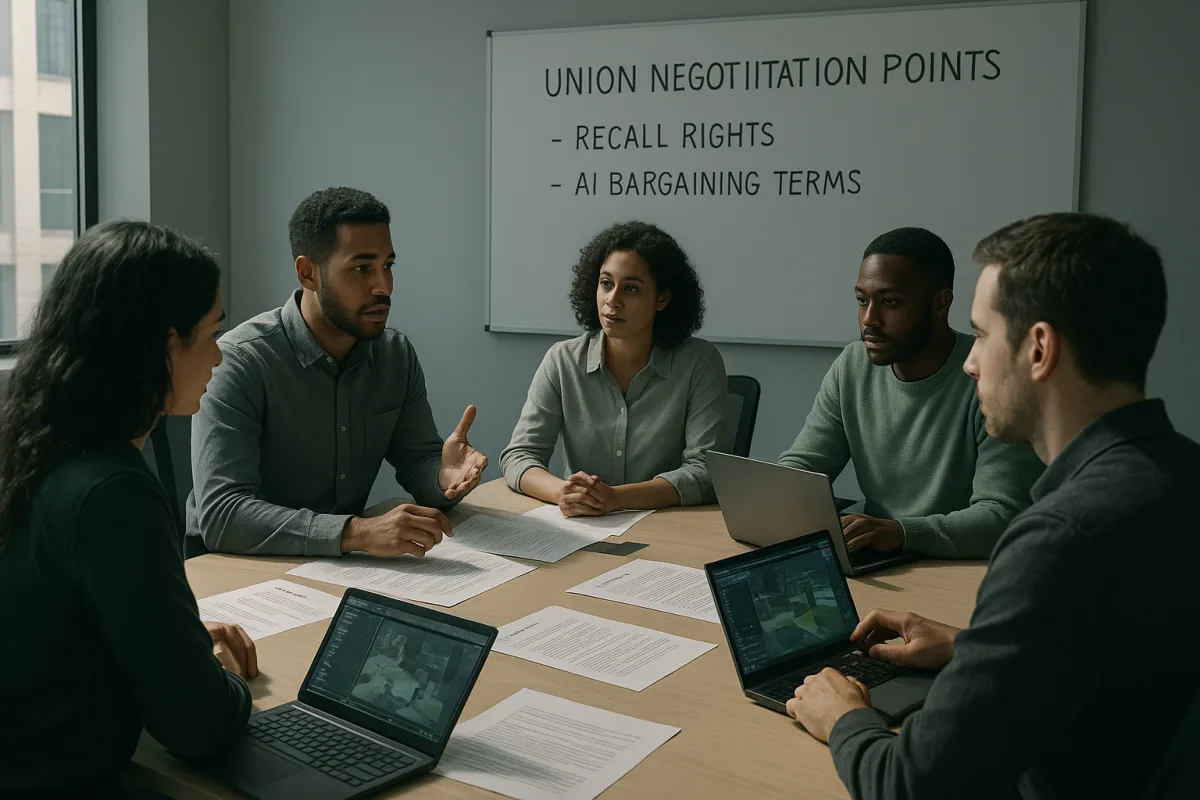
The important mechanic is the 14-month recall window
The headline version is that Blizzard workers have ratified a historic union contract. That is true, but “historic” is publisher-and-union press-release language until someone asks what a worker can actually do differently on a bad Tuesday.
The most concrete new protection is the recall right. Under the agreement, a laid-off worker can be recalled into an open position across any Blizzard bargaining unit for 14 months from the date their layoff is announced. [2][3]
That sounds like a small administrative perk until you compare it with the usual games-industry layoff script. A studio cuts a team, closes a project, gives people severance, posts a few “we are hiring” roles months later, and expects former employees to apply as outside candidates.
Recall changes that last step. It treats a laid-off Blizzard union member as someone with an ongoing contractual connection to the employer during that 14-month period, rather than simply another applicant refreshing LinkedIn after their badge stops working.
The covered workforce is substantial: around 1,900 people across teams supporting World of Warcraft, Hearthstone, Warcraft Rumble, Overwatch, and Diablo, plus quality assurance, Platform and Technology, and Story and Franchise Development staff. [2][3]
That scope is why the phrase “across any Blizzard bargaining unit” matters. A worker laid off from one project is not necessarily confined to waiting for the exact same project, discipline, or local team to recover.
What “recall” does, and what it does not do
A recall clause is easiest to understand as a queue-management system for layoffs. When an employer creates an eligible vacancy, it must account for certain recently laid-off workers before treating the job market as entirely external.
It does not mean Blizzard must invent a role, preserve every cancelled project, or rehire everyone who loses a job. If no suitable openings exist, a recall right cannot manufacture work from the void.
It also does not mean every former worker automatically returns the moment Blizzard posts a vacancy. The published announcements say workers can be recalled into open positions, but neither Blizzard nor the CWA has released the operative language explaining qualifications, notice procedures, interview requirements, or dispute rules. [2]
Those omissions are not trivial fine print. They determine whether recall behaves like a meaningful priority system or merely an additional application channel with better paperwork.
For example, contracts often need to answer whether a former worker must be minimally qualified or best qualified, whether seniority breaks ties, how Blizzard contacts eligible people, and how long someone has to respond. None of those details is public here.
So the safe reading is deliberately narrower than the community’s more optimistic version. Blizzard has agreed to a 14-month recall protection, but outsiders cannot yet calculate an individual worker’s odds of returning after a layoff.
That is still a major shift. In a conventional non-union layoff, the employer can usually recruit later without a negotiated obligation to revisit people it dismissed. Here, a missed recall opportunity can potentially become a contract grievance.
Why 14 months is the number that changes behaviour
The duration is not arbitrary. Fourteen months is long enough to cover more than one annual planning cycle, a post-launch staffing adjustment, or the period between cancelling one initiative and approving its replacement.
Games companies commonly lay people off while retaining the intellectual property, live-service operation, engine technology, and future sequel plans that drew on their labour. The work does not always disappear permanently. It often moves, changes scope, or reappears under a new budget.
A short recall period might expire before that reshuffling settles. A 14-month period leaves former workers eligible through the part of the cycle when a studio discovers that its “leaner” team still needs more QA, production support, technical work, or content capacity.
There is a practical pressure on management, too. A Blizzard hiring manager cannot necessarily view a newly approved opening as a completely clean slate. The position may come with an existing pool of workers who already know Blizzard’s tools, games, and processes.
That does not kill outside hiring. It does make it harder to justify ignoring people who were recently doing similar work for the same company, especially if the employer has resumed hiring after a broad “efficiency” round.
For the worker, recall has value beyond the possibility of another salary. It can avoid the career reset created by a layoff, where experienced developers must compete for entry points at studios that may not recognise their internal experience or may be cutting staff themselves.
The downside is uncertainty. A recall right is useful only if vacancies appear, the employee is eligible, and the role is viable for that person. The available reporting contains no worker accounts identifying problems with the policy, but that is not evidence that its eventual administration will be frictionless.
Why this arrived now
The contract landed while Microsoft’s gaming business is in a prolonged restructuring phase. The Associated Press reported that Microsoft cut 4,800 jobs in July 2026, including substantial Xbox reductions, as part of a reset of the division. [1]
Game Developer separately reported Microsoft plans to eliminate 3,200 Xbox roles before the end of its fiscal year, following cuts affecting studios including ZeniMax Online Studios, id Software, and Obsidian. [3] The exact totals and timing have shifted across reports, which is normal for rolling layoffs.
The relevant point is not that Blizzard workers were the primary target. Blizzard president Johanna Faries said the studio had not faced substantial layoffs at that point, according to Windows Central’s reporting. [7]
It is that workers bargaining a recall provision were doing so with fresh evidence that being inside a large, profitable games division does not make a team structurally safe. A company can call a cut a reset, a reallocation, or a renewed focus. The affected worker still needs income.
That is the difference between the contract’s most useful language and corporate reassurance. Reassurance is contingent on current leadership plans. Recall rights are an enforceable process for when those plans change.
AI bargaining is a control point, not an off switch
The other widely reported protection requires Blizzard to discuss, evaluate, and bargain with union workers over generative AI use in the workplace. [2][3] This is significant, but it is regularly flattened into “Blizzard’s union banned AI,” which the available evidence does not support.
The contract does not appear to prohibit a Blizzard team from using generative AI. Instead, it makes the decision to introduce or materially use those tools something management must negotiate with the CWA-represented workforce.
That distinction is the whole mechanic. A ban says a tool cannot be used. Bargaining says an employer cannot simply announce a tool, deploy it into a workflow, and expect affected employees to absorb the consequences without a negotiated response.
Those consequences vary sharply by department. For QA workers, an AI system may affect test-case generation, bug triage, or reporting volume. For narrative, franchise, and technology teams, it could affect drafting, asset pipelines, coding support, localisation preparation, or how player data enters a tool.
A bargaining process can put practical questions on the table: whether a system will displace work, what training is provided, whether employees must use it, how output is reviewed, what data is fed into it, and what recourse exists when it creates bad work.
It cannot guarantee the union wins every one of those disputes. Bargaining is a contest over terms, not a magic immunity buff. Its strength is that it forces the employer to disclose an intended change and negotiate before implementation becomes an irreversible fait accompli.
There is no comprehensive US federal rule specifically requiring video game employers to negotiate AI use with workers, according to the independent research brief. That makes this a contract-driven protection, built through union bargaining rather than supplied by a sector-wide law.
Blizzard is not alone in seeking AI protections. GameSpot reported that a 2K Games motion-capture performers union affiliated with RPG-IATSE secured protections around AI and likeness reproduction. [5] The details differ, but the pattern is clear: affected workers are trying to get rules in writing before the tool rollout.
The protections around the protections
The CWA says Blizzard’s contracts also include wage increases, grievance procedures, a three-day in-office hybrid workweek, remote-work and disability accommodations, and just-cause protections. [2][3] These are less flashy than AI language, but they are what make the other provisions usable.
A grievance procedure is the system that turns “Blizzard should have recalled me” into a claim that can be formally raised and adjudicated. Without one, workers may have a promise but lack a defined route to challenge an alleged breach.
Just-cause protection similarly matters because it places limits on arbitrary discipline or dismissal. It does not make a worker impossible to fire, but it generally requires an employer to establish a defensible reason and follow an agreed process.
The wage increase is real as a contractual category, but its numbers are not public. Neither Blizzard nor the CWA has disclosed the percentages, schedules, or job classifications involved, so claims that the deal beats inflation or transforms Blizzard pay would be guesswork.
Severance needs the same caution. Game Developer reported an additional four weeks of severance regardless of tenure, but the independent research brief notes that neither the CWA nor Blizzard has published detailed terms confirming it. [3][6]
That claim may prove correct when the agreement becomes available, but it should not yet be treated as a fully verified universal payout. Public reporting has supplied the buff icon, not the underlying tooltip.
What is clear is the contract’s broader direction. It gives Blizzard’s unionised employees more say over technology changes, more procedure around workplace disputes, and a 14-month route back into Blizzard after layoffs. [2][3]
For players, none of this guarantees faster patches, fewer bugs, or a particular Overwatch balance decision. The honest claim is smaller and more important: workers now have more tools to contest the conditions under which those games are made.
Frequently Asked Questions
What protections does the Blizzard union contract provide to workers?
The contract includes a 14-month recall right allowing laid-off workers to seek open union-covered positions within Blizzard, rather than being treated as permanent exits. It also requires Blizzard to bargain with the union over generative AI usage in the workplace. Other protections include wage increases, hybrid/remote work options, disability accommodations, and grievance procedures.
How does the Blizzard union contract handle layoffs and recall rights?
Laid-off workers have a 14-month window to be recalled into any open position across Blizzard bargaining units. This recall right means the company must consider eligible laid-off workers before hiring externally. However, it is not a guarantee of rehiring or a no-layoff clause, and details on qualifications or selection procedures have not been publicly disclosed.
What are the terms of the Blizzard union contract regarding AI usage?
Blizzard must discuss, evaluate, and bargain with the Communications Workers of America about generative AI tools used in the workplace. This gives the union leverage over how AI is implemented but does not impose a blanket ban on AI usage.
Who is covered under the Blizzard union contract?
Approximately 1,900 workers are covered, including teams supporting World of Warcraft, Hearthstone, Warcraft Rumble, Overwatch, Diablo, quality assurance, Platform and Technology, and Story and Franchise Development staff.
How long is the recall period in Blizzard's union contract?
The recall period lasts 14 months from the date a worker’s layoff is announced, during which laid-off employees can be recalled into open union-covered positions across Blizzard.
How we researched this
This article was assembled from 5 published articles, 8 cited references.
Nothing here is based on hands-on testing. Where a figure or finding appears, it belongs to the source cited beside it, and the writing says so rather than implying otherwise. Every source is listed below so you can check it.
Sources
Unionised Blizzard workers vote through contract giving them a say on genAI adoption and protection against layoffs — Rock Paper Shotgun
Blizzard union workers ratify historic contract covering 1,900 employees — Game Developer
No Man's Sky's 10th Anniversary Update is a Massive Overhaul of Space Itself — Polygon
Avatar’s Creators Officially Reveal When 'Seven Havens' Takes Place After 'Legend Of Korra' — Polygon
Microsoft cuts 4,800 jobs, including many at Xbox in a 'reset' of its gaming division
Blizzard union workers ratify contract covering 1,900 employees
Historic, First-Ever Union Formed By Workers At 2K Games - GameSpot
Blizzard union workers ratify historic contract covering 1,900 employees | Vuink.com
Blizzard QA union reaches deal with Microsoft after almost 3 years | PC Gamer
Related Articles

BioWare Closure and Mass Effect 5 Cancellation Explained
Learn why BioWare shut down and Mass Effect 5 was canceled, including details on the leaked trailer and EA's restructuring impact.
Xbox layoffs and next-gen console pricing update 2026
Explore Xbox layoffs, Project Helix pricing rumors, and upcoming service changes affecting gamers and developers in 2026.
Xbox Halo restructuring: studio changes and industry impact
Explore Xbox Halo restructuring, studio layoffs, and Activision's new role in Halo's future development and industry impact.
Blizzard Upcoming Games 2026
Discover Blizzard's upcoming games in 2026 including Diablo 5, StarCraft open-world shooter, and Overwatch's new hero Doctrine with release dates and