
GTA 6 Partner System Gameplay
Explore GTA 6 partner system gameplay, how Jason and Lucia impact tactics, AI behavior, and wanted level escalation in free roam and missions.
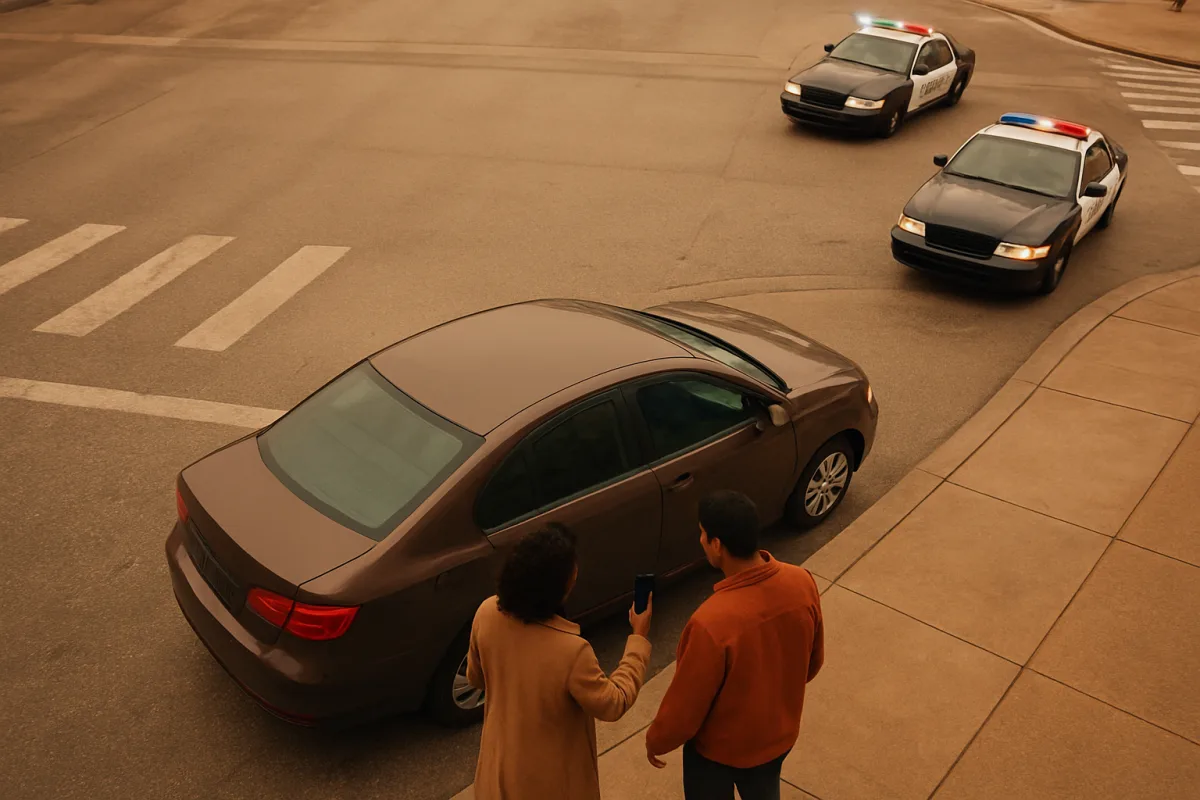
The passenger seat is where GTA 6 changes shape
Lucia driving while Jason scrolls his phone, scans a passing car through binoculars, or talks through the next move is a small scene with a major implication. GTA 6’s most substantial new system is not a collectible, minigame, or hyper-detailed object simulation. It is the other protagonist.
Previous GTA games often made companions mission-specific liabilities. They followed a script, stood in the wrong doorway, failed stealth checks, or died because an enemy had a better angle than you did. Jason and Lucia are designed to remain active partners outside story missions too.
GameSpot’s control breakdown identifies the foundation: when traveling together, you can ask your partner to drive and use the passenger time for phone activity, conversation, and binocular scanning. If you are behind the wheel, you can also initiate conversation with the passenger through a controller shortcut.
That sounds cosmetic until you look at what it removes. Traveling is normally dead time between jobs, stores, safehouses, and side activities. GTA 6 lets one protagonist handle movement while the other uses the trip to inspect the environment and maintain the relationship layer.
We would use it before a robbery or hostile encounter. Letting Lucia drive while Jason scopes entrances, vehicles, and nearby pedestrians is slower than simply flooring it into a parking lot, but it gives you information without immediately turning a quiet area into combat.
Two cars, one plan
The partner system gets more interesting once vehicles enter the equation. GameSpot reports that you can ask one protagonist to take a car, enter another vehicle yourself, and direct the partner to follow. That is an unusually direct answer to an old open-world problem.
Normally, stealing a second vehicle means abandoning your companion or hoping the game teleports them behind you. Here, two cars let you establish a spare escape option, move more than one useful vehicle, or separate the team before an objective turns loud.
The cost is management. A trailing partner has to navigate traffic, maintain line of sight, and arrive without creating their own collision pileup. Rockstar has not published exact follow-distance rules, pathfinding priorities, or conditions under which the partner abandons the instruction.
That uncertainty is why we would not build a heist around the second car being perfectly positioned. Use it as redundancy. Park your intended getaway car near the exit, have your partner keep the backup mobile, and accept that the AI may have to improvise.
The same thinking applies to leaving engines running. GameSpot found that double-tapping the exit command leaves a car idling, ready for a fast departure. It saves the re-entry animation, but the game also allows passersby to take an unattended running car.
That is a clean risk-reward trade. A running car is strong for a quick smash-and-grab, especially if the driver’s door faces the store exit. It is foolish for a long robbery, a multi-floor building, or any situation where the alarm will bring police before you return.
Why an invulnerable partner bends free roam
IGN put the system under much uglier pressure at a Taco Bomb restaurant in Gellhorn. Their experiment began with Jason firing one bullet at an employee, then hiding behind an industrial refrigerator while Lucia fought the responding police.
IGN reports that the non-controlled partner is invulnerable in free roam and carries unlimited ammunition, although mission conditions can still allow either protagonist to die. [6] That makes the companion less like a standard NPC follower and more like a renewable combat resource.
The immediate advantage is obvious. Your partner can draw attention, keep officers occupied, and absorb shots while you reposition, loot, flee, or simply survive. If you are short on ammunition or armor, that changes the economy of an open-world firefight.
It also changes which cover matters. IGN’s kitchen worked because the refrigerator provided solid protection and the room lacked an exterior door, cutting off a flanking route. The team’s survival came from the room layout as much as Lucia’s unlimited gunfire.
But their result also exposes the system’s limits. After roughly 45 minutes in one attempt, then about an hour in a second, Lucia’s shooting produced five wanted stars but did not trigger the sixth. Police eventually stopped escalating in a meaningful way. [6]
IGN finally earned six stars by throwing a grenade into incapacitated officers inside the restaurant. One player bullet plus one grenade did the job, but the “one bullet” claim failed. More importantly, it demonstrated that wanted escalation expects continued player participation, not passive AI attrition.
The exploit has a timer, even if Rockstar has not named it
This is where community hype needs trimming down. An invulnerable, fully armed partner sounds like a way to trivialize every police chase. IGN’s test suggests otherwise: the AI can sustain violence indefinitely, while the wanted system can stall when the player hides.
Rockstar has not published the hidden values that determine six-star escalation, police spawn behavior, heat decay, or how the game attributes companion kills. Without those figures, claims that a particular restaurant, weapon, or duration guarantees six stars are premature.
The interaction still has clear tactical value. Use your partner as a moving distraction while you actively complete the objective, then leave. Do not crouch behind a refrigerator for an hour expecting the simulation to resolve itself in your favor.
This is likely to be a slow-moving meta rather than an instant balance collapse. Players will find strong interiors, bottleneck doors, and durable cover first. Rockstar can alter escalation thresholds or NPC response behavior later without touching the partner’s central fantasy.
The more interesting question is whether the system is reliable during lower-stakes crime. Polygon reports players using a six-pack of beer as an improvised melee tool while robbing jewelry stores and banks, often avoiding the response expected from an armed holdup.
One video Polygon highlights, from YouTuber RandomWeirdThings 248, shows Jason robbing three banks and leaving with roughly $65,000 without a police chase. The routine relies on guard hesitation and weapon-state ambiguity, not on a formal “beer robbery” mechanic.
We would skip that route for routine cash. The videos appear to depend on precise guard timing, knowledge of where security emerges, and inconsistent reactions to an item that is technically not a drawn firearm. That is a trick, not a build.
The world supports plans, but not every detail is a system
GTA 6’s environmental detail helps sell the partner system because the world gives both characters things to do. GameSpot notes that you can lower a boat anchor through the vehicle menu, push or flip a stranded vehicle, duck while driving, and use turn signals.
Turn signals are especially revealing. GamingBolt reports that nearby traffic responds to them, while GameSpot says they cancel automatically after a turn. Following the law is not the point, but a predictable lane change can reduce pointless impacts before a planned escape.
Auto Drive serves the same low-stakes role. With a waypoint set, the cinematic view can hand basic navigation to the game, with slow, normal, and fast speed settings reported by GameSpot and community guides. [3][4] It is built for sightseeing and multitasking, not precision driving.
Do not confuse it with adaptive driving assistance. GTA 6’s Auto Drive follows a destination through the existing world, while it offers far less control than systems that dynamically respond to traffic conditions or enforce detailed driving rules. It is a commute button.
Jackfrags’ gas-truck demonstration is the kind of detail that makes a sandbox clip spread quickly. Shooting holes in a tanker appeared to create a visible gas leak, leave a flammable trail as the truck drove, and ignite back toward the vehicle.
It is a great example of emergent spectacle, but the exact mechanics are unknown. Rockstar has discussed a rewritten vehicle simulation centered on believability, but has not published tanker damage thresholds, fuel volumes, ignition rules, or explosion radii. [1]
So use it for chaos, not planning. A leaking truck may offer a dramatic trap, yet the cost is attracting attention, losing the vehicle, and potentially burning the route you need to escape. It is much less dependable than bringing your partner and a second car.
Secrets reward looking around, not blindly consuming the map
The details that survive repeated play tend to be ones with an interaction behind them. GamingBolt points to obstructed car-exit animations, detachable side mirrors, water coolers that drain to the level of a bullet hole, and boats that take on water before sinking.
Some details are purely observational. Dirty footwear, phone-screen fingerprints, warming brake discs, and a partner dancing to store music deepen the setting, but they do not alter your odds in a fight. Enjoy them, but do not mistake visual fidelity for mechanical depth.
Others support exploration. Jackfrags found first-person canoe travel, a small-game rifle in the King Fisher shack, and a construction lift that could raise the player toward elevated spaces. Those tools encourage the kind of poking around GTA usually rewards.
The TMNT-style turtle-and-rat reference in Millport, reported by GamingBolt, sits at the opposite end of the spectrum. It is a secret to find, not a progression system. GTA 6 has both, and knowing the difference keeps you from chasing rumors for hours.
Food is another area where surface detail and mechanics diverge. Polygon criticized restaurant eating animations as visually flat despite more than 350 food stops, describing meals that can resemble quick snack consumption rather than a close-up culinary showcase.
The broader food system is deeper than that criticism suggests. Community databases list eateries, stores, and home refrigerators as food sources, while food can affect temporary health, stamina, and focus states alongside hunger, weight, body fat, and sleep tracking. [9][10]
Rockstar reportedly cut mandatory grocery runs to avoid pushing GTA 6 fully into life-sim territory. [11] That sounds right to us. A meal should support a night out, recovery, or a character routine, not become a checklist that delays the next job.
The PC catch
For a PC gaming audience, the frustrating secret is that there is no PC version to tune yet. GTA 6 launched on PlayStation 5 and Xbox Series X|S on November 19, 2026, and Rockstar has not announced a PC release date or official specifications. [12][13]
Ignore supposed recommended PC builds and unofficial performance targets. They are estimates based on console behavior, not Rockstar requirements. Reports of an unstable method that averages 36 fps after bypassing the console’s 30 fps cap are not a substitute for a proper PC release. [5]
When GTA 6 does reach PC, the partner AI is the system we will scrutinize first. If it remains as flexible as it appears now, the strongest player strategy will not be a particular gun, vehicle, or viral exploit. It will be keeping Jason and Lucia working together.
Frequently Asked Questions
How does the partner system work in GTA 6?
The partner system allows you to control one protagonist while the other remains active with AI behavior. You can issue commands such as asking your partner to drive, follow in a second vehicle, or hold position. This system turns traveling into an opportunity for environmental scanning, conversation, and planning rather than just dead time.
What tactical advantages do Jason and Lucia provide in GTA 6?
Jason and Lucia can act as distractions or draw enemy attention, allowing you to reposition or loot safely. The non-controlled partner is invulnerable in free roam and has unlimited ammunition, making them a renewable combat resource that can absorb damage and keep foes occupied during firefights.
Can the partner AI in GTA 6 affect wanted level escalation?
Yes, the partner’s actions can cause wanted-level escalation, but passive AI combat alone does not always trigger the highest wanted levels. Wanted escalation typically requires continued player participation rather than relying solely on the partner’s AI to engage enemies.
Is the non-controlled partner invulnerable in GTA 6 free roam?
In free roam, the non-controlled partner is invulnerable and carries unlimited ammunition. However, during missions, either protagonist can still die depending on mission conditions.
How do partner commands influence gameplay in GTA 6?
Partner commands can be used strategically for transport by directing one protagonist to drive or follow in another vehicle, creating repeatable advantages without relying on AI combat. Commands like leaving a getaway vehicle running provide convenience but come with risks, such as NPCs stealing unattended cars.
How we researched this
This article was assembled from 3 video sources across 3 channels, 4 published articles, 14 cited references.
Nothing here is based on hands-on testing. Where a figure or finding appears, it belongs to the source cited beside it, and the writing says so rather than implying otherwise. Every source is listed below so you can check it.
Sources
Grand Theft Auto 6 is on a completely different level..., jackfrags
Hidden Control Options In GTA 6, GameSpot
GTA 6 - 15 MORE SECRETS And Attention To Details You Probably Missed, GamingBolt
Go fishing and fire Hornet out of a cannon in Silksong's December-bound Sea of Sorrow expansion, which Team Cherry say is "unlike anything we’ve done before", Rock Paper Shotgun
I Tried to Get Six Stars in GTA 6 With Just One Bullet and Broke the Game, IGN
'GTA 6' Fans Are Pulling Off Perfect Robberies With Only A Six Pack of Beer, Polygon
How to Enable Auto-Drive in GTA 6 / GTA 6 Guides and Tips / gta.guide
How GTA 6's interface kept the classic Pricedown font but still managed to feel modern
Food and Drink: Fast Food, Bars and Prices | GTA 6 | RaidDex
GTA 6 Dropped Mandatory Grocery Runs But Kept Food Systems | Rockstar Report
Watch GTA 6 Gameplay Depth and Secrets on Youtube
Also from the sources
Related Articles
GTA 6 Robbery Gameplay Tips and Hidden Heist Secrets
Discover GTA 6 robbery gameplay tips, including getaway tricks, partner driving, and how to plan successful heists with hidden mechanics explained.
GTA 6 Criminal Profile Impact on Gameplay and Wanted System
Explore how GTA 6's criminal profile affects gameplay, police response, and the wanted system for Jason and Lucia.
Wardogs Early Access Preview: Tactical FPS and Cash Economy
Explore Wardogs Early Access preview covering its tactical FPS gameplay, cash economy, roles, PC requirements, and known launch issues.
Metro 2039 Gameplay and Developer Insights on Survival
Explore Metro 2039 gameplay and developer insights focusing on crafting, stealth, and survival mechanics shaping the player experience.