
GTA 6 Narrative and Character Depth Explained
Explore GTA 6's narrative and character depth, focusing on criminal profiles and how player choices shape Jason and Lucia's story.

Your profile is the story system hiding behind the gunfire
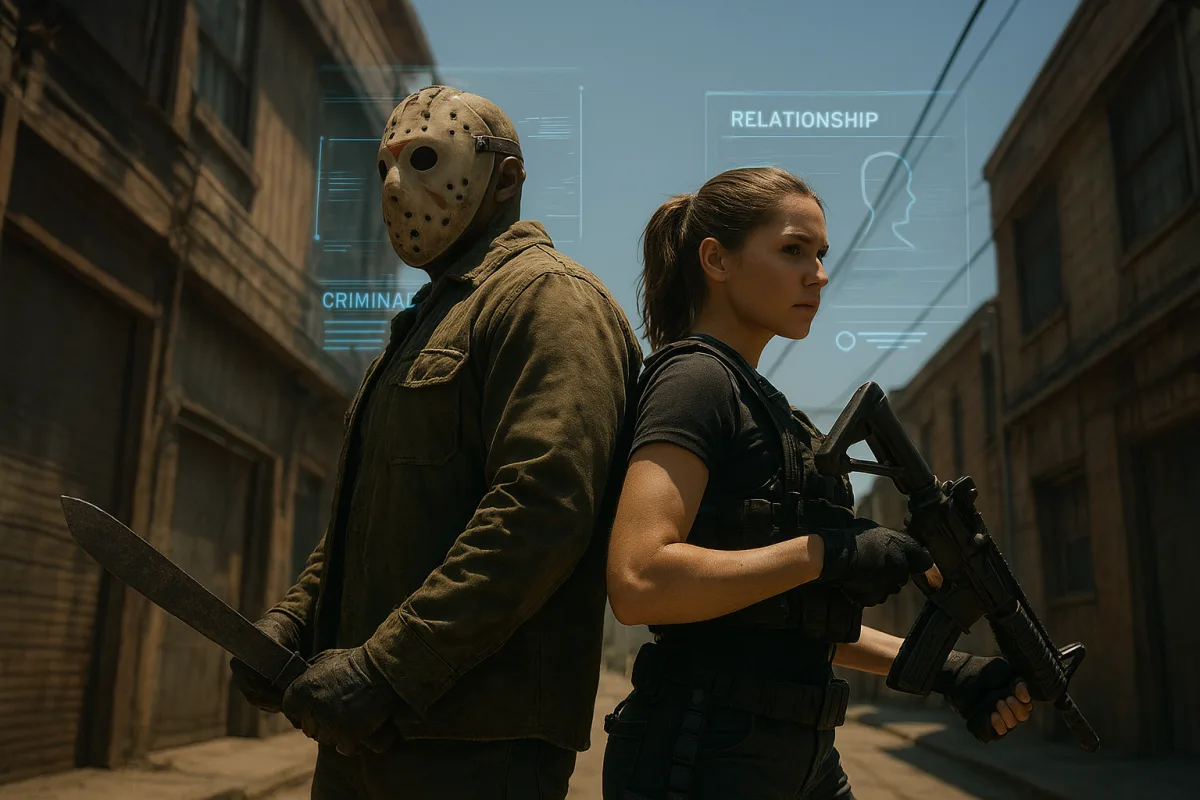
Hold right on the D-pad while playing GTA 6 and you can check the current criminal identity built around Jason Duval and Lucia Caminos. The game labels that identity through five escalating profile levels: Professional, Hardened, Violent, Psycho, and Irredeemable. [5]
The labels sound like a morality meter, but they are closer to a build archetype. GTA 6 is not asking whether you are a good person. It asks what kind of criminal you have become, and what tactics your protagonists now receive rewards for. [1]
Professional uses a yellow icon, Hardened orange, Violent purple, Psycho light gray, and Irredeemable dark gray. [3] That color ladder gives you a quick read on where your sessions have gone, from controlled work to the kind of spree that makes every police encounter worse.
Rockstar has made games about chaotic crime for decades, so putting a long-term cost on chaos is a real storytelling choice. The profile gives Jason and Lucia a criminal reputation shaped by your habits, not only by the mission cutscenes where they must act a certain way.
That lets the same robbery or chase feel different across saves. A player who slips through a job with stealthy takedowns is role-playing a couple trying to survive a tightening criminal world. A player leaving bodies behind is playing something closer to a Vice City panic button.
We would treat Professional as the default first-run path. Not because it is morally correct, but because it preserves flexibility. You can still go loud when a mission collapses, yet you are not building a system that demands constant escalation to stay effective.
The five levels and what feeds them
Professional is GTA 6’s clean-operator profile. Non-lethal takedowns, avoiding civilian casualties, and actions classified as good deeds push Jason and Lucia toward it, with Focus bonuses tied to that controlled approach. [3]
Hardened sits nearby. It still supports restraint, but it reads as a character who has accepted the job’s uglier side without becoming indiscriminate. The distinction is important in play: both lower tiers reward non-lethal actions through Focus, giving stealth and careful positioning mechanical support. [3]
Violent is the pivot. At that point, Focus bonuses stop favoring clean work and begin rewarding headshots instead. [3] Your combat loop changes from avoiding attention to rapidly deleting threats before they can turn an already-bad scene into a wanted-level disaster.
Psycho doubles down on that loop. Headshots continue to drive Focus gains, but police pressure rises with the profile, and reports indicate officers may refuse surrender at Psycho level. [4] The game is effectively telling you that Jason and Lucia have become too dangerous for the normal off-ramp.
Irredeemable is the cliff edge. It removes Focus bonuses completely, is reported as permanent, and may affect both interactions and GTA 6’s ending. [3][4] That is a harsh cost for players who assume every Rockstar sandbox lets them reset consequences with a wardrobe change and a mission replay.
The unclear part is how generously GTA 6 explains the thresholds. Tech Yahoo reported criticism from players who felt the system could punish self-defense and failed to clearly communicate its rules. [16] If an NPC attack or a messy mission response quietly pushes a profile upward, that can feel less like character building and more like hidden-stat bookkeeping.
Focus decides whether your profile is a build or a punishment
Focus is the key to understanding why Criminal Profile matters. It is not flavor text attached to a police system. It is the reward engine that tells you what GTA 6 wants each version of Jason and Lucia to do under pressure. [3]
At Professional and Hardened, Focus comes from restraint. That creates a loop where you scout, isolate a target, use a non-lethal takedown, and keep civilian harm low. The payout is a protagonist better positioned to maintain control when the job gets complicated. [3]
At Violent and Psycho, the loop changes to precision lethality. You are not rewarded for spraying a room, at least not directly. You are rewarded for headshots, which means the game is encouraging decisive aim even as its police response punishes the broader consequences of becoming a known killer. [3][4]
That is a sharper design than an honor bar that only says “good” or “bad.” A player who wants a hard-edged gunfighter has a route, but it comes with social and systemic heat. A player who wants a stealthier crime drama gives up some immediate combat satisfaction for steadier control.
Irredeemable offers no such compensating perk. No Focus bonuses means no preferred combat rhythm is being fed back to you. [3] If the permanent-state reporting is accurate, it resembles a self-imposed challenge mode, except one many players may enter before realizing they have closed off easier tools.
The likely best use of the system is to commit early. Build Professional or Hardened if you enjoy planning jobs and keeping the protagonists credible as criminals who still have a line. Build Violent only if fast gunfights and deliberate headshot play are what you actually want.
We would skip Psycho and Irredeemable until a later run. GTA 6 is already packed with enough open-world nonsense to encourage accidental collateral damage. You do not need to turn your first story playthrough into a test of whether the police system will forgive an exploding gas station.
Jason and Lucia are built to make the meter hurt
The Criminal Profile would be thin if GTA 6 treated Jason and Lucia as interchangeable player skins. Its stronger ambition is to make their relationship the lens for every escalation, with crime affecting not only heat levels but the emotional shape of their partnership.
The Indian Express described GTA 6 as a shift toward love, relationships, and nurturing a partner, themes the series has traditionally treated with more distance and satire. [8] That is a major tonal change for a franchise often happy to make its protagonists walking punchlines.
Lucia carries much of that change. Her more expressive, forceful presence gives scenes a center when plans go wrong, while Jason’s quieter, controlled demeanor creates contrast. GamersExtra characterized Jason’s approach as deliberately restrained, making him a counterweight to Lucia’s intensity. [14]
That restraint has also drawn criticism. Kongchang reported complaints that Jason can feel flat and gets overshadowed by Lucia in major decisions. [10] Both readings can be true: a quiet character can make a relationship feel grounded, but he still needs enough moments of agency to avoid becoming the passenger in his own story.
Rockstar reportedly reduced an earlier plan for four protagonists to two, aiming to avoid spreading player time too thinly across a larger cast. [2] GTA 6’s profile system shows why that reduction makes sense. A consequence system tied to two people can track a shared criminal identity more clearly than one split across four leads.
The missions reportedly allow more experimentation and fewer abrupt failure states, giving players room to respond creatively when plans break down. [7] That openness is where the profile earns its place. A failed stealth plan is no longer only a reload screen or a shootout, it can be a nudge toward becoming a different kind of criminal.
The world reacts, but it is not thinking like a person
GTA 6’s police response gives Criminal Profile its pressure. Higher profile levels intensify law-enforcement attention, and Psycho can reportedly make surrender unavailable. [4] You can see the intended narrative consequence: violence becomes a habit that narrows Jason and Lucia’s options.
That is more convincing than a simple wanted-star reset, but it has limits. iTechGuides argues the game’s NPCs use contextual scripted reactions, not human-like reasoning or durable personal memory. [11] The world can react persuasively without every pedestrian carrying a private dossier of your last twenty crimes.
Players should keep expectations there. A shopkeeper may respond to the game state, police may apply the relevant rules, and missions may reference your behavior. GTA 6 has not established a simulation where every character independently understands Jason and Lucia’s evolving psychology.
El País also criticized the broader story’s pacing, arguing that its intimate scenes and larger action sequences can disrupt each other’s flow. [9] Criminal Profile can make that swing more pronounced: one moment you are quietly protecting a relationship, the next you are mechanically rewarded for landing three fast headshots.
Still, that friction has value when it is deliberate. GTA 6 wants crime to be both seductive and corrosive. The meter makes that theme playable, though it needs transparent feedback so a defensive firefight does not accidentally rewrite the protagonists as irredeemable monsters.
Handcrafted scenes need authored consequences
Rockstar parent company Take-Two CEO Strauss Zelnick said generative AI had “zero part” in what Rockstar Games was building, according to GamesRadar. [12] Rockstar has not published specific AI tools used for GTA 6’s narrative or character systems.
That stance lands differently after Team Ninja producer Kohei Shibata told Eurogamer that his studio uses AI for QA and verification tasks, while arguing that a game becomes fun when “crafted by human hands.” For a relationship-driven crime story, authored judgment is the part that matters.
A Criminal Profile system needs writers and designers to decide which violent acts define Jason and Lucia, which are understandable panic, and which should poison their future options. Automating QA can find broken triggers. It cannot decide whether Lucia’s anger after a bad job feels earned.
Even GTA 6’s smaller authored moments help sell that point. During the early “Down to Earth” mission, Jason powerwashes Brian’s boat. FuturLab’s PowerWash Simulator 2 team praised the shiny result to Eurogamer, but joked that Rockstar omitted soap, equipment upgrades, protective gear, and PowerWash Simulator’s signature completion ding.
It is a throwaway activity, and that is why it works. The boat cleaning does not need to become another progression tree with seven nozzle types. It gives Jason a moment of ordinary labor inside a game about escalating crime, making the later profile choices feel like choices made by people, not by mission markers.
Critical reaction has broadly praised the relationship and cinematic mission work. Windows Central called GTA 6 a potential landmark and highlighted its compelling dual-protagonist dynamic, while TechRadar praised its memorable, gripping missions. [6][7] The harder judgment will come from whether the Criminal Profile remains legible after forty hours.
If the system clearly tells you why your profile moved, we would play it as a Professional-to-Hardened arc, using restraint until the story gives the couple a reason to break. If it hides those rules, players will not read consequence. They will read a dirty stat meter standing between them and the game they thought they were playing.
Frequently Asked Questions
How does GTA 6's criminal profile system affect narrative?
The criminal profile system shapes the story by reflecting the player’s crime style through five escalating levels, from Professional to Irredeemable. This system influences how Jason and Lucia are perceived in the game world, affecting police behavior and story interactions. It allows the same mission to feel different based on the player’s approach, making the narrative responsive to gameplay choices rather than fixed cutscenes.
What are the different criminal profiles in GTA 6?
GTA 6 features five criminal profiles: Professional (yellow), Hardened (orange), Violent (purple), Psycho (light gray), and Irredeemable (dark gray). Professional and Hardened reward stealth and restraint, Violent and Psycho reward precision lethality like headshots, and Irredeemable removes Focus bonuses entirely and may permanently alter the story and police response.
How do Jason and Lucia's characters influence GTA 6's story?
Lucia provides the emotional center of the crime story with a more forceful presence, while Jason’s restrained writing adds strength in some missions but can be a weak point in others. Their abilities and effectiveness evolve based on the player’s criminal profile, linking character development directly to player behavior.
What impact does player behavior have on GTA 6's character development?
Player actions determine the criminal profile level, which changes what Jason and Lucia are good at doing. Restraint and non-lethal tactics improve Focus bonuses at lower profiles, while violent, headshot-focused play shifts abilities toward combat momentum but increases police hostility. This dynamic means repeated violent or clean approaches alter both gameplay and narrative outcomes.
Why is GTA 6's narrative considered deeper than previous titles?
The narrative depth comes from the criminal profile system that ties player behavior to character reputation and story consequences. Instead of a simple morality meter, the game tracks the style of crime, which affects mission experiences, police reactions, and character strengths. This creates a more personalized and evolving story that responds to how players choose to engage with the game world.
How we researched this
This article was assembled from 4 published articles, 16 cited references.
Nothing here is based on hands-on testing. Where a figure or finding appears, it belongs to the source cited beside it, and the writing says so rather than implying otherwise. Every source is listed below so you can check it.
Sources
7 Years Later, Hollywood’s Most Notorious Fantasy Flop Deserves Another Shot, Polygon
GTA 6 causes surge in UK physical game sales, despite there being no disc in the box, Eurogamer
GTA 6 Criminal Profile Explained: How the New Honor System Works - GTA.media
GTA 6 honor system: How the 'criminal profile' works | PC Gamer
GTA 6 Criminal Profile: How Each Rating Works and How to Lower It
GTA 6 criminal profile explained: the 5 levels | Guías GTA 6
'Grand Theft Auto 6' review - A bittersweet symphony of absolute excellence
Grand Theft Auto VI will steal your heart | Technology News - The Indian Express
Crítica de 'GTA VI': bienvenidos al mayor parque de atracciones digital jamás creado
Streamer Playtest of GTA 6: Car Theft Economy and the Jason Character Controversy - KongchangAI
Are GTA 6 NPCs Actually Intelligent? Scripted Behavior Explained
GTA 6 Is More Mature Than GTA 5, and That's a Good Thing, RAWM GAMING
GTA 6 Narrative Lead Explains Jason's Quiet, Controlled Approach | GamersExtra
Rockstar says GTA 6 mission design delivers its most seamless gameplay experience yet - Tech Edition
'The System Is Not Good Vs. Evil': Why GTA 6's Criminal Profile Mechanic Is Dividing Fans
Related Articles
GTA 6 Story, Characters, and Cast Details Explained
Explore GTA 6 story, characters, and cast details including Jason and Lucia's relationship and the criminal profile system.

GTA 6 Criminal Profile Impact on Gameplay and Wanted System
Explore how GTA 6's criminal profile affects gameplay, police response, and the wanted system for Jason and Lucia.

GTA 6 Criminal Profile System
Explore GTA 6's criminal profile system and Rockstar's animation innovations shaping player behavior and crime consequences.

GTA 6 Open World Innovations
Explore GTA 6 open world innovations including dynamic localized weather, water simulation, and their impact on gameplay and environment.