
Epic Games AI-First Development and Shooter Delay Explained
Learn about Epic Games' AI-first development approach and the delay of their Marvel and Star Wars shooter with insights on AI's role in game creation.
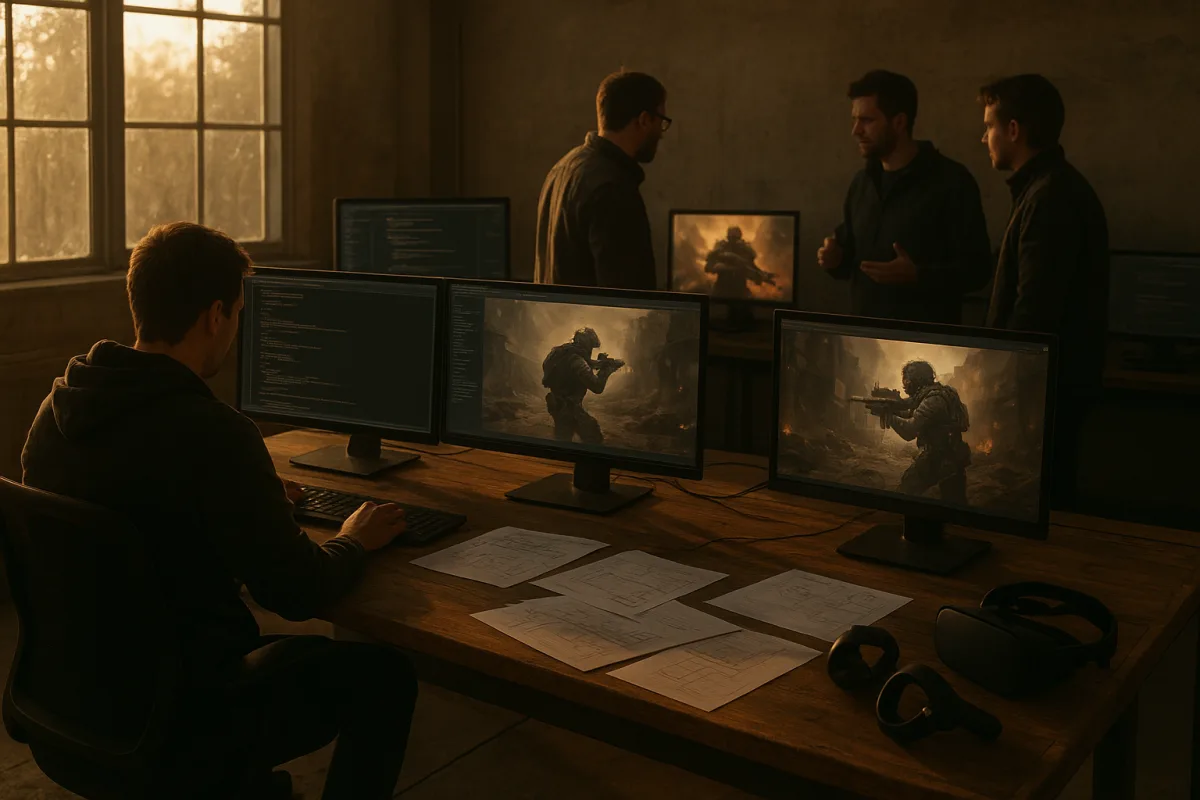
“AI-first” is a pipeline decision, not a magic content button
The useful way to read Epic Games’ reported AI-first shift is not “the studio has replaced developers.” It is that Epic appears to be trying to move the bottleneck in development from making a first version to judging whether that version is any good.
Epic chief executive Tim Sweeney described a “huge pivot” involving developers being moved around to “retool for maximum AI acceleration.” His stated goal is shorter time between an idea and a playable build, not simply producing the same games with fewer staff. [12]
That distinction matters especially for a shooter. A team can debate an extraction loop for months, writing design documents about loot value, respawn rules, enemy density, weapon recoil, extraction timing, and squad incentives. None of that reveals whether players actually enjoy it.
A playable prototype does. Give players a rough map, a basic assault rifle, a rare item, an extraction point, and a reason to betray or cooperate with another squad. Within a week, testers will find the loopholes no design document caught.
Maybe extraction is too safe because squads can camp the final zone. Maybe a cheap shotgun kills too quickly indoors. Maybe rare loot is so valuable that players avoid fights entirely. Those are gameplay problems, not presentation problems.
This is where generative code tools could genuinely be useful. A model such as Anthropic’s Claude can draft UI logic, write placeholder quest triggers, produce test scripts, explain unfamiliar systems, and make broad changes across connected files more quickly than a developer manually starting from a blank page.
The model’s large context capacity is relevant here. Anthropic’s newer Claude systems have been promoted as capable of working across very large codebases, including contexts of up to one million tokens, which can make them more practical for searching and revising connected systems than earlier chatbots. [1]
That does not mean the model understands a multiplayer game’s priorities. It can implement “reduce shotgun damage at close range” in several technically plausible ways. It cannot decide whether the game needs lower damage, wider spread, slower handling, scarcer ammunition, or a map layout that gives rifles more room.
That decision still comes from designers, combat programmers, analysts, QA staff, and players. In patch-note terms, AI can help write the change list. It cannot reliably tell you whether a 10 percent damage nerf kills an oppressive build or merely moves it from best-in-slot to annoying.
Why a faster prototype can still produce a delayed game
The reported delay is the part that cuts through the usual AI pitch. Bloomberg’s reporting, relayed by VGC and other outlets, says Epic’s unannounced Marvel and Star Wars shooter was previously aimed at March 2027 and is now delayed indefinitely. [11]
That is not inherently contradictory. Changing a studio’s development method during production is expensive, particularly when the project already has staffing plans, internal tools, asset pipelines, approval gates, and gameplay systems built around older assumptions.
Think of it like changing a live-service game’s progression economy halfway through a season. You may gain a better long-term system, but every reward table, challenge, tutorial, store bundle, telemetry dashboard, and balance assumption has to be checked again.
For a Disney-licensed game, there is another layer. Marvel and Star Wars characters are not generic enemy models that can be replaced casually. Their appearances, dialogue, abilities, names, animations, and use in marketing can require approvals from rights holders.
AI-generated material can add review work rather than remove it. If an artist makes a character skin through an approved internal workflow, reviewers evaluate a known set of files. If a generative pipeline produces hundreds of variations, somebody still has to determine which ones are usable.
The reported internal instruction, “no more hand-written code,” sounds dramatic because it is dramatic. Taken literally, it would turn every generated implementation into a review problem: someone must inspect it, test it, integrate it, profile it, and own the result when it breaks. [11]
This is the bit that investor presentations usually skip. Code generation reduces typing time most effectively on predictable work. A shooter’s difficult problems are often integration problems: server authority, matchmaking, cheating, hit registration, memory use, platform certification, and ugly edge cases found by thousands of players.
A generated inventory system can look complete in an internal build. Then a player disconnects while trading an item, reconnects through a different platform account, receives a reward twice, and discovers a duplication exploit. The prototype was fast. The fix still requires engineering judgment.
Epic’s leadership is betting that reducing the time to first playable will outweigh that added verification cost. That could work for isolated features and disposable prototypes. It is much less certain when the generated work becomes the foundation beneath a commercial multiplayer game.
Claude is not an art generator, whatever the mandate implies
One technical correction matters here. Reports identify Anthropic’s Claude as one of the tools Epic developers are being encouraged to use, while the reported internal direction also calls for art made through “full AI workflows.” [11]
Those are not the same capability. Claude is a text and code model. It can write descriptions, scripts, UI markup, SVG files, diagrams, and production documentation, but it does not generate conventional game art, such as character paintings, textures, or finished 3D assets. [11]
So a headline claiming that Claude is being used to generate the game’s art would overstate what the tool itself does. If Epic is pursuing AI-generated visual assets, it would need other image, video, 3D, material, or animation tools alongside Claude.
That distinction is not pedantry. Different asset types have different failure modes. Generated concept art may be useful for brainstorming silhouettes or colour palettes. Generated textures may introduce visual inconsistency. Generated 3D meshes can create topology, rigging, collision, or performance headaches.
A shooter also needs visual readability. Players must instantly recognize a weapon pickup, an enemy outline, a throwable’s blast radius, and a usable cover object under movement, effects, latency, and console viewing distance. A pretty generated image does not automatically meet those requirements.
The same goes for Marvel and Star Wars. Recognisability is not just a branding issue, it is gameplay language. A famous character’s costume, weapon, animation, and audio cues all communicate information to players. Small deviations can make a licensed crossover feel off before anyone can explain why.
Epic’s official line is more cautious than the reported internal wording. Communications director Jake Jones said the company is pursuing “AI-accelerated development” led by Epic developers as the creative drivers. [11] That suggests human oversight remains the public position.
The gap between “AI-accelerated” and “no more hand-written code” is where staff concern makes sense. One describes a tool that speeds up parts of work. The other sounds like a production rule that can prevent teams using the method best suited to a specific problem.
The actual balance question is verification cost
The number Epic needs to beat is not “lines of code per developer.” It is the cost of getting a feature from generated draft to something stable enough to put before real players.
Industry surveys cited by Cubix suggest 73 percent of studios have adopted AI tools, 88 percent expect them to become standard, and around 40 percent report productivity gains above 20 percent. [2] Those figures show broad experimentation, not a guarantee of finished-game quality.
The phrase “20 percent faster” can hide a lot. If it means an engineer makes a greybox map objective in four hours rather than five, that is helpful. If the resulting implementation creates two days of bugs for QA and multiplayer engineers, the gain disappears.
This is why the likely meta shift is slower than the rhetoric suggests. Tools can spread quickly because every studio can buy access. Development habits change more slowly because studios need evidence that generated code and assets survive production, certification, updates, and player abuse.
Community panic also needs a cooldown. There is no confirmed platform, release structure, playable footage, or final toolchain for Epic’s delayed crossover game. There is not enough evidence to declare it either an automated-content disaster or proof that AAA development has been solved.
There is, however, a real audience risk. A Windows Central report on Steam data found AI-disclosed games averaged four user reviews and an 84.6 percent score, compared with seven reviews and 88.3 percent for games without those disclosures. [3]
That is correlation, not a clean verdict on AI use. Smaller or rougher projects may be more likely to disclose generative tools in the first place. Still, it shows that “made with AI” is not currently a neutral label for a game trying to build trust.
Labour concerns are also part of the cost equation. SAG-AFTRA’s 2024 strike centred on AI protections for performers, while later union actions and agreements elsewhere in games have continued to push for bargaining and consent around AI deployment. [6]
No union action specifically targeting Epic’s Disney shooter has been reported. But a company cannot treat voice, art, programming, and QA as interchangeable token-saving opportunities without affecting recruitment, retention, and the willingness of experienced staff to clean up generated work.
The best-case version of Epic’s approach is not an autonomous studio. It is a studio that can get a combat loop in players’ hands earlier, identify the bad ideas sooner, and reserve experienced developers for the problems models cannot meaningfully evaluate.
The worst-case version is familiar to anyone who has watched a live-service patch ship too early: lots of content, weak ownership, unclear edge cases, and a cleanup cycle that lasts longer than building it properly would have. Epic’s indefinite delay suggests that calculation is still unresolved.
Frequently Asked Questions
What is Epic Games' AI-first development approach?
Epic Games’ AI-first approach focuses on accelerating the creation of playable prototypes by using AI to generate initial code and content drafts. This shift aims to reduce the time between an idea and a playable build, allowing teams to test gameplay concepts earlier rather than replacing developers. The approach changes the development pipeline, moving the bottleneck from initial creation to evaluating and refining AI-generated prototypes.
Why was the Marvel and Star Wars shooter delayed?
The Marvel and Star Wars crossover shooter was delayed indefinitely from its original March 2027 target due to the complexities of shifting to an AI-first development method mid-production. Changing workflows, approval processes for licensed characters, and the need to review AI-generated content all contribute to the delay. Additionally, integrating AI tools requires rechecking many interconnected systems, which adds time rather than speeding up delivery immediately.
How does AI impact Epic Games' development pipeline?
AI tools like Anthropic’s Claude assist by generating and revising large portions of code quickly, enabling faster creation of first-playable builds. However, AI does not replace human decision-making or quality assurance; designers and testers still evaluate gameplay balance, integration, and player experience. AI-generated outputs require thorough review, testing, and refinement, especially for complex multiplayer and licensed content.
Can AI replace developers in game creation?
No, AI cannot replace developers. While AI can automate repetitive coding tasks and produce initial prototypes, human developers remain essential for design decisions, debugging, integration, and playtesting. AI helps speed up early stages but does not understand gameplay priorities or handle the nuanced challenges of multiplayer systems and licensing requirements.
What tools does Epic Games use for AI-assisted coding?
Epic Games uses Anthropic’s Claude AI models for code generation and revision. Claude excels at working with large codebases due to its ability to handle up to one million tokens in context, making it practical for managing complex game systems. However, Claude does not generate finished image assets, so other tools or human artists handle visual content.
How we researched this
This article was assembled from 4 published articles, 12 cited references.
Nothing here is based on hands-on testing. Where a figure or finding appears, it belongs to the source cited beside it, and the writing says so rather than implying otherwise. Every source is listed below so you can check it.
Sources
No Man's Sky is somehow coming to mobile, and Hello Games says it's partly thanks to Light No Fire — Eurogamer
"No more hand-written code": Epic reportedly impose "AI-first" model on creators of new Disney shooter with Marvel and Star Wars characters — Rock Paper Shotgun
Epic Reportedly Pushing Devs to Use AI, Delays Secret Star Wars and Marvel Crossover Shooter — IGN
AI in Game Development 2026: What's Actually Changing | IRCNF | AIO APEX
Epic Games reportedly pivoting to "AI first" game development model | GameDev.net
Videogame voice actors are officially on strike over AI: 'We refuse this paradigm' | PC Gamer
Mega Man: Dual Override Is Hit By Actors' Union "Do Not Work" Order - GameSpot
Marvel 1943: Rise of Hydra delayed to unannounced date - Gematsu
Report: Epic Games goes all-in on AI for Disney collaboration - Ars Technica
Epic Games reportedly orders staff to implement ‘AI-first’ development | VGC
Epic Games: Fortnite-maker Epic Games makes 'huge pivot' with AI, CEO says - The Economic Times
Related Articles
Star Wars Galactic Racer review
Read our Star Wars Galactic Racer review covering campaign, editions, PC performance, and top sci-fi racing alternatives for 2026.
Blizzard Upcoming Games 2026
Discover Blizzard's upcoming games in 2026 including Diablo 5, StarCraft open-world shooter, and Overwatch's new hero Doctrine with release dates and
PlayStation State of Play September 2026 Highlights
Discover key announcements from PlayStation State of Play September 2026, including Marvel’s Wolverine release dates and game highlights.
Gaming Industry Development Trends and Insights for 2026
Explore gaming industry development trends, risk management, licensing, and digital distribution shaping game production in 2026.